

2. They can cost-effectively assimilate the stable isotopes
13 C,
15 N, and
2 H into their
biomass, and thereby into plentiful compounds they produce (Richard and Bruce
1994).
3. They represent a large, uncultivated group of organisms, and thus provide an
almost accessible source of many valuable products (Richard and Bruce 1994).
Microalgae can be used as a prospective source of single-cell protein (SCP)
(Priyadarshani and Biswajit 2012), a means of carbon sequestration (carbon dioxide)
from stack gas, and can be utilized in sewage purification and for the production of
biofuel. Microalgae have been projected as sunlight driven living-cell factories for
biofuel production and several bio-chemicals used in food, aquaculture, poultry, and
pharmaceutical establishments due to presence of different useful compounds
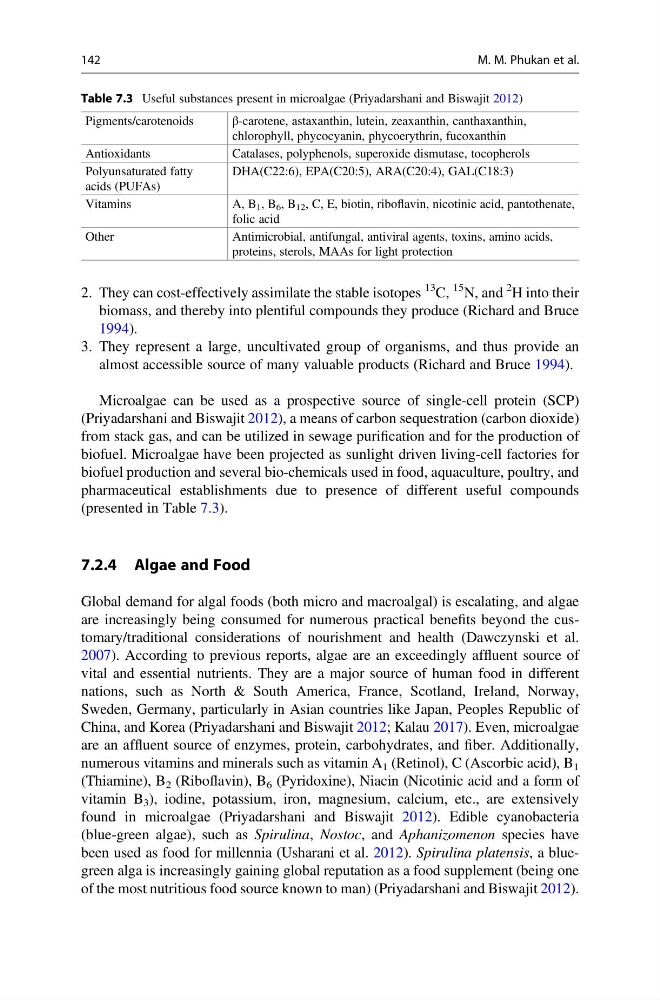
(presented in Table 7.3).
7.2.4 Algae and Food
Global demand for algal foods (both micro and macroalgal) is escalating, and algae
are increasingly being consumed for numerous practical benefits beyond the customary/traditional considerations of nourishment and health (Dawczynski et al.
2007). According to previous reports, algae are an exceedingly affluent source of
vital and essential nutrients. They are a major source of human food in different
nations, such as North & South America, France, Scotland, Ireland, Norway,
Sweden, Germany, particularly in Asian countries like Japan, Peoples Republic of
China, and Korea (Priyadarshani and Biswajit 2012; Kalau 2017). Even, microalgae
are an affluent source of enzymes, protein, carbohydrates, and fiber. Additionally,
numerous vitamins and minerals such as vitamin A 1 (Retinol), C (Ascorbic acid), B 1
(Thiamine), B 2 (Riboflavin), B 6 (Pyridoxine), Niacin (Nicotinic acid and a form of
vitamin B 3 ), iodine, potassium, iron, magnesium, calcium, etc., are extensively
found in microalgae (Priyadarshani and Biswajit 2012). Edible cyanobacteria
(blue-green algae), such as Spirulina, Nostoc, and Aphanizomenon species have
been used as food for millennia (Usharani et al. 2012). Spirulina platensis, a bluegreen alga is increasingly gaining global reputation as a food supplement (being one
of the most nutritious food source known to man) (Priyadarshani and Biswajit 2012).
Table 7.3 Useful substances present in microalgae (Priyadarshani and Biswajit 2012)
Pigments/carotenoids
β-carotene, astaxanthin, lutein, zeaxanthin, canthaxanthin,
chlorophyll, phycocyanin, phycoerythrin, fucoxanthin
Antioxidants
Catalases, polyphenols, superoxide dismutase, tocopherols
Polyunsaturated fatty
acids (PUFAs)
DHA(C22:6), EPA(C20:5), ARA(C20:4), GAL(C18:3)
Vitamins
A, B 1 , B 6 , B 12 , C, E, biotin, riboflavin, nicotinic acid, pantothenate,
folic acid
Other
Antimicrobial, antifungal, antiviral agents, toxins, amino acids,
proteins, sterols, MAAs for light protection
142
M. M. Phukan et al.
13 C,
15 N, and
2 H into their
biomass, and thereby into plentiful compounds they produce (Richard and Bruce
1994).
3. They represent a large, uncultivated group of organisms, and thus provide an
almost accessible source of many valuable products (Richard and Bruce 1994).
Microalgae can be used as a prospective source of single-cell protein (SCP)
(Priyadarshani and Biswajit 2012), a means of carbon sequestration (carbon dioxide)
from stack gas, and can be utilized in sewage purification and for the production of
biofuel. Microalgae have been projected as sunlight driven living-cell factories for
biofuel production and several bio-chemicals used in food, aquaculture, poultry, and
pharmaceutical establishments due to presence of different useful compounds
(presented in Table 7.3).
7.2.4 Algae and Food
Global demand for algal foods (both micro and macroalgal) is escalating, and algae
are increasingly being consumed for numerous practical benefits beyond the customary/traditional considerations of nourishment and health (Dawczynski et al.
2007). According to previous reports, algae are an exceedingly affluent source of
vital and essential nutrients. They are a major source of human food in different
nations, such as North & South America, France, Scotland, Ireland, Norway,
Sweden, Germany, particularly in Asian countries like Japan, Peoples Republic of
China, and Korea (Priyadarshani and Biswajit 2012; Kalau 2017). Even, microalgae
are an affluent source of enzymes, protein, carbohydrates, and fiber. Additionally,
numerous vitamins and minerals such as vitamin A 1 (Retinol), C (Ascorbic acid), B 1
(Thiamine), B 2 (Riboflavin), B 6 (Pyridoxine), Niacin (Nicotinic acid and a form of
vitamin B 3 ), iodine, potassium, iron, magnesium, calcium, etc., are extensively
found in microalgae (Priyadarshani and Biswajit 2012). Edible cyanobacteria
(blue-green algae), such as Spirulina, Nostoc, and Aphanizomenon species have
been used as food for millennia (Usharani et al. 2012). Spirulina platensis, a bluegreen alga is increasingly gaining global reputation as a food supplement (being one
of the most nutritious food source known to man) (Priyadarshani and Biswajit 2012).
Table 7.3 Useful substances present in microalgae (Priyadarshani and Biswajit 2012)
Pigments/carotenoids
β-carotene, astaxanthin, lutein, zeaxanthin, canthaxanthin,
chlorophyll, phycocyanin, phycoerythrin, fucoxanthin
Antioxidants
Catalases, polyphenols, superoxide dismutase, tocopherols
Polyunsaturated fatty
acids (PUFAs)
DHA(C22:6), EPA(C20:5), ARA(C20:4), GAL(C18:3)
Vitamins
A, B 1 , B 6 , B 12 , C, E, biotin, riboflavin, nicotinic acid, pantothenate,
folic acid
Other
Antimicrobial, antifungal, antiviral agents, toxins, amino acids,
proteins, sterols, MAAs for light protection
142
M. M. Phukan et al.