

Recently, various bacterial strains have been reported for lignin degradation.
Bacterial strains responsible for lignin degradation can be applied in valorization
of biomass. Lignin-degrading bacterial strains having cellulose-free xylanase can be
an excellent choice for pretreatment. The bacteria responsible for lignin degradation
can be found in diverse environments such as soil, digestive system of herbivores,
wood-eating insects, effluents from paper industry, sludge, etc. (Brown and Chang
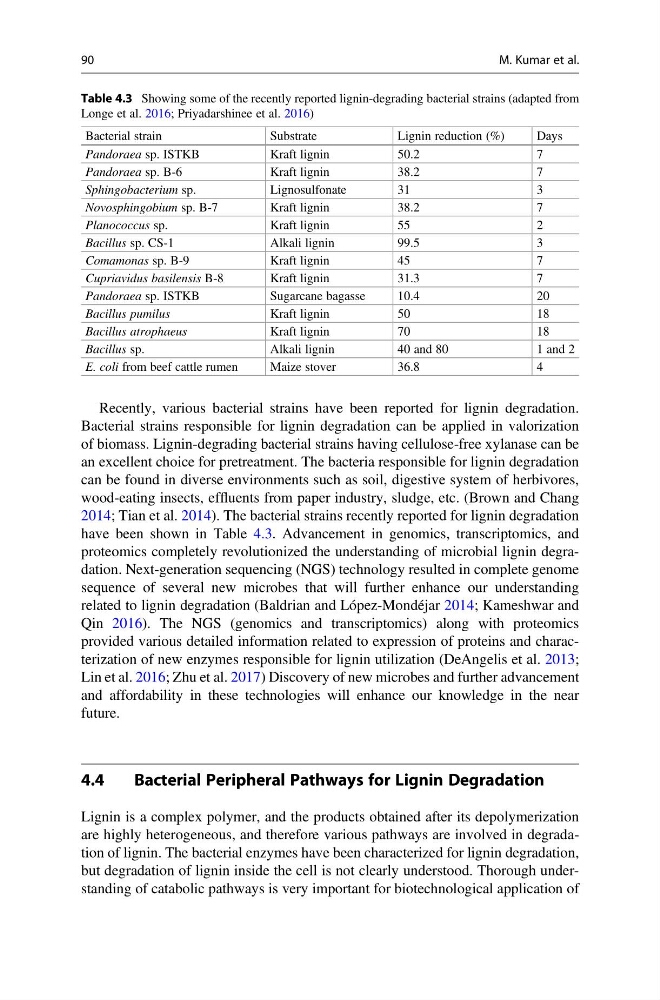
2014; Tian et al. 2014). The bacterial strains recently reported for lignin degradation
have been shown in Table 4.3. Advancement in genomics, transcriptomics, and
proteomics completely revolutionized the understanding of microbial lignin degradation. Next-generation sequencing (NGS) technology resulted in complete genome
sequence of several new microbes that will further enhance our understanding
related to lignin degradation (Baldrian and López-Mondéjar 2014; Kameshwar and
Qin 2016). The NGS (genomics and transcriptomics) along with proteomics
provided various detailed information related to expression of proteins and characterization of new enzymes responsible for lignin utilization (DeAngelis et al. 2013;
Lin et al. 2016; Zhu et al. 2017) Discovery of new microbes and further advancement
and affordability in these technologies will enhance our knowledge in the near
future.
4.4
Bacterial Peripheral Pathways for Lignin Degradation
Lignin is a complex polymer, and the products obtained after its depolymerization
are highly heterogeneous, and therefore various pathways are involved in degradation of lignin. The bacterial enzymes have been characterized for lignin degradation,
but degradation of lignin inside the cell is not clearly understood. Thorough understanding of catabolic pathways is very important for biotechnological application of
Table 4.3 Showing some of the recently reported lignin-degrading bacterial strains (adapted from
Longe et al. 2016; Priyadarshinee et al. 2016)
Bacterial strain
Substrate
Lignin reduction (%)
Days
Pandoraea sp. ISTKB
Kraft lignin
50.2
7
Pandoraea sp. B-6
Kraft lignin
38.2
7
Sphingobacterium sp.
Lignosulfonate
31
3
Novosphingobium sp. B-7
Kraft lignin
38.2
7
Planococcus sp.
Kraft lignin
55
2
Bacillus sp. CS-1
Alkali lignin
99.5
3
Comamonas sp. B-9
Kraft lignin
45
7
Cupriavidus basilensis B-8
Kraft lignin
31.3
7
Pandoraea sp. ISTKB
Sugarcane bagasse
10.4
20
Bacillus pumilus
Kraft lignin
50
18
Bacillus atrophaeus
Kraft lignin
70
18
Bacillus sp.
Alkali lignin
40 and 80
1 and 2
E. coli from beef cattle rumen
Maize stover
36.8
4
90
M. Kumar et al.
Bacterial strains responsible for lignin degradation can be applied in valorization
of biomass. Lignin-degrading bacterial strains having cellulose-free xylanase can be
an excellent choice for pretreatment. The bacteria responsible for lignin degradation
can be found in diverse environments such as soil, digestive system of herbivores,
wood-eating insects, effluents from paper industry, sludge, etc. (Brown and Chang
2014; Tian et al. 2014). The bacterial strains recently reported for lignin degradation
have been shown in Table 4.3. Advancement in genomics, transcriptomics, and
proteomics completely revolutionized the understanding of microbial lignin degradation. Next-generation sequencing (NGS) technology resulted in complete genome
sequence of several new microbes that will further enhance our understanding
related to lignin degradation (Baldrian and López-Mondéjar 2014; Kameshwar and
Qin 2016). The NGS (genomics and transcriptomics) along with proteomics
provided various detailed information related to expression of proteins and characterization of new enzymes responsible for lignin utilization (DeAngelis et al. 2013;
Lin et al. 2016; Zhu et al. 2017) Discovery of new microbes and further advancement
and affordability in these technologies will enhance our knowledge in the near
future.
4.4
Bacterial Peripheral Pathways for Lignin Degradation
Lignin is a complex polymer, and the products obtained after its depolymerization
are highly heterogeneous, and therefore various pathways are involved in degradation of lignin. The bacterial enzymes have been characterized for lignin degradation,
but degradation of lignin inside the cell is not clearly understood. Thorough understanding of catabolic pathways is very important for biotechnological application of
Table 4.3 Showing some of the recently reported lignin-degrading bacterial strains (adapted from
Longe et al. 2016; Priyadarshinee et al. 2016)
Bacterial strain
Substrate
Lignin reduction (%)
Days
Pandoraea sp. ISTKB
Kraft lignin
50.2
7
Pandoraea sp. B-6
Kraft lignin
38.2
7
Sphingobacterium sp.
Lignosulfonate
31
3
Novosphingobium sp. B-7
Kraft lignin
38.2
7
Planococcus sp.
Kraft lignin
55
2
Bacillus sp. CS-1
Alkali lignin
99.5
3
Comamonas sp. B-9
Kraft lignin
45
7
Cupriavidus basilensis B-8
Kraft lignin
31.3
7
Pandoraea sp. ISTKB
Sugarcane bagasse
10.4
20
Bacillus pumilus
Kraft lignin
50
18
Bacillus atrophaeus
Kraft lignin
70
18
Bacillus sp.
Alkali lignin
40 and 80
1 and 2
E. coli from beef cattle rumen
Maize stover
36.8
4
90
M. Kumar et al.