

The most abundant coupling is favored at β-carbon of one monolignol with
hydroxyl group of the other to form β-O-4-aryl ether linkage. This is the major
linkage observed in case of lignin structure. The others are α-aryl ether (α-O-4),
phenylcoumaran (β-5), diaryl ether (4-O-5), biphenyl and dibenzodioxocin (5-5),
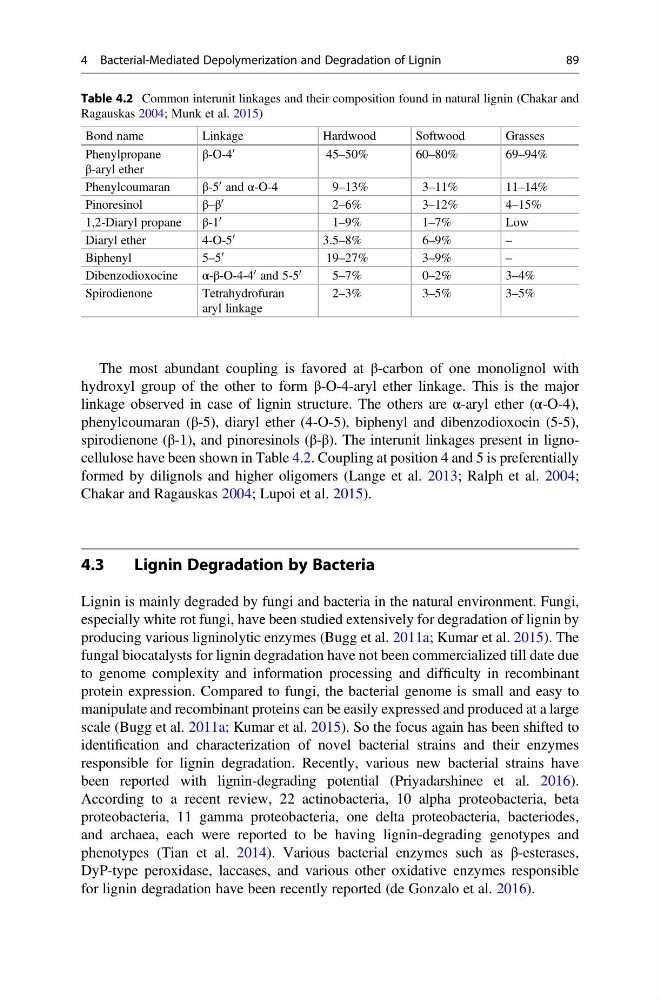
spirodienone (β-1), and pinoresinols (β-β). The interunit linkages present in lignocellulose have been shown in Table 4.2. Coupling at position 4 and 5 is preferentially
formed by dilignols and higher oligomers (Lange et al. 2013; Ralph et al. 2004;
Chakar and Ragauskas 2004; Lupoi et al. 2015).
4.3
Lignin Degradation by Bacteria
Lignin is mainly degraded by fungi and bacteria in the natural environment. Fungi,
especially white rot fungi, have been studied extensively for degradation of lignin by
producing various ligninolytic enzymes (Bugg et al. 2011a; Kumar et al. 2015). The
fungal biocatalysts for lignin degradation have not been commercialized till date due
to genome complexity and information processing and difficulty in recombinant
protein expression. Compared to fungi, the bacterial genome is small and easy to
manipulate and recombinant proteins can be easily expressed and produced at a large
scale (Bugg et al. 2011a; Kumar et al. 2015). So the focus again has been shifted to
identification and characterization of novel bacterial strains and their enzymes
responsible for lignin degradation. Recently, various new bacterial strains have
been reported with lignin-degrading potential (Priyadarshinee et al. 2016).
According to a recent review, 22 actinobacteria, 10 alpha proteobacteria, beta
proteobacteria, 11 gamma proteobacteria, one delta proteobacteria, bacteriodes,
and archaea, each were reported to be having lignin-degrading genotypes and
phenotypes (Tian et al. 2014). Various bacterial enzymes such as β-esterases,
DyP-type peroxidase, laccases, and various other oxidative enzymes responsible
for lignin degradation have been recently reported (de Gonzalo et al. 2016).
Table 4.2 Common interunit linkages and their composition found in natural lignin (Chakar and
Ragauskas 2004; Munk et al. 2015)
Bond name
Linkage
Hardwood
Softwood
Grasses
Phenylpropane
β-aryl ether
β-O-4
0
45–50%
60–80%
69–94%
Phenylcoumaran
β-5
0 and α-O-4
9–13%
3–11%
11–14%
Pinoresinol
β–β
0
2–6%
3–12%
4–15%
1,2-Diaryl propane
β-1
0
1–9%
1–7%
Low
Diaryl ether
4-O-5
0
3.5–8%
6–9%
–
Biphenyl
5–5
0
19–27%
3–9%
–
Dibenzodioxocine
α-β-O-4-4
0 and 5-5
0
5–7%
0–2%
3–4%
Spirodienone
Tetrahydrofuran
aryl linkage
2–3%
3–5%
3–5%
4 Bacterial-Mediated Depolymerization and Degradation of Lignin
89
hydroxyl group of the other to form β-O-4-aryl ether linkage. This is the major
linkage observed in case of lignin structure. The others are α-aryl ether (α-O-4),
phenylcoumaran (β-5), diaryl ether (4-O-5), biphenyl and dibenzodioxocin (5-5),
spirodienone (β-1), and pinoresinols (β-β). The interunit linkages present in lignocellulose have been shown in Table 4.2. Coupling at position 4 and 5 is preferentially
formed by dilignols and higher oligomers (Lange et al. 2013; Ralph et al. 2004;
Chakar and Ragauskas 2004; Lupoi et al. 2015).
4.3
Lignin Degradation by Bacteria
Lignin is mainly degraded by fungi and bacteria in the natural environment. Fungi,
especially white rot fungi, have been studied extensively for degradation of lignin by
producing various ligninolytic enzymes (Bugg et al. 2011a; Kumar et al. 2015). The
fungal biocatalysts for lignin degradation have not been commercialized till date due
to genome complexity and information processing and difficulty in recombinant
protein expression. Compared to fungi, the bacterial genome is small and easy to
manipulate and recombinant proteins can be easily expressed and produced at a large
scale (Bugg et al. 2011a; Kumar et al. 2015). So the focus again has been shifted to
identification and characterization of novel bacterial strains and their enzymes
responsible for lignin degradation. Recently, various new bacterial strains have
been reported with lignin-degrading potential (Priyadarshinee et al. 2016).
According to a recent review, 22 actinobacteria, 10 alpha proteobacteria, beta
proteobacteria, 11 gamma proteobacteria, one delta proteobacteria, bacteriodes,
and archaea, each were reported to be having lignin-degrading genotypes and
phenotypes (Tian et al. 2014). Various bacterial enzymes such as β-esterases,
DyP-type peroxidase, laccases, and various other oxidative enzymes responsible
for lignin degradation have been recently reported (de Gonzalo et al. 2016).
Table 4.2 Common interunit linkages and their composition found in natural lignin (Chakar and
Ragauskas 2004; Munk et al. 2015)
Bond name
Linkage
Hardwood
Softwood
Grasses
Phenylpropane
β-aryl ether
β-O-4
0
45–50%
60–80%
69–94%
Phenylcoumaran
β-5
0 and α-O-4
9–13%
3–11%
11–14%
Pinoresinol
β–β
0
2–6%
3–12%
4–15%
1,2-Diaryl propane
β-1
0
1–9%
1–7%
Low
Diaryl ether
4-O-5
0
3.5–8%
6–9%
–
Biphenyl
5–5
0
19–27%
3–9%
–
Dibenzodioxocine
α-β-O-4-4
0 and 5-5
0
5–7%
0–2%
3–4%
Spirodienone
Tetrahydrofuran
aryl linkage
2–3%
3–5%
3–5%
4 Bacterial-Mediated Depolymerization and Degradation of Lignin
89