

254
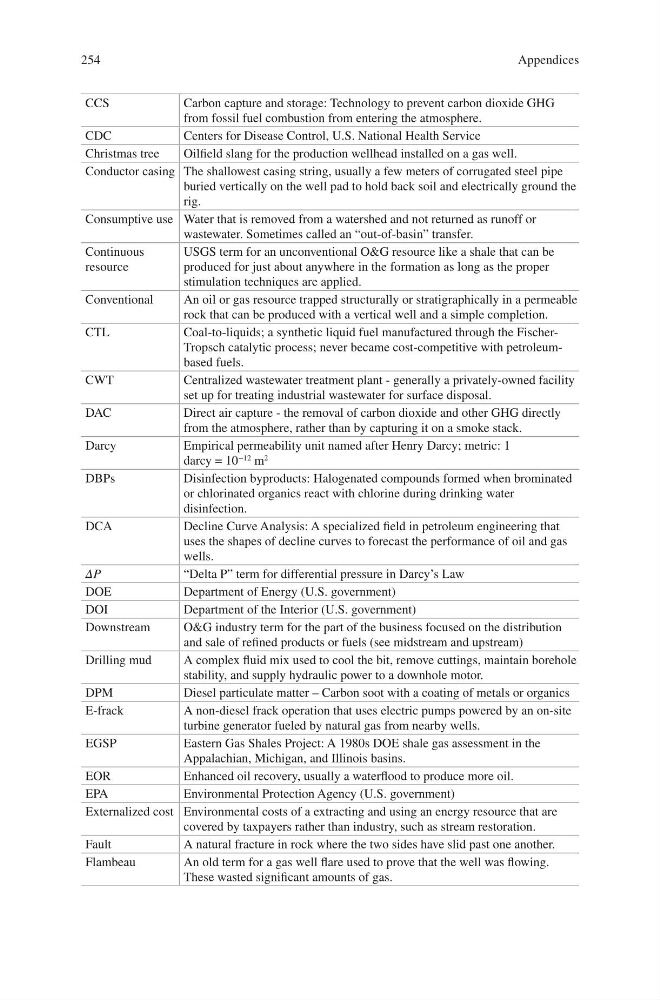
CCS
Carbon capture and storage: Technology to prevent carbon dioxide GHG
from fossil fuel combustion from entering the atmosphere.
CDC
Centers for Disease Control, U.S. National Health Service
Christmas tree
Oilfield slang for the production wellhead installed on a gas well.
Conductor casing The shallowest casing string, usually a few meters of corrugated steel pipe
buried vertically on the well pad to hold back soil and electrically ground the
rig.
Consumptive use Water that is removed from a watershed and not returned as runoff or
wastewater. Sometimes called an “out-of-basin” transfer.
Continuous
resource
USGS term for an unconventional O&G resource like a shale that can be
produced for just about anywhere in the formation as long as the proper
stimulation techniques are applied.
Conventional
An oil or gas resource trapped structurally or stratigraphically in a permeable
rock that can be produced with a vertical well and a simple completion.
CTL
Coal-to-liquids; a synthetic liquid fuel manufactured through the FischerTropsch catalytic process; never became cost-competitive with petroleumbased fuels.
CWT
Centralized wastewater treatment plant - generally a privately-owned facility
set up for treating industrial wastewater for surface disposal.
DAC
Direct air capture - the removal of carbon dioxide and other GHG directly
from the atmosphere, rather than by capturing it on a smoke stack.
Darcy
Empirical permeability unit named after Henry Darcy; metric: 1
darcy = 10
−12 m
2
DBPs
Disinfection byproducts: Halogenated compounds formed when brominated
or chlorinated organics react with chlorine during drinking water
disinfection.
DCA
Decline Curve Analysis: A specialized field in petroleum engineering that
uses the shapes of decline curves to forecast the performance of oil and gas
wells.
ΔP
“Delta P” term for differential pressure in Darcy’s Law
DOE
Department of Energy (U.S. government)
DOI
Department of the Interior (U.S. government)
Downstream
O&G industry term for the part of the business focused on the distribution
and sale of refined products or fuels (see midstream and upstream)
Drilling mud
A complex fluid mix used to cool the bit, remove cuttings, maintain borehole
stability, and supply hydraulic power to a downhole motor.
DPM
Diesel particulate matter – Carbon soot with a coating of metals or organics
E-frack
A non-diesel frack operation that uses electric pumps powered by an on-site
turbine generator fueled by natural gas from nearby wells.
EGSP
Eastern Gas Shales Project: A 1980s DOE shale gas assessment in the
Appalachian, Michigan, and Illinois basins.
EOR
Enhanced oil recovery, usually a waterflood to produce more oil.
EPA
Environmental Protection Agency (U.S. government)
Externalized cost Environmental costs of a extracting and using an energy resource that are
covered by taxpayers rather than industry, such as stream restoration.
Fault
A natural fracture in rock where the two sides have slid past one another.
Flambeau
An old term for a gas well flare used to prove that the well was flowing.
These wasted significant amounts of gas.
Appendices
CCS
Carbon capture and storage: Technology to prevent carbon dioxide GHG
from fossil fuel combustion from entering the atmosphere.
CDC
Centers for Disease Control, U.S. National Health Service
Christmas tree
Oilfield slang for the production wellhead installed on a gas well.
Conductor casing The shallowest casing string, usually a few meters of corrugated steel pipe
buried vertically on the well pad to hold back soil and electrically ground the
rig.
Consumptive use Water that is removed from a watershed and not returned as runoff or
wastewater. Sometimes called an “out-of-basin” transfer.
Continuous
resource
USGS term for an unconventional O&G resource like a shale that can be
produced for just about anywhere in the formation as long as the proper
stimulation techniques are applied.
Conventional
An oil or gas resource trapped structurally or stratigraphically in a permeable
rock that can be produced with a vertical well and a simple completion.
CTL
Coal-to-liquids; a synthetic liquid fuel manufactured through the FischerTropsch catalytic process; never became cost-competitive with petroleumbased fuels.
CWT
Centralized wastewater treatment plant - generally a privately-owned facility
set up for treating industrial wastewater for surface disposal.
DAC
Direct air capture - the removal of carbon dioxide and other GHG directly
from the atmosphere, rather than by capturing it on a smoke stack.
Darcy
Empirical permeability unit named after Henry Darcy; metric: 1
darcy = 10
−12 m
2
DBPs
Disinfection byproducts: Halogenated compounds formed when brominated
or chlorinated organics react with chlorine during drinking water
disinfection.
DCA
Decline Curve Analysis: A specialized field in petroleum engineering that
uses the shapes of decline curves to forecast the performance of oil and gas
wells.
ΔP
“Delta P” term for differential pressure in Darcy’s Law
DOE
Department of Energy (U.S. government)
DOI
Department of the Interior (U.S. government)
Downstream
O&G industry term for the part of the business focused on the distribution
and sale of refined products or fuels (see midstream and upstream)
Drilling mud
A complex fluid mix used to cool the bit, remove cuttings, maintain borehole
stability, and supply hydraulic power to a downhole motor.
DPM
Diesel particulate matter – Carbon soot with a coating of metals or organics
E-frack
A non-diesel frack operation that uses electric pumps powered by an on-site
turbine generator fueled by natural gas from nearby wells.
EGSP
Eastern Gas Shales Project: A 1980s DOE shale gas assessment in the
Appalachian, Michigan, and Illinois basins.
EOR
Enhanced oil recovery, usually a waterflood to produce more oil.
EPA
Environmental Protection Agency (U.S. government)
Externalized cost Environmental costs of a extracting and using an energy resource that are
covered by taxpayers rather than industry, such as stream restoration.
Fault
A natural fracture in rock where the two sides have slid past one another.
Flambeau
An old term for a gas well flare used to prove that the well was flowing.
These wasted significant amounts of gas.
Appendices