

236
A repository design at Hanford was complicated because the individual basalt
flows are not thick enough to accommodate a repository within a single unit. Cutting
tunnels across multiple basalt flows would potentially provide groundwater flow
paths along the contacts between the layers, and the highly fractured basalts may
also have a direct hydraulic connection to the Columbia River in some locations.
The potential for extremely short groundwater travel times became a show-stopper
for Hanford. Thus, the intention of Congress in 1987 was to save time and money
by amending the Nuclear Waste Policy Act to focus solely on Yucca Mountain as the
most viable of the three sites. The state of Nevada at the time had two Senators and
only one Representative in the House, and they were unable to drum up enough support to stop the bill from passing.
The 1987 amendment to the Nuclear Waste Policy Act created a huge amount of
resentment in Nevada for being singled out as the only state in the country forced to
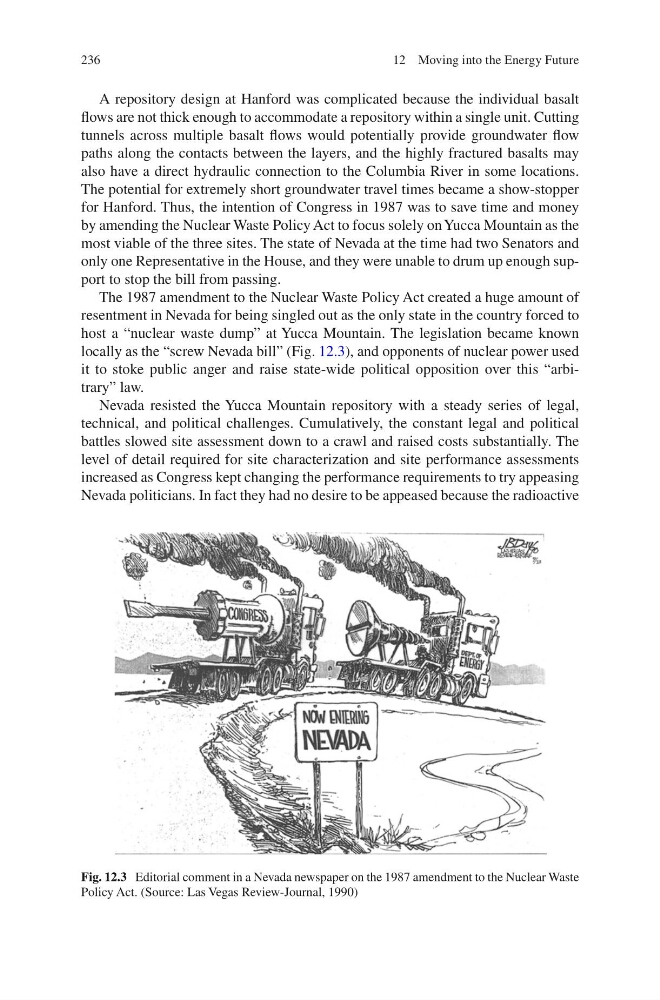
host a “nuclear waste dump” at Yucca Mountain. The legislation became known
locally as the “screw Nevada bill” (Fig. 12.3), and opponents of nuclear power used
it to stoke public anger and raise state-wide political opposition over this “arbitrary” law.
Nevada resisted the Yucca Mountain repository with a steady series of legal,
technical, and political challenges. Cumulatively, the constant legal and political
battles slowed site assessment down to a crawl and raised costs substantially. The
level of detail required for site characterization and site performance assessments
increased as Congress kept changing the performance requirements to try appeasing
Nevada politicians. In fact they had no desire to be appeased because the radioactive
Fig. 12.3 Editorial comment in a Nevada newspaper on the 1987 amendment to the Nuclear Waste
Policy Act. (Source: Las Vegas Review-Journal, 1990)
12 Moving into the Energy Future
A repository design at Hanford was complicated because the individual basalt
flows are not thick enough to accommodate a repository within a single unit. Cutting
tunnels across multiple basalt flows would potentially provide groundwater flow
paths along the contacts between the layers, and the highly fractured basalts may
also have a direct hydraulic connection to the Columbia River in some locations.
The potential for extremely short groundwater travel times became a show-stopper
for Hanford. Thus, the intention of Congress in 1987 was to save time and money
by amending the Nuclear Waste Policy Act to focus solely on Yucca Mountain as the
most viable of the three sites. The state of Nevada at the time had two Senators and
only one Representative in the House, and they were unable to drum up enough support to stop the bill from passing.
The 1987 amendment to the Nuclear Waste Policy Act created a huge amount of
resentment in Nevada for being singled out as the only state in the country forced to
host a “nuclear waste dump” at Yucca Mountain. The legislation became known
locally as the “screw Nevada bill” (Fig. 12.3), and opponents of nuclear power used
it to stoke public anger and raise state-wide political opposition over this “arbitrary” law.
Nevada resisted the Yucca Mountain repository with a steady series of legal,
technical, and political challenges. Cumulatively, the constant legal and political
battles slowed site assessment down to a crawl and raised costs substantially. The
level of detail required for site characterization and site performance assessments
increased as Congress kept changing the performance requirements to try appeasing
Nevada politicians. In fact they had no desire to be appeased because the radioactive
Fig. 12.3 Editorial comment in a Nevada newspaper on the 1987 amendment to the Nuclear Waste
Policy Act. (Source: Las Vegas Review-Journal, 1990)
12 Moving into the Energy Future