

182
underdeveloped nations point out that it is easy for western environmentalists to
relax in their comfortable, warm, and well-lit houses and demand that the third
world adopt renewables to light their thatched huts. There is a risk that urging developing countries to use more expensive and less reliable renewable power will be
seen as an attempt to deny them the opportunity to attain the same level of economic
achievement, industrialization, and wealth as western nations. This is a sensitive
subject in many parts of the third world.
Finally, people in developing nations bristle at the idea that they should be
designated as the planetary leaders for reducing GHG emissions by being forced to
use renewables. The damage that has already been done to the climate can be laid
squarely at the feet of the United States, China, Japan, Russia, and the European
Union. Emissions from India are climbing and will soon surpass those of the
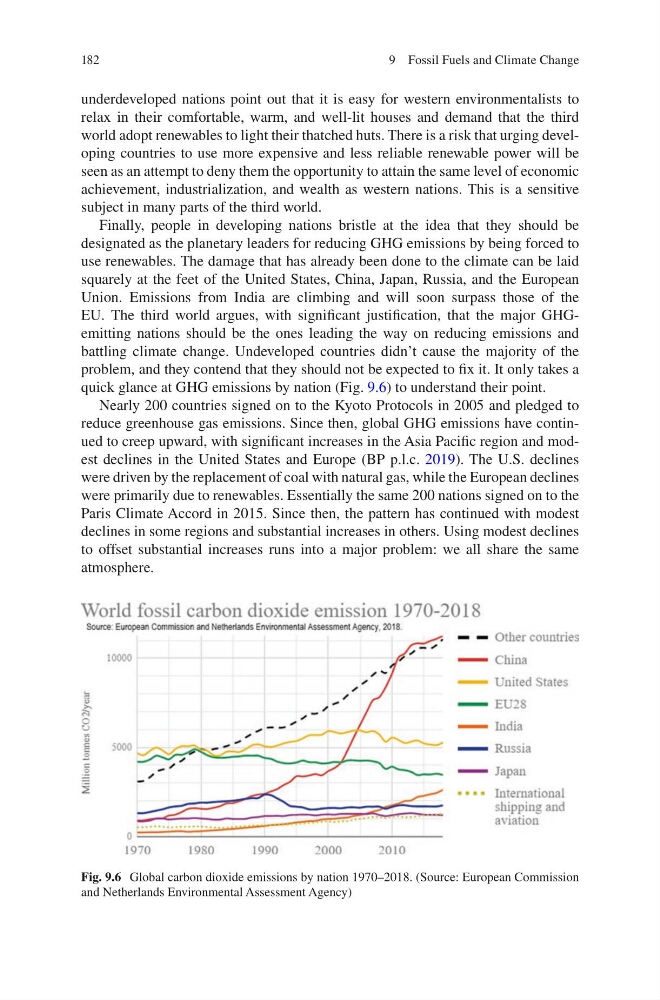
EU. The third world argues, with significant justification, that the major GHGemitting nations should be the ones leading the way on reducing emissions and
battling climate change. Undeveloped countries didn’t cause the majority of the
problem, and they contend that they should not be expected to fix it. It only takes a
quick glance at GHG emissions by nation (Fig. 9.6) to understand their point.
Nearly 200 countries signed on to the Kyoto Protocols in 2005 and pledged to
reduce greenhouse gas emissions. Since then, global GHG emissions have continued to creep upward, with significant increases in the Asia Pacific region and modest declines in the United States and Europe (BP p.l.c. 2019). The U.S. declines
were driven by the replacement of coal with natural gas, while the European declines
were primarily due to renewables. Essentially the same 200 nations signed on to the
Paris Climate Accord in 2015. Since then, the pattern has continued with modest
declines in some regions and substantial increases in others. Using modest declines
to offset substantial increases runs into a major problem: we all share the same
atmosphere.
Fig. 9.6 Global carbon dioxide emissions by nation 1970–2018. (Source: European Commission
and Netherlands Environmental Assessment Agency)
9 Fossil Fuels and Climate Change
underdeveloped nations point out that it is easy for western environmentalists to
relax in their comfortable, warm, and well-lit houses and demand that the third
world adopt renewables to light their thatched huts. There is a risk that urging developing countries to use more expensive and less reliable renewable power will be
seen as an attempt to deny them the opportunity to attain the same level of economic
achievement, industrialization, and wealth as western nations. This is a sensitive
subject in many parts of the third world.
Finally, people in developing nations bristle at the idea that they should be
designated as the planetary leaders for reducing GHG emissions by being forced to
use renewables. The damage that has already been done to the climate can be laid
squarely at the feet of the United States, China, Japan, Russia, and the European
Union. Emissions from India are climbing and will soon surpass those of the
EU. The third world argues, with significant justification, that the major GHGemitting nations should be the ones leading the way on reducing emissions and
battling climate change. Undeveloped countries didn’t cause the majority of the
problem, and they contend that they should not be expected to fix it. It only takes a
quick glance at GHG emissions by nation (Fig. 9.6) to understand their point.
Nearly 200 countries signed on to the Kyoto Protocols in 2005 and pledged to
reduce greenhouse gas emissions. Since then, global GHG emissions have continued to creep upward, with significant increases in the Asia Pacific region and modest declines in the United States and Europe (BP p.l.c. 2019). The U.S. declines
were driven by the replacement of coal with natural gas, while the European declines
were primarily due to renewables. Essentially the same 200 nations signed on to the
Paris Climate Accord in 2015. Since then, the pattern has continued with modest
declines in some regions and substantial increases in others. Using modest declines
to offset substantial increases runs into a major problem: we all share the same
atmosphere.
Fig. 9.6 Global carbon dioxide emissions by nation 1970–2018. (Source: European Commission
and Netherlands Environmental Assessment Agency)
9 Fossil Fuels and Climate Change