

180
steam that turns a turbine. Replacing these with renewables would require utility
companies to abandon millions of dollars’ worth of existing thermoelectric generating
infrastructure, while simultaneously spending huge sums of capital to build new
wind and solar farms to make up for that lost capacity. There are not too many shareholders that would agree to this.
The main technical issue with wind and solar is that they generate energy
intermittently. Wind turbines need a windy day. Solar doesn’t work at night. Until
energy storage devices are developed that can provide continuous power, renewables
cannot be used for baseload electricity, only for peak shaving. Some lithium battery
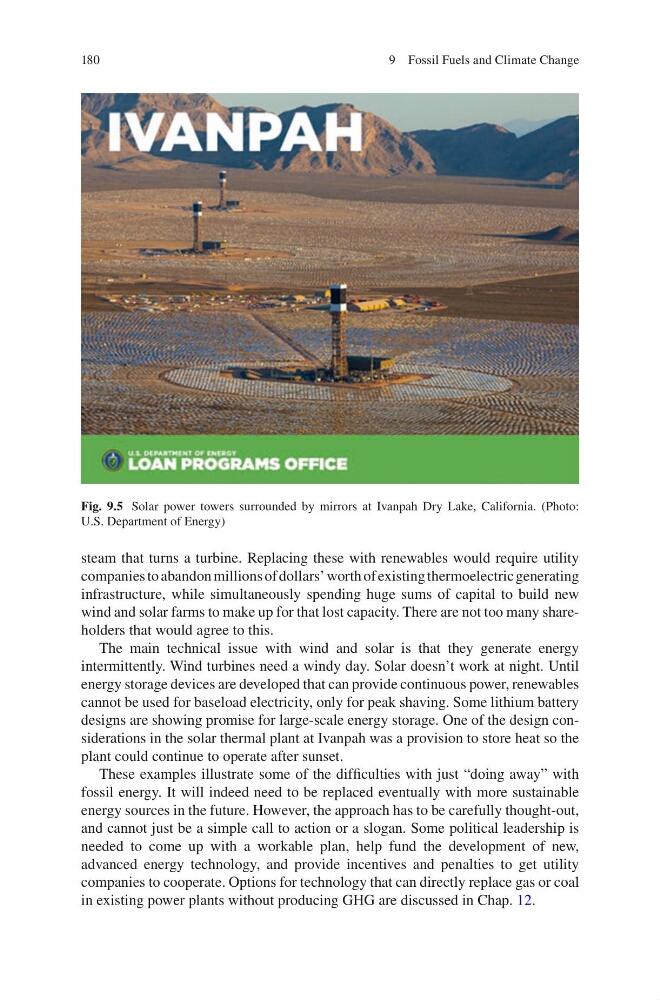
designs are showing promise for large-scale energy storage. One of the design considerations in the solar thermal plant at Ivanpah was a provision to store heat so the
plant could continue to operate after sunset.
These examples illustrate some of the difficulties with just “doing away” with
fossil energy. It will indeed need to be replaced eventually with more sustainable
energy sources in the future. However, the approach has to be carefully thought-out,
and cannot just be a simple call to action or a slogan. Some political leadership is
needed to come up with a workable plan, help fund the development of new,
advanced energy technology, and provide incentives and penalties to get utility
companies to cooperate. Options for technology that can directly replace gas or coal
in existing power plants without producing GHG are discussed in Chap. 12.
Fig. 9.5 Solar power towers surrounded by mirrors at Ivanpah Dry Lake, California. (Photo:
U.S. Department of Energy)
9 Fossil Fuels and Climate Change
steam that turns a turbine. Replacing these with renewables would require utility
companies to abandon millions of dollars’ worth of existing thermoelectric generating
infrastructure, while simultaneously spending huge sums of capital to build new
wind and solar farms to make up for that lost capacity. There are not too many shareholders that would agree to this.
The main technical issue with wind and solar is that they generate energy
intermittently. Wind turbines need a windy day. Solar doesn’t work at night. Until
energy storage devices are developed that can provide continuous power, renewables
cannot be used for baseload electricity, only for peak shaving. Some lithium battery
designs are showing promise for large-scale energy storage. One of the design considerations in the solar thermal plant at Ivanpah was a provision to store heat so the
plant could continue to operate after sunset.
These examples illustrate some of the difficulties with just “doing away” with
fossil energy. It will indeed need to be replaced eventually with more sustainable
energy sources in the future. However, the approach has to be carefully thought-out,
and cannot just be a simple call to action or a slogan. Some political leadership is
needed to come up with a workable plan, help fund the development of new,
advanced energy technology, and provide incentives and penalties to get utility
companies to cooperate. Options for technology that can directly replace gas or coal
in existing power plants without producing GHG are discussed in Chap. 12.
Fig. 9.5 Solar power towers surrounded by mirrors at Ivanpah Dry Lake, California. (Photo:
U.S. Department of Energy)
9 Fossil Fuels and Climate Change