

163
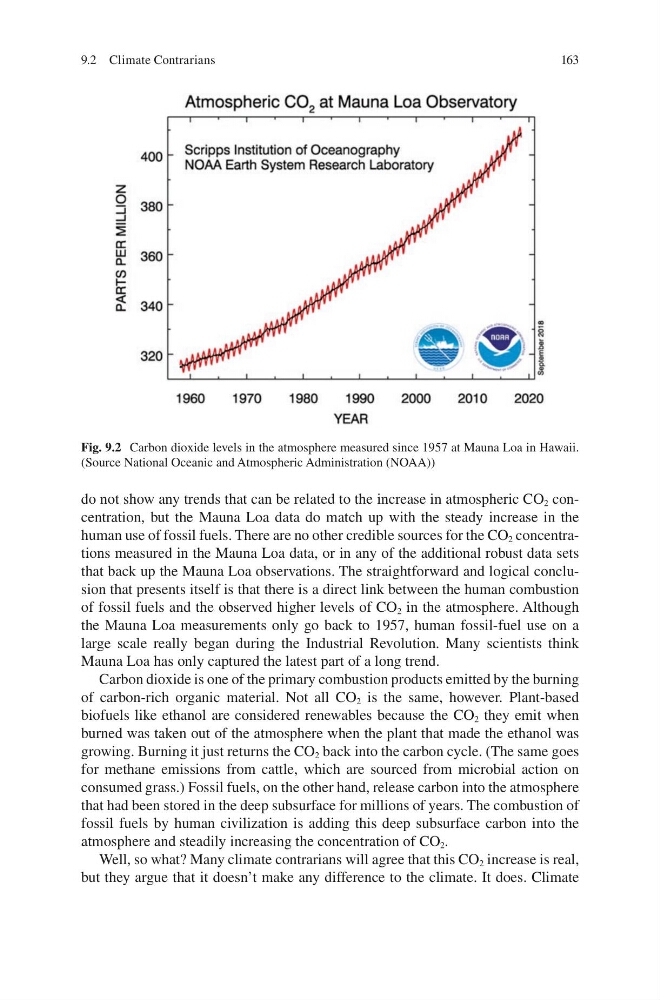
do not show any trends that can be related to the increase in atmospheric CO 2 concentration, but the Mauna Loa data do match up with the steady increase in the
human use of fossil fuels. There are no other credible sources for the CO 2 concentrations measured in the Mauna Loa data, or in any of the additional robust data sets
that back up the Mauna Loa observations. The straightforward and logical conclusion that presents itself is that there is a direct link between the human combustion
of fossil fuels and the observed higher levels of CO 2 in the atmosphere. Although
the Mauna Loa measurements only go back to 1957, human fossil-fuel use on a
large scale really began during the Industrial Revolution. Many scientists think
Mauna Loa has only captured the latest part of a long trend.
Carbon dioxide is one of the primary combustion products emitted by the burning
of carbon-rich organic material. Not all CO 2 is the same, however. Plant-based
biofuels like ethanol are considered renewables because the CO 2 they emit when
burned was taken out of the atmosphere when the plant that made the ethanol was
growing. Burning it just returns the CO 2 back into the carbon cycle. (The same goes
for methane emissions from cattle, which are sourced from microbial action on
consumed grass.) Fossil fuels, on the other hand, release carbon into the atmosphere
that had been stored in the deep subsurface for millions of years. The combustion of
fossil fuels by human civilization is adding this deep subsurface carbon into the
atmosphere and steadily increasing the concentration of CO 2 .
Well, so what? Many climate contrarians will agree that this CO 2 increase is real,
but they argue that it doesn’t make any difference to the climate. It does. Climate
Fig. 9.2 Carbon dioxide levels in the atmosphere measured since 1957 at Mauna Loa in Hawaii.
(Source National Oceanic and Atmospheric Administration (NOAA))
9.2 Climate Contrarians
do not show any trends that can be related to the increase in atmospheric CO 2 concentration, but the Mauna Loa data do match up with the steady increase in the
human use of fossil fuels. There are no other credible sources for the CO 2 concentrations measured in the Mauna Loa data, or in any of the additional robust data sets
that back up the Mauna Loa observations. The straightforward and logical conclusion that presents itself is that there is a direct link between the human combustion
of fossil fuels and the observed higher levels of CO 2 in the atmosphere. Although
the Mauna Loa measurements only go back to 1957, human fossil-fuel use on a
large scale really began during the Industrial Revolution. Many scientists think
Mauna Loa has only captured the latest part of a long trend.
Carbon dioxide is one of the primary combustion products emitted by the burning
of carbon-rich organic material. Not all CO 2 is the same, however. Plant-based
biofuels like ethanol are considered renewables because the CO 2 they emit when
burned was taken out of the atmosphere when the plant that made the ethanol was
growing. Burning it just returns the CO 2 back into the carbon cycle. (The same goes
for methane emissions from cattle, which are sourced from microbial action on
consumed grass.) Fossil fuels, on the other hand, release carbon into the atmosphere
that had been stored in the deep subsurface for millions of years. The combustion of
fossil fuels by human civilization is adding this deep subsurface carbon into the
atmosphere and steadily increasing the concentration of CO 2 .
Well, so what? Many climate contrarians will agree that this CO 2 increase is real,
but they argue that it doesn’t make any difference to the climate. It does. Climate
Fig. 9.2 Carbon dioxide levels in the atmosphere measured since 1957 at Mauna Loa in Hawaii.
(Source National Oceanic and Atmospheric Administration (NOAA))
9.2 Climate Contrarians