

4 Classifying the Forest Surfaces in Metropolitan Areas …
59
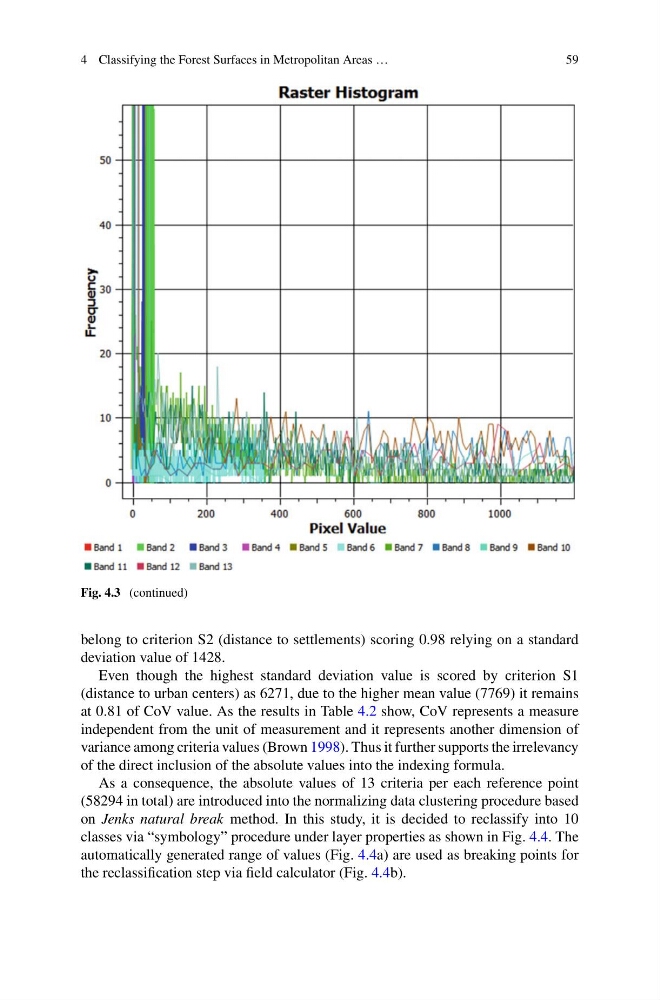
Fig. 4.3 (continued)
belong to criterion S2 (distance to settlements) scoring 0.98 relying on a standard
deviation value of 1428.
Even though the highest standard deviation value is scored by criterion S1
(distance to urban centers) as 6271, due to the higher mean value (7769) it remains
at 0.81 of CoV value. As the results in Table 4.2 show, CoV represents a measure
independent from the unit of measurement and it represents another dimension of
variance among criteria values (Brown 1998). Thus it further supports the irrelevancy
of the direct inclusion of the absolute values into the indexing formula.
As a consequence, the absolute values of 13 criteria per each reference point
(58294 in total) are introduced into the normalizing data clustering procedure based
on Jenks natural break method. In this study, it is decided to reclassify into 10
classes via “symbology” procedure under layer properties as shown in Fig. 4.4. The
automatically generated range of values (Fig. 4.4a) are used as breaking points for
the reclassification step via field calculator (Fig. 4.4b).
59
Fig. 4.3 (continued)
belong to criterion S2 (distance to settlements) scoring 0.98 relying on a standard
deviation value of 1428.
Even though the highest standard deviation value is scored by criterion S1
(distance to urban centers) as 6271, due to the higher mean value (7769) it remains
at 0.81 of CoV value. As the results in Table 4.2 show, CoV represents a measure
independent from the unit of measurement and it represents another dimension of
variance among criteria values (Brown 1998). Thus it further supports the irrelevancy
of the direct inclusion of the absolute values into the indexing formula.
As a consequence, the absolute values of 13 criteria per each reference point
(58294 in total) are introduced into the normalizing data clustering procedure based
on Jenks natural break method. In this study, it is decided to reclassify into 10
classes via “symbology” procedure under layer properties as shown in Fig. 4.4. The
automatically generated range of values (Fig. 4.4a) are used as breaking points for
the reclassification step via field calculator (Fig. 4.4b).