

18 Bridging the Vulnerability Paradigm to Critical Infrastructure …
349
international policies that address problems such as climate change. On a regional and
local level, Bodin (2017) calls for further efforts to create new forms of public–private
partnerships that are more focused on facilitation and less focused on command and
control. Managing risk of complex systems requires a comprehensive approach that
is embedded in systemic risk analysis. CI failures due to extreme events or slow
environmental change can be modeled and mitigated but are never fully avoided and
should not be expected to be. The resilience premise aligns with this expectation of
continually dealing with shocks through iterative processes of recovery and transition
to a more desirable state where you can also apply mitigation. Proactive planning
for wide variety of hazards facilitates the capability of systems to recover from
unexpected shocks, adapt, and transform, but requires stakeholders and organizations
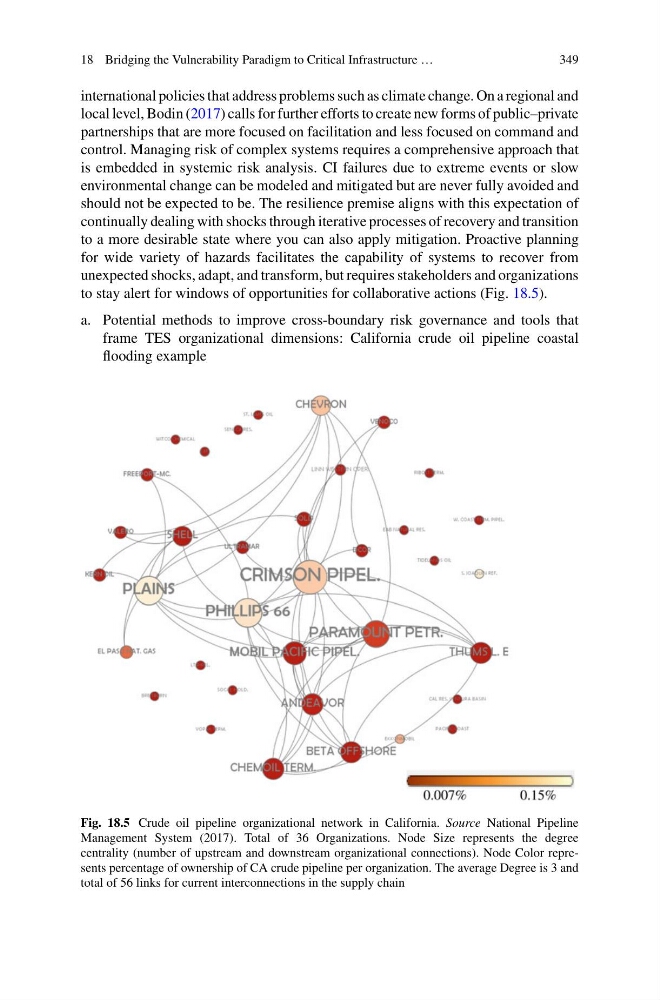
to stay alert for windows of opportunities for collaborative actions (Fig. 18.5).
a. Potential methods to improve cross-boundary risk governance and tools that
frame TES organizational dimensions: California crude oil pipeline coastal
flooding example
Fig. 18.5 Crude oil pipeline organizational network in California. Source National Pipeline
Management System (2017). Total of 36 Organizations. Node Size represents the degree
centrality (number of upstream and downstream organizational connections). Node Color represents percentage of ownership of CA crude pipeline per organization. The average Degree is 3 and
total of 56 links for current interconnections in the supply chain
349
international policies that address problems such as climate change. On a regional and
local level, Bodin (2017) calls for further efforts to create new forms of public–private
partnerships that are more focused on facilitation and less focused on command and
control. Managing risk of complex systems requires a comprehensive approach that
is embedded in systemic risk analysis. CI failures due to extreme events or slow
environmental change can be modeled and mitigated but are never fully avoided and
should not be expected to be. The resilience premise aligns with this expectation of
continually dealing with shocks through iterative processes of recovery and transition
to a more desirable state where you can also apply mitigation. Proactive planning
for wide variety of hazards facilitates the capability of systems to recover from
unexpected shocks, adapt, and transform, but requires stakeholders and organizations
to stay alert for windows of opportunities for collaborative actions (Fig. 18.5).
a. Potential methods to improve cross-boundary risk governance and tools that
frame TES organizational dimensions: California crude oil pipeline coastal
flooding example
Fig. 18.5 Crude oil pipeline organizational network in California. Source National Pipeline
Management System (2017). Total of 36 Organizations. Node Size represents the degree
centrality (number of upstream and downstream organizational connections). Node Color represents percentage of ownership of CA crude pipeline per organization. The average Degree is 3 and
total of 56 links for current interconnections in the supply chain