

346
S. Lindbergh and J. Radke
18.6.3 Uncovering the Organizational Network of CI
as a Social-Technical Approach to the TES
A specific field that embraces systems thinking and the resilience premise in CI is the
study of High Reliability Organizations (HRO) (Roberts 1989). One of the early goals
was to identify the factors that enabled organizations to maintain reliable performance
under conditions of high risk and uncertainty. The key implication is, again, that reliability must be viewed as a dynamic and adaptive process, a similar premise with
resilience. This field has stretched from a focus on specific types of organizations to
societal functions and human communities where the goal of a reliable performance
becomes highly complex due to multi-organizational systems at nested scales of interaction (Comfort 2017). Political Scientist Louise K. Comfort defines resilience as the
“tension between a speedy recovery and a timely adaptation…where somewhere in
the middle we find the capacity to prevent something bad from becoming something
worst” (Comfort et al. 2010). Comfort applies HRO inquiry systems to understand
community resilience to natural hazards and argues that the task of seeking reliability for a single organization exists within a system of interacting organizations
whose reality is more aligned with interconnected, interdependent systems that are
predisposed to cascading failures.
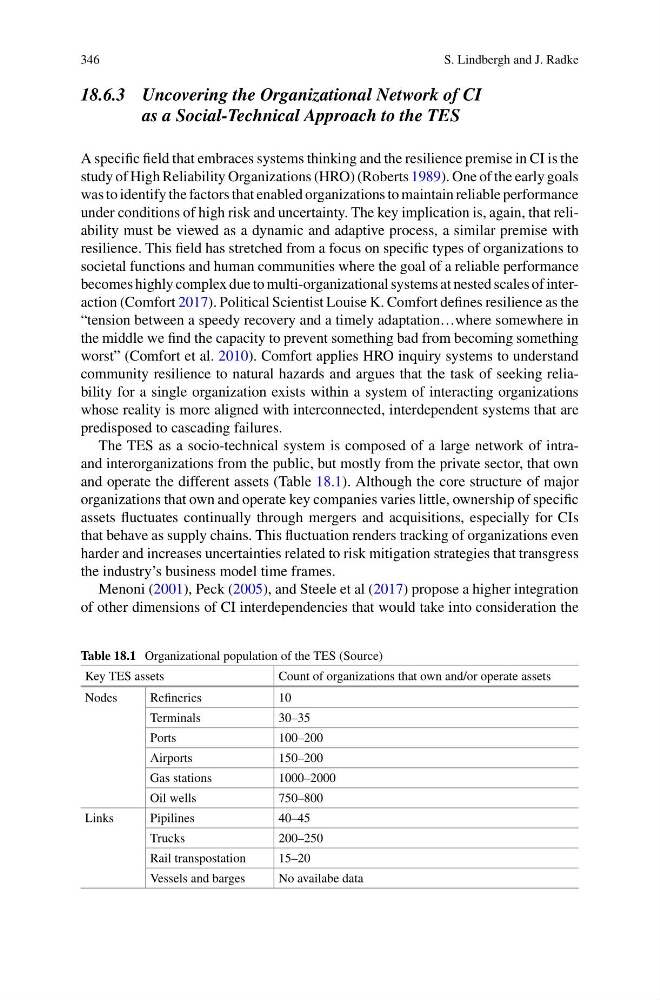
The TES as a socio-technical system is composed of a large network of intraand interorganizations from the public, but mostly from the private sector, that own
and operate the different assets (Table 18.1). Although the core structure of major
organizations that own and operate key companies varies little, ownership of specific
assets fluctuates continually through mergers and acquisitions, especially for CIs
that behave as supply chains. This fluctuation renders tracking of organizations even
harder and increases uncertainties related to risk mitigation strategies that transgress
the industry’s business model time frames.
Menoni (2001), Peck (2005), and Steele et al (2017) propose a higher integration
of other dimensions of CI interdependencies that would take into consideration the
Table 18.1 Organizational population of the TES (Source)
Key TES assets
Count of organizations that own and/or operate assets
Nodes
Refineries
10
Terminals
30–35
Ports
100–200
Airports
150–200
Gas stations
1000–2000
Oil wells
750–800
Links
Pipilines
40–45
Trucks
200–250
Rail transpostation
15–20
Vessels and barges
No availabe data
S. Lindbergh and J. Radke
18.6.3 Uncovering the Organizational Network of CI
as a Social-Technical Approach to the TES
A specific field that embraces systems thinking and the resilience premise in CI is the
study of High Reliability Organizations (HRO) (Roberts 1989). One of the early goals
was to identify the factors that enabled organizations to maintain reliable performance
under conditions of high risk and uncertainty. The key implication is, again, that reliability must be viewed as a dynamic and adaptive process, a similar premise with
resilience. This field has stretched from a focus on specific types of organizations to
societal functions and human communities where the goal of a reliable performance
becomes highly complex due to multi-organizational systems at nested scales of interaction (Comfort 2017). Political Scientist Louise K. Comfort defines resilience as the
“tension between a speedy recovery and a timely adaptation…where somewhere in
the middle we find the capacity to prevent something bad from becoming something
worst” (Comfort et al. 2010). Comfort applies HRO inquiry systems to understand
community resilience to natural hazards and argues that the task of seeking reliability for a single organization exists within a system of interacting organizations
whose reality is more aligned with interconnected, interdependent systems that are
predisposed to cascading failures.
The TES as a socio-technical system is composed of a large network of intraand interorganizations from the public, but mostly from the private sector, that own
and operate the different assets (Table 18.1). Although the core structure of major
organizations that own and operate key companies varies little, ownership of specific
assets fluctuates continually through mergers and acquisitions, especially for CIs
that behave as supply chains. This fluctuation renders tracking of organizations even
harder and increases uncertainties related to risk mitigation strategies that transgress
the industry’s business model time frames.
Menoni (2001), Peck (2005), and Steele et al (2017) propose a higher integration
of other dimensions of CI interdependencies that would take into consideration the
Table 18.1 Organizational population of the TES (Source)
Key TES assets
Count of organizations that own and/or operate assets
Nodes
Refineries
10
Terminals
30–35
Ports
100–200
Airports
150–200
Gas stations
1000–2000
Oil wells
750–800
Links
Pipilines
40–45
Trucks
200–250
Rail transpostation
15–20
Vessels and barges
No availabe data