

7 Comparative GIS-Based Assessment …
121
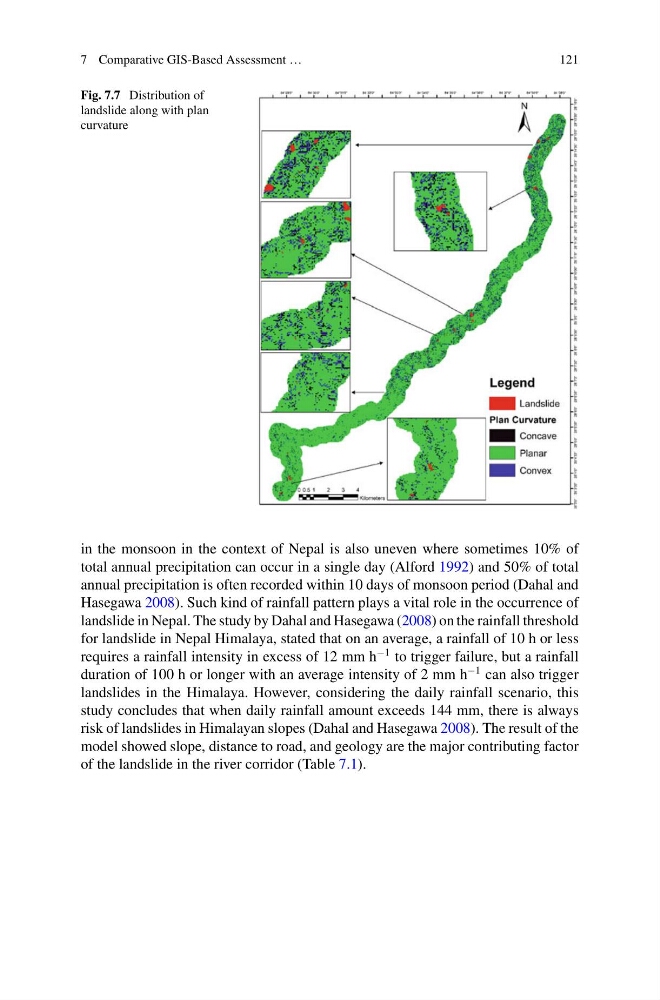
Fig. 7.7 Distribution of
landslide along with plan
curvature
in the monsoon in the context of Nepal is also uneven where sometimes 10% of
total annual precipitation can occur in a single day (Alford 1992) and 50% of total
annual precipitation is often recorded within 10 days of monsoon period (Dahal and
Hasegawa 2008). Such kind of rainfall pattern plays a vital role in the occurrence of
landslide in Nepal. The study by Dahal and Hasegawa (2008) on the rainfall threshold
for landslide in Nepal Himalaya, stated that on an average, a rainfall of 10 h or less
requires a rainfall intensity in excess of 12 mm h
−1 to trigger failure, but a rainfall
duration of 100 h or longer with an average intensity of 2 mm h
−1 can also trigger
landslides in the Himalaya. However, considering the daily rainfall scenario, this
study concludes that when daily rainfall amount exceeds 144 mm, there is always
risk of landslides in Himalayan slopes (Dahal and Hasegawa 2008). The result of the
model showed slope, distance to road, and geology are the major contributing factor
of the landslide in the river corridor (Table 7.1).
121
Fig. 7.7 Distribution of
landslide along with plan
curvature
in the monsoon in the context of Nepal is also uneven where sometimes 10% of
total annual precipitation can occur in a single day (Alford 1992) and 50% of total
annual precipitation is often recorded within 10 days of monsoon period (Dahal and
Hasegawa 2008). Such kind of rainfall pattern plays a vital role in the occurrence of
landslide in Nepal. The study by Dahal and Hasegawa (2008) on the rainfall threshold
for landslide in Nepal Himalaya, stated that on an average, a rainfall of 10 h or less
requires a rainfall intensity in excess of 12 mm h
−1 to trigger failure, but a rainfall
duration of 100 h or longer with an average intensity of 2 mm h
−1 can also trigger
landslides in the Himalaya. However, considering the daily rainfall scenario, this
study concludes that when daily rainfall amount exceeds 144 mm, there is always
risk of landslides in Himalayan slopes (Dahal and Hasegawa 2008). The result of the
model showed slope, distance to road, and geology are the major contributing factor
of the landslide in the river corridor (Table 7.1).