

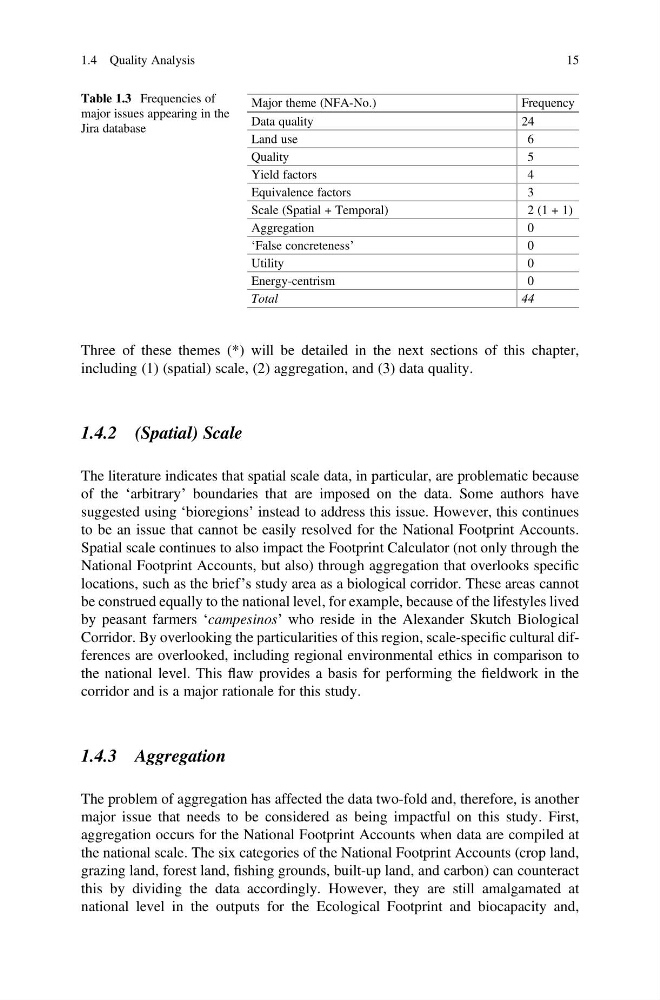
Three of these themes (*) will be detailed in the next sections of this chapter,
including (1) (spatial) scale, (2) aggregation, and (3) data quality.
1.4.2 (Spatial) Scale
The literature indicates that spatial scale data, in particular, are problematic because
of the ‘arbitrary’ boundaries that are imposed on the data. Some authors have
suggested using ‘bioregions’ instead to address this issue. However, this continues
to be an issue that cannot be easily resolved for the National Footprint Accounts.
Spatial scale continues to also impact the Footprint Calculator (not only through the
National Footprint Accounts, but also) through aggregation that overlooks specific
locations, such as the brief’s study area as a biological corridor. These areas cannot
be construed equally to the national level, for example, because of the lifestyles lived
by peasant farmers ‘campesinos’ who reside in the Alexander Skutch Biological
Corridor. By overlooking the particularities of this region, scale-specific cultural differences are overlooked, including regional environmental ethics in comparison to
the national level. This flaw provides a basis for performing the fieldwork in the
corridor and is a major rationale for this study.
1.4.3 Aggregation
The problem of aggregation has affected the data two-fold and, therefore, is another
major issue that needs to be considered as being impactful on this study. First,
aggregation occurs for the National Footprint Accounts when data are compiled at
the national scale. The six categories of the National Footprint Accounts (crop land,
grazing land, forest land, fishing grounds, built-up land, and carbon) can counteract
this by dividing the data accordingly. However, they are still amalgamated at
national level in the outputs for the Ecological Footprint and biocapacity and,
Table 1.3 Frequencies of
major issues appearing in the
Jira database
Major theme (NFA-No.)
Frequency
Data quality
24
Land use
6
Quality
5
Yield factors
4
Equivalence factors
3
Scale (Spatial + Temporal)
2 (1 + 1)
Aggregation
0
‘False concreteness’
0
Utility
0
Energy-centrism
0
Total
44
1.4 Quality Analysis
15
including (1) (spatial) scale, (2) aggregation, and (3) data quality.
1.4.2 (Spatial) Scale
The literature indicates that spatial scale data, in particular, are problematic because
of the ‘arbitrary’ boundaries that are imposed on the data. Some authors have
suggested using ‘bioregions’ instead to address this issue. However, this continues
to be an issue that cannot be easily resolved for the National Footprint Accounts.
Spatial scale continues to also impact the Footprint Calculator (not only through the
National Footprint Accounts, but also) through aggregation that overlooks specific
locations, such as the brief’s study area as a biological corridor. These areas cannot
be construed equally to the national level, for example, because of the lifestyles lived
by peasant farmers ‘campesinos’ who reside in the Alexander Skutch Biological
Corridor. By overlooking the particularities of this region, scale-specific cultural differences are overlooked, including regional environmental ethics in comparison to
the national level. This flaw provides a basis for performing the fieldwork in the
corridor and is a major rationale for this study.
1.4.3 Aggregation
The problem of aggregation has affected the data two-fold and, therefore, is another
major issue that needs to be considered as being impactful on this study. First,
aggregation occurs for the National Footprint Accounts when data are compiled at
the national scale. The six categories of the National Footprint Accounts (crop land,
grazing land, forest land, fishing grounds, built-up land, and carbon) can counteract
this by dividing the data accordingly. However, they are still amalgamated at
national level in the outputs for the Ecological Footprint and biocapacity and,
Table 1.3 Frequencies of
major issues appearing in the
Jira database
Major theme (NFA-No.)
Frequency
Data quality
24
Land use
6
Quality
5
Yield factors
4
Equivalence factors
3
Scale (Spatial + Temporal)
2 (1 + 1)
Aggregation
0
‘False concreteness’
0
Utility
0
Energy-centrism
0
Total
44
1.4 Quality Analysis
15