

Some of the main critical themes considered in this brief affecting the Footprint
Calculator are summarised below:
• *Aggregation – in adding the consumption categories (food, housing, and
transportation), it is not possible to see individual scores for these categories.
• *(Spatial) Scale – national information (from the National Footprint Accounts) is
used to ‘inform’ the calculation of the Footprint Calculator.
• Energy-centrism – a country that uses 95% of renewable energy will affect
household energy consumption qualitatively, although not necessarily quantitatively. There is also a cultural aspect to consider, as for example when heating and
cooling are not extensively or intensively used.
• *Data quality – the survey needs to be culturally tailored for use, e.g. tropical
countries.
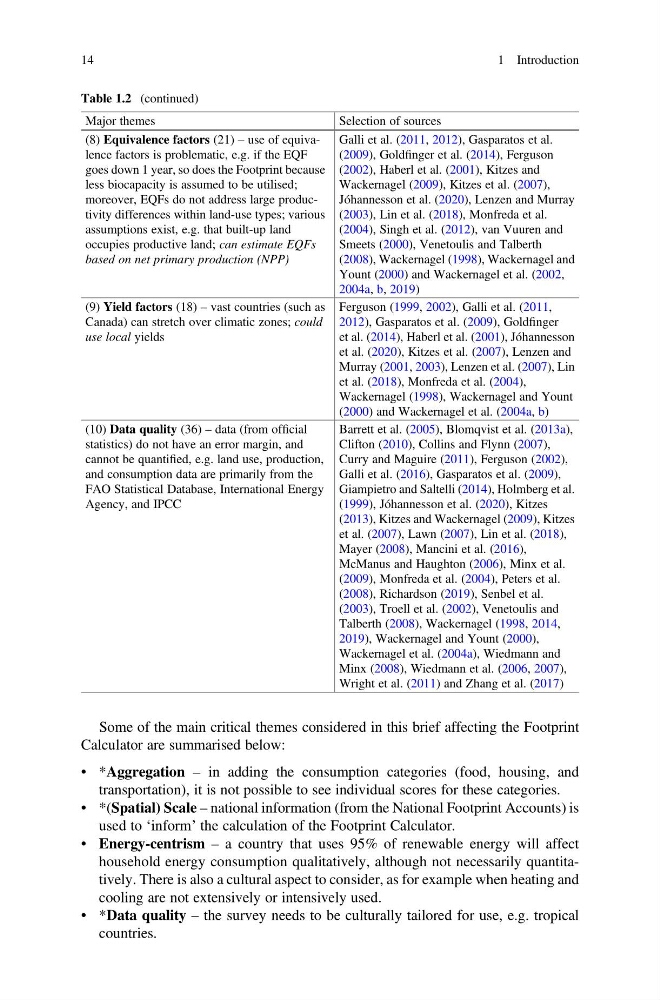
Table 1.2 (continued)
Major themes
Selection of sources
(8) Equivalence factors (21) – use of equivalence factors is problematic, e.g. if the EQF
goes down 1 year, so does the Footprint because
less biocapacity is assumed to be utilised;
moreover, EQFs do not address large productivity differences within land-use types; various
assumptions exist, e.g. that built-up land
occupies productive land; can estimate EQFs
based on net primary production (NPP)
Galli et al. (2011, 2012), Gasparatos et al.
(2009), Goldfinger et al. (2014), Ferguson
(2002), Haberl et al. (2001), Kitzes and
Wackernagel (2009), Kitzes et al. (2007),
Jóhannesson et al. (2020), Lenzen and Murray
(2003), Lin et al. (2018), Monfreda et al.
(2004), Singh et al. (2012), van Vuuren and
Smeets (2000), Venetoulis and Talberth
(2008), Wackernagel (1998), Wackernagel and
Yount (2000) and Wackernagel et al. (2002,
2004a, b, 2019)
(9) Yield factors (18) – vast countries (such as
Canada) can stretch over climatic zones; could
use local yields
Ferguson (1999, 2002), Galli et al. (2011,
2012), Gasparatos et al. (2009), Goldfinger
et al. (2014), Haberl et al. (2001), Jóhannesson
et al. (2020), Kitzes et al. (2007), Lenzen and
Murray (2001, 2003), Lenzen et al. (2007), Lin
et al. (2018), Monfreda et al. (2004),
Wackernagel (1998), Wackernagel and Yount
(2000) and Wackernagel et al. (2004a, b)
(10) Data quality (36) – data (from official
statistics) do not have an error margin, and
cannot be quantified, e.g. land use, production,
and consumption data are primarily from the
FAO Statistical Database, International Energy
Agency, and IPCC
Barrett et al. (2005), Blomqvist et al. (2013a),
Clifton (2010), Collins and Flynn (2007),
Curry and Maguire (2011), Ferguson (2002),
Galli et al. (2016), Gasparatos et al. (2009),
Giampietro and Saltelli (2014), Holmberg et al.
(1999), Jóhannesson et al. (2020), Kitzes
(2013), Kitzes and Wackernagel (2009), Kitzes
et al. (2007), Lawn (2007), Lin et al. (2018),
Mayer (2008), Mancini et al. (2016),
McManus and Haughton (2006), Minx et al.
(2009), Monfreda et al. (2004), Peters et al.
(2008), Richardson (2019), Senbel et al.
(2003), Troell et al. (2002), Venetoulis and
Talberth (2008), Wackernagel (1998, 2014,
2019), Wackernagel and Yount (2000),
Wackernagel et al. (2004a), Wiedmann and
Minx (2008), Wiedmann et al. (2006, 2007),
Wright et al. (2011) and Zhang et al. (2017)
14
1 Introduction
Calculator are summarised below:
• *Aggregation – in adding the consumption categories (food, housing, and
transportation), it is not possible to see individual scores for these categories.
• *(Spatial) Scale – national information (from the National Footprint Accounts) is
used to ‘inform’ the calculation of the Footprint Calculator.
• Energy-centrism – a country that uses 95% of renewable energy will affect
household energy consumption qualitatively, although not necessarily quantitatively. There is also a cultural aspect to consider, as for example when heating and
cooling are not extensively or intensively used.
• *Data quality – the survey needs to be culturally tailored for use, e.g. tropical
countries.
Table 1.2 (continued)
Major themes
Selection of sources
(8) Equivalence factors (21) – use of equivalence factors is problematic, e.g. if the EQF
goes down 1 year, so does the Footprint because
less biocapacity is assumed to be utilised;
moreover, EQFs do not address large productivity differences within land-use types; various
assumptions exist, e.g. that built-up land
occupies productive land; can estimate EQFs
based on net primary production (NPP)
Galli et al. (2011, 2012), Gasparatos et al.
(2009), Goldfinger et al. (2014), Ferguson
(2002), Haberl et al. (2001), Kitzes and
Wackernagel (2009), Kitzes et al. (2007),
Jóhannesson et al. (2020), Lenzen and Murray
(2003), Lin et al. (2018), Monfreda et al.
(2004), Singh et al. (2012), van Vuuren and
Smeets (2000), Venetoulis and Talberth
(2008), Wackernagel (1998), Wackernagel and
Yount (2000) and Wackernagel et al. (2002,
2004a, b, 2019)
(9) Yield factors (18) – vast countries (such as
Canada) can stretch over climatic zones; could
use local yields
Ferguson (1999, 2002), Galli et al. (2011,
2012), Gasparatos et al. (2009), Goldfinger
et al. (2014), Haberl et al. (2001), Jóhannesson
et al. (2020), Kitzes et al. (2007), Lenzen and
Murray (2001, 2003), Lenzen et al. (2007), Lin
et al. (2018), Monfreda et al. (2004),
Wackernagel (1998), Wackernagel and Yount
(2000) and Wackernagel et al. (2004a, b)
(10) Data quality (36) – data (from official
statistics) do not have an error margin, and
cannot be quantified, e.g. land use, production,
and consumption data are primarily from the
FAO Statistical Database, International Energy
Agency, and IPCC
Barrett et al. (2005), Blomqvist et al. (2013a),
Clifton (2010), Collins and Flynn (2007),
Curry and Maguire (2011), Ferguson (2002),
Galli et al. (2016), Gasparatos et al. (2009),
Giampietro and Saltelli (2014), Holmberg et al.
(1999), Jóhannesson et al. (2020), Kitzes
(2013), Kitzes and Wackernagel (2009), Kitzes
et al. (2007), Lawn (2007), Lin et al. (2018),
Mayer (2008), Mancini et al. (2016),
McManus and Haughton (2006), Minx et al.
(2009), Monfreda et al. (2004), Peters et al.
(2008), Richardson (2019), Senbel et al.
(2003), Troell et al. (2002), Venetoulis and
Talberth (2008), Wackernagel (1998, 2014,
2019), Wackernagel and Yount (2000),
Wackernagel et al. (2004a), Wiedmann and
Minx (2008), Wiedmann et al. (2006, 2007),
Wright et al. (2011) and Zhang et al. (2017)
14
1 Introduction