

throughout Libya. However, barley is considered as the main
cereal crop across the country, as the lack of rain and low
soil fertility give it an edge over wheat. Under favorable
weather conditions, barley and wheat sowing begin in
October. Harvesting of barley starts in April and ends in
mid-May, while harvesting of wheat starts in May and is
finalized by mid June (Fig. 6.7).
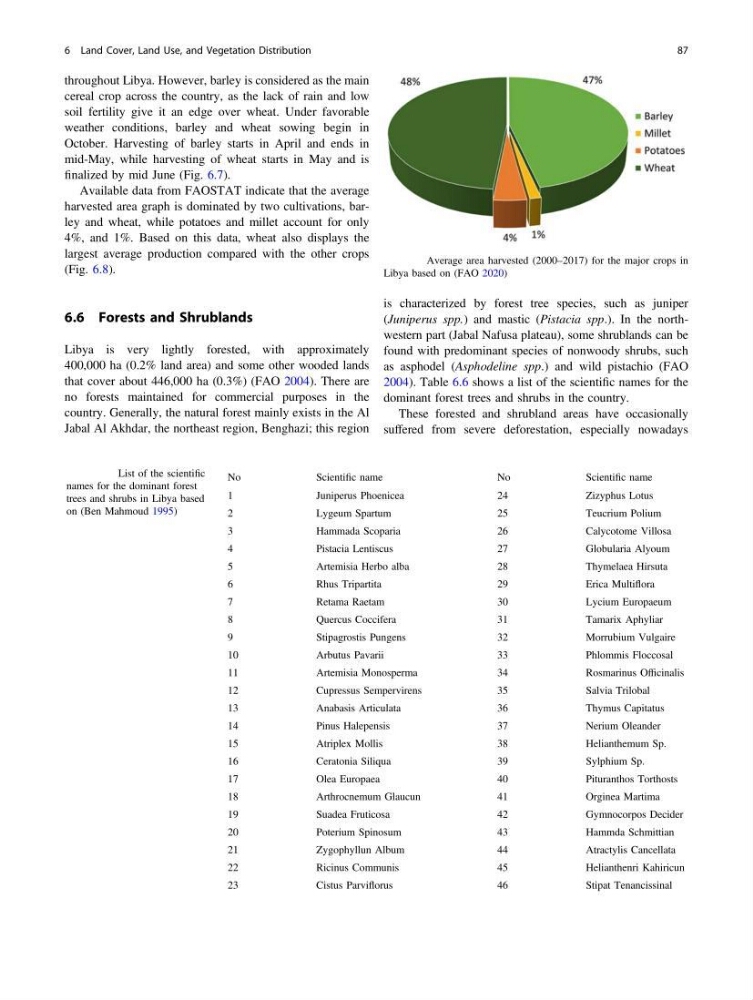
Available data from FAOSTAT indicate that the average
harvested area graph is dominated by two cultivations, barley and wheat, while potatoes and millet account for only
4%, and 1%. Based on this data, wheat also displays the
largest average production compared with the other crops
(Fig. 6.8).
6.6 Forests and Shrublands
Libya is very lightly forested, with approximately
400,000 ha (0.2% land area) and some other wooded lands
that cover about 446,000 ha (0.3%) (FAO 2004). There are
no forests maintained for commercial purposes in the
country. Generally, the natural forest mainly exists in the Al
Jabal Al Akhdar, the northeast region, Benghazi; this region
is characterized by forest tree species, such as juniper
(Juniperus spp.) and mastic (Pistacia spp.). In the northwestern part (Jabal Nafusa plateau), some shrublands can be
found with predominant species of nonwoody shrubs, such
as asphodel (Asphodeline spp.) and wild pistachio (FAO
2004). Table 6.6 shows a list of the scientific names for the
dominant forest trees and shrubs in the country.
These forested and shrubland areas have occasionally
suffered from severe deforestation, especially nowadays
Fig. 6.8 Average area harvested (2000–2017) for the major crops in
Libya based on (FAO 2020)
Table 6.6 List of the scientific
names for the dominant forest
trees and shrubs in Libya based
on (Ben Mahmoud 1995)
No
Scientific name
No
Scientific name
1
Juniperus Phoenicea
24
Zizyphus Lotus
2
Lygeum Spartum
25
Teucrium Polium
3
Hammada Scoparia
26
Calycotome Villosa
4
Pistacia Lentiscus
27
Globularia Alyoum
5
Artemisia Herbo alba
28
Thymelaea Hirsuta
6
Rhus Tripartita
29
Erica Multiflora
7
Retama Raetam
30
Lycium Europaeum
8
Quercus Coccifera
31
Tamarix Aphyliar
9
Stipagrostis Pungens
32
Morrubium Vulgaire
10
Arbutus Pavarii
33
Phlommis Floccosal
11
Artemisia Monosperma
34
Rosmarinus Officinalis
12
Cupressus Sempervirens
35
Salvia Trilobal
13
Anabasis Articulata
36
Thymus Capitatus
14
Pinus Halepensis
37
Nerium Oleander
15
Atriplex Mollis
38
Helianthemum Sp.
16
Ceratonia Siliqua
39
Sylphium Sp.
17
Olea Europaea
40
Pituranthos Torthosts
18
Arthrocnemum Glaucun
41
Orginea Martima
19
Suadea Fruticosa
42
Gymnocorpos Decider
20
Poterium Spinosum
43
Hammda Schmittian
21
Zygophyllun Album
44
Atractylis Cancellata
22
Ricinus Communis
45
Helianthenri Kahiricun
23
Cistus Parviflorus
46
Stipat Tenancissinal
6 Land Cover, Land Use, and Vegetation Distribution
87
cereal crop across the country, as the lack of rain and low
soil fertility give it an edge over wheat. Under favorable
weather conditions, barley and wheat sowing begin in
October. Harvesting of barley starts in April and ends in
mid-May, while harvesting of wheat starts in May and is
finalized by mid June (Fig. 6.7).
Available data from FAOSTAT indicate that the average
harvested area graph is dominated by two cultivations, barley and wheat, while potatoes and millet account for only
4%, and 1%. Based on this data, wheat also displays the
largest average production compared with the other crops
(Fig. 6.8).
6.6 Forests and Shrublands
Libya is very lightly forested, with approximately
400,000 ha (0.2% land area) and some other wooded lands
that cover about 446,000 ha (0.3%) (FAO 2004). There are
no forests maintained for commercial purposes in the
country. Generally, the natural forest mainly exists in the Al
Jabal Al Akhdar, the northeast region, Benghazi; this region
is characterized by forest tree species, such as juniper
(Juniperus spp.) and mastic (Pistacia spp.). In the northwestern part (Jabal Nafusa plateau), some shrublands can be
found with predominant species of nonwoody shrubs, such
as asphodel (Asphodeline spp.) and wild pistachio (FAO
2004). Table 6.6 shows a list of the scientific names for the
dominant forest trees and shrubs in the country.
These forested and shrubland areas have occasionally
suffered from severe deforestation, especially nowadays
Fig. 6.8 Average area harvested (2000–2017) for the major crops in
Libya based on (FAO 2020)
Table 6.6 List of the scientific
names for the dominant forest
trees and shrubs in Libya based
on (Ben Mahmoud 1995)
No
Scientific name
No
Scientific name
1
Juniperus Phoenicea
24
Zizyphus Lotus
2
Lygeum Spartum
25
Teucrium Polium
3
Hammada Scoparia
26
Calycotome Villosa
4
Pistacia Lentiscus
27
Globularia Alyoum
5
Artemisia Herbo alba
28
Thymelaea Hirsuta
6
Rhus Tripartita
29
Erica Multiflora
7
Retama Raetam
30
Lycium Europaeum
8
Quercus Coccifera
31
Tamarix Aphyliar
9
Stipagrostis Pungens
32
Morrubium Vulgaire
10
Arbutus Pavarii
33
Phlommis Floccosal
11
Artemisia Monosperma
34
Rosmarinus Officinalis
12
Cupressus Sempervirens
35
Salvia Trilobal
13
Anabasis Articulata
36
Thymus Capitatus
14
Pinus Halepensis
37
Nerium Oleander
15
Atriplex Mollis
38
Helianthemum Sp.
16
Ceratonia Siliqua
39
Sylphium Sp.
17
Olea Europaea
40
Pituranthos Torthosts
18
Arthrocnemum Glaucun
41
Orginea Martima
19
Suadea Fruticosa
42
Gymnocorpos Decider
20
Poterium Spinosum
43
Hammda Schmittian
21
Zygophyllun Album
44
Atractylis Cancellata
22
Ricinus Communis
45
Helianthenri Kahiricun
23
Cistus Parviflorus
46
Stipat Tenancissinal
6 Land Cover, Land Use, and Vegetation Distribution
87