

encroachment, and fall of sand on residential areas. This can
lead to things like the disruption of transportation routes and
the spread of eye and respiratory diseases.
• Soil Erosion by water: The Northern mountain regions
in Libya are the most vulnerable areas for soil erosion by
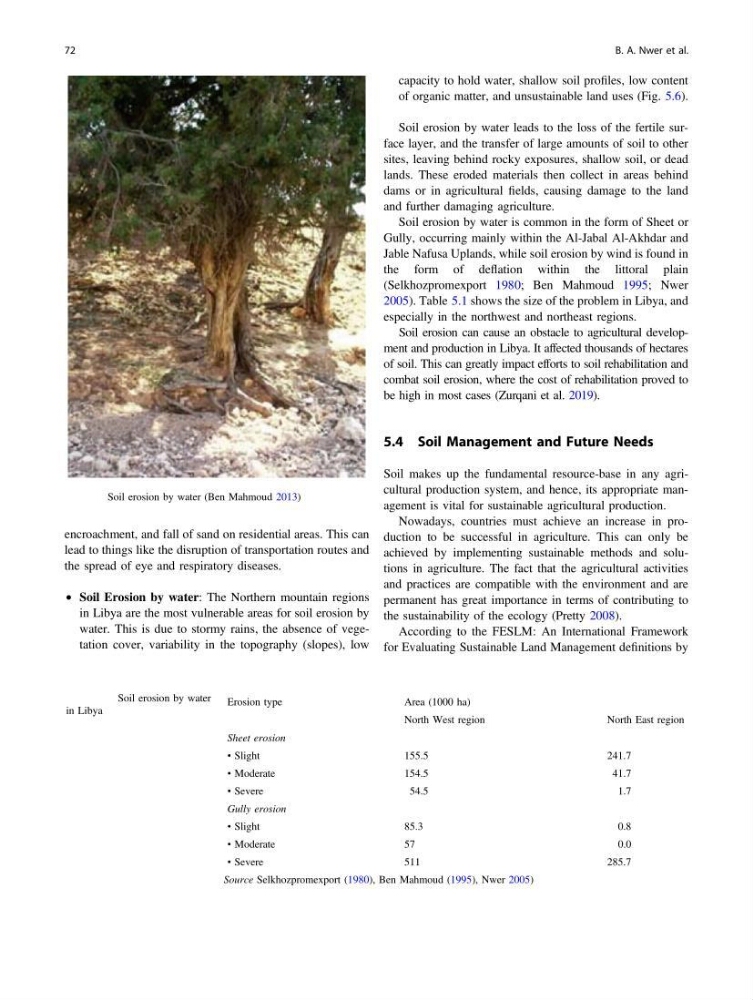
water. This is due to stormy rains, the absence of vegetation cover, variability in the topography (slopes), low
capacity to hold water, shallow soil profiles, low content
of organic matter, and unsustainable land uses (Fig. 5.6).
Soil erosion by water leads to the loss of the fertile surface layer, and the transfer of large amounts of soil to other
sites, leaving behind rocky exposures, shallow soil, or dead
lands. These eroded materials then collect in areas behind
dams or in agricultural fields, causing damage to the land
and further damaging agriculture.
Soil erosion by water is common in the form of Sheet or
Gully, occurring mainly within the Al-Jabal Al-Akhdar and
Jable Nafusa Uplands, while soil erosion by wind is found in
the form of deflation within the littoral plain
(Selkhozpromexport 1980; Ben Mahmoud 1995; Nwer
2005). Table 5.1 shows the size of the problem in Libya, and
especially in the northwest and northeast regions.
Soil erosion can cause an obstacle to agricultural development and production in Libya. It affected thousands of hectares
of soil. This can greatly impact efforts to soil rehabilitation and
combat soil erosion, where the cost of rehabilitation proved to
be high in most cases (Zurqani et al. 2019).
5.4 Soil Management and Future Needs
Soil makes up the fundamental resource-base in any agricultural production system, and hence, its appropriate management is vital for sustainable agricultural production.
Nowadays, countries must achieve an increase in production to be successful in agriculture. This can only be
achieved by implementing sustainable methods and solutions in agriculture. The fact that the agricultural activities
and practices are compatible with the environment and are
permanent has great importance in terms of contributing to
the sustainability of the ecology (Pretty 2008).
According to the FESLM: An International Framework
for Evaluating Sustainable Land Management definitions by
Fig. 5.6 Soil erosion by water (Ben Mahmoud 2013)
Table 5.1 Soil erosion by water
in Libya
Erosion type
Area (1000 ha)
North West region
North East region
Sheet erosion
• Slight
155.5
241.7
• Moderate
154.5
41.7
• Severe
54.5
1.7
Gully erosion
• Slight
85.3
0.8
• Moderate
57
0.0
• Severe
511
285.7
Source Selkhozpromexport (1980), Ben Mahmoud (1995), Nwer 2005)
72
B. A. Nwer et al.
lead to things like the disruption of transportation routes and
the spread of eye and respiratory diseases.
• Soil Erosion by water: The Northern mountain regions
in Libya are the most vulnerable areas for soil erosion by
water. This is due to stormy rains, the absence of vegetation cover, variability in the topography (slopes), low
capacity to hold water, shallow soil profiles, low content
of organic matter, and unsustainable land uses (Fig. 5.6).
Soil erosion by water leads to the loss of the fertile surface layer, and the transfer of large amounts of soil to other
sites, leaving behind rocky exposures, shallow soil, or dead
lands. These eroded materials then collect in areas behind
dams or in agricultural fields, causing damage to the land
and further damaging agriculture.
Soil erosion by water is common in the form of Sheet or
Gully, occurring mainly within the Al-Jabal Al-Akhdar and
Jable Nafusa Uplands, while soil erosion by wind is found in
the form of deflation within the littoral plain
(Selkhozpromexport 1980; Ben Mahmoud 1995; Nwer
2005). Table 5.1 shows the size of the problem in Libya, and
especially in the northwest and northeast regions.
Soil erosion can cause an obstacle to agricultural development and production in Libya. It affected thousands of hectares
of soil. This can greatly impact efforts to soil rehabilitation and
combat soil erosion, where the cost of rehabilitation proved to
be high in most cases (Zurqani et al. 2019).
5.4 Soil Management and Future Needs
Soil makes up the fundamental resource-base in any agricultural production system, and hence, its appropriate management is vital for sustainable agricultural production.
Nowadays, countries must achieve an increase in production to be successful in agriculture. This can only be
achieved by implementing sustainable methods and solutions in agriculture. The fact that the agricultural activities
and practices are compatible with the environment and are
permanent has great importance in terms of contributing to
the sustainability of the ecology (Pretty 2008).
According to the FESLM: An International Framework
for Evaluating Sustainable Land Management definitions by
Fig. 5.6 Soil erosion by water (Ben Mahmoud 2013)
Table 5.1 Soil erosion by water
in Libya
Erosion type
Area (1000 ha)
North West region
North East region
Sheet erosion
• Slight
155.5
241.7
• Moderate
154.5
41.7
• Severe
54.5
1.7
Gully erosion
• Slight
85.3
0.8
• Moderate
57
0.0
• Severe
511
285.7
Source Selkhozpromexport (1980), Ben Mahmoud (1995), Nwer 2005)
72
B. A. Nwer et al.