

consideration. This can be done by targeting crops that
consume less water, and at the same time, developing water
resources other than groundwater resources.
5.3.3 Terrain
Since the topography plays a fundamental role in choosing
agricultural crops, because of their impact on the local climate, vegetation cover, the type of the existing soil, the local
humidity and temperature conditions, the extent of their
exposure to erosion by wind or water, and others. However,
what concerns us here is one of its elements that controls the
methods that must be followed when growing agricultural
crops, especially irrigated ones, which is the slope of the
land surface. The slope of the land surface is one of the
important characteristics that control the choice of agricultural crops, as well as the selection of agricultural operations
that must be followed. Such as the use of agricultural
mechanization or not, the type of irrigation system, measures
related to soil and water conservation, etc.
5.3.4 Erosion
Soil erosion leads to a reduction in soil quality, productivity,
and crop yield. Its impact extends to several variables such
as crop type, soil properties, management practices, and
climate characteristics. Erosion often results in a decrease of
the soil supply functions in three ways: (1) the removal of
organic matter; (2) the change in depth to a possible
root-barrier; and (3) the loss of structure and increased
compaction (Bakker et al. 2004). Erosion may also cause
physical hindrance to root growth, for example, when a
clayey subsoil is present. Physical hindrance is a significant
part of the root system encountering the restricting horizon.
Where growth is hindered by bedrock or a pan, yields will
rapidly approach zero once the minimum soil requirements
for rooting are exceeded by soil removal (National Soil
Erosion—Soil Productivity Research Planning Committee
1981).
In Libya, where the environment is vulnerable, the variability of rainfall, the occurrence of occasional relatively
heavy showers characterized by high intensity, and the land
surface are the main factors that accelerate soil erosion. The
combination of these factors, in addition to the topography,
has increased the rate of soil erosion by water.
Selkhozpromexport (1980) distinguished two types of
accelerated erosion: Soil erosion by wind and Soil erosion
by water.
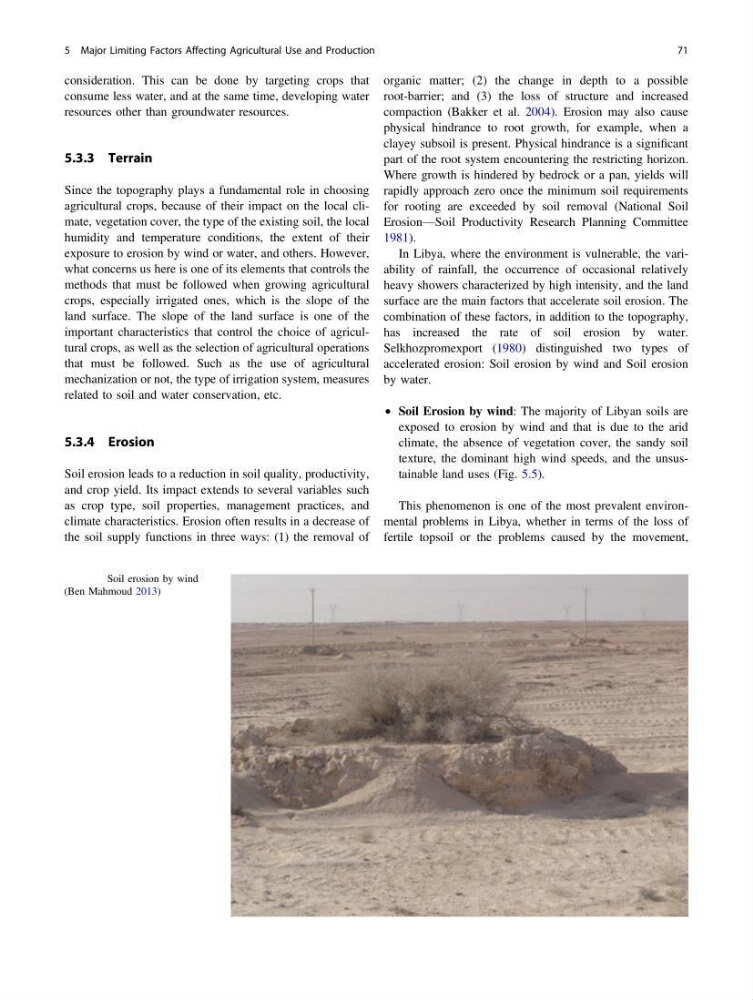
• Soil Erosion by wind: The majority of Libyan soils are
exposed to erosion by wind and that is due to the arid
climate, the absence of vegetation cover, the sandy soil
texture, the dominant high wind speeds, and the unsustainable land uses (Fig. 5.5).
This phenomenon is one of the most prevalent environmental problems in Libya, whether in terms of the loss of
fertile topsoil or the problems caused by the movement,
Fig. 5.5 Soil erosion by wind
(Ben Mahmoud 2013)
5 Major Limiting Factors Affecting Agricultural Use and Production
71
consume less water, and at the same time, developing water
resources other than groundwater resources.
5.3.3 Terrain
Since the topography plays a fundamental role in choosing
agricultural crops, because of their impact on the local climate, vegetation cover, the type of the existing soil, the local
humidity and temperature conditions, the extent of their
exposure to erosion by wind or water, and others. However,
what concerns us here is one of its elements that controls the
methods that must be followed when growing agricultural
crops, especially irrigated ones, which is the slope of the
land surface. The slope of the land surface is one of the
important characteristics that control the choice of agricultural crops, as well as the selection of agricultural operations
that must be followed. Such as the use of agricultural
mechanization or not, the type of irrigation system, measures
related to soil and water conservation, etc.
5.3.4 Erosion
Soil erosion leads to a reduction in soil quality, productivity,
and crop yield. Its impact extends to several variables such
as crop type, soil properties, management practices, and
climate characteristics. Erosion often results in a decrease of
the soil supply functions in three ways: (1) the removal of
organic matter; (2) the change in depth to a possible
root-barrier; and (3) the loss of structure and increased
compaction (Bakker et al. 2004). Erosion may also cause
physical hindrance to root growth, for example, when a
clayey subsoil is present. Physical hindrance is a significant
part of the root system encountering the restricting horizon.
Where growth is hindered by bedrock or a pan, yields will
rapidly approach zero once the minimum soil requirements
for rooting are exceeded by soil removal (National Soil
Erosion—Soil Productivity Research Planning Committee
1981).
In Libya, where the environment is vulnerable, the variability of rainfall, the occurrence of occasional relatively
heavy showers characterized by high intensity, and the land
surface are the main factors that accelerate soil erosion. The
combination of these factors, in addition to the topography,
has increased the rate of soil erosion by water.
Selkhozpromexport (1980) distinguished two types of
accelerated erosion: Soil erosion by wind and Soil erosion
by water.
• Soil Erosion by wind: The majority of Libyan soils are
exposed to erosion by wind and that is due to the arid
climate, the absence of vegetation cover, the sandy soil
texture, the dominant high wind speeds, and the unsustainable land uses (Fig. 5.5).
This phenomenon is one of the most prevalent environmental problems in Libya, whether in terms of the loss of
fertile topsoil or the problems caused by the movement,
Fig. 5.5 Soil erosion by wind
(Ben Mahmoud 2013)
5 Major Limiting Factors Affecting Agricultural Use and Production
71