

second, it requires detecting the temporal and spatial changes in this occurrence. Ben Mahmoud et al. (2000) reported
that approximately 1900 km
2 are affected by salinity, probably due to using saline water for irrigation, poor drainage,
and increasing concentrations of salts in the irrigated water
from seawater intrusion. There are many reasons for the
salinity problem in Libyan soils including: sequences of arid
years, low quality of irrigation water, high evaporation rate
from the soils due to the high temperature, bad drainage of
the soils, soil saturation, and interruption between groundwater and salty seawater. In addition to the presence and
spread of saline and natural Sebkha soils, significant areas of
irrigated lands in Libya are annually transformed into saline
soils. Secondary salinity may also arise in some Libyan soils
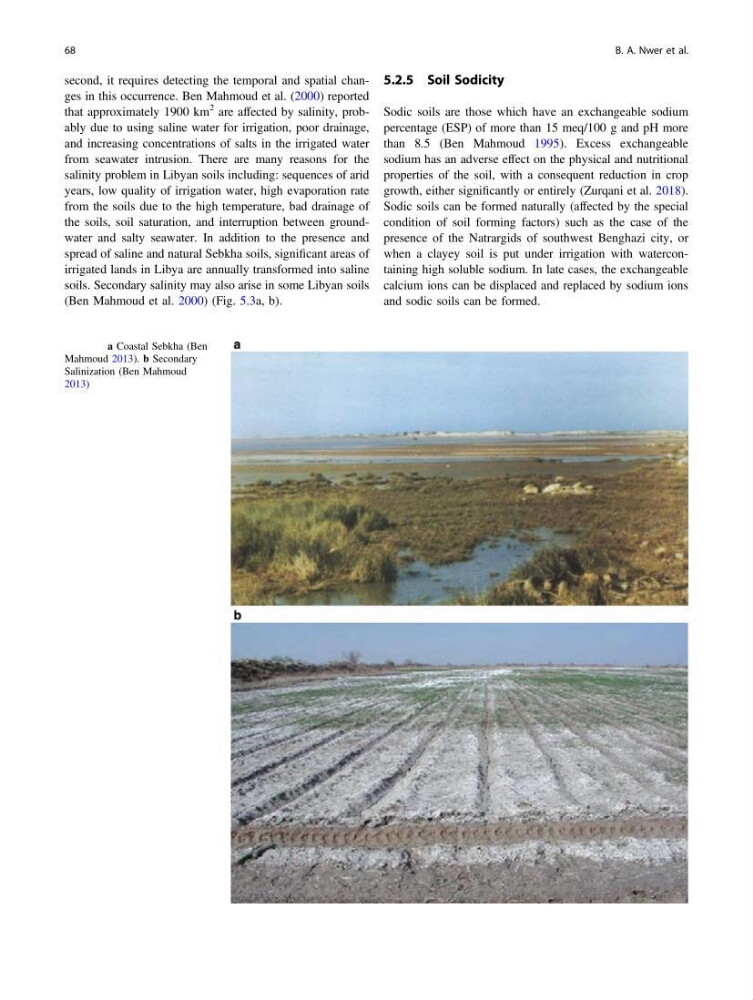
(Ben Mahmoud et al. 2000) (Fig. 5.3a, b).
5.2.5 Soil Sodicity
Sodic soils are those which have an exchangeable sodium
percentage (ESP) of more than 15 meq/100 g and pH more
than 8.5 (Ben Mahmoud 1995). Excess exchangeable
sodium has an adverse effect on the physical and nutritional
properties of the soil, with a consequent reduction in crop
growth, either significantly or entirely (Zurqani et al. 2018).
Sodic soils can be formed naturally (affected by the special
condition of soil forming factors) such as the case of the
presence of the Natrargids of southwest Benghazi city, or
when a clayey soil is put under irrigation with watercontaining high soluble sodium. In late cases, the exchangeable
calcium ions can be displaced and replaced by sodium ions
and sodic soils can be formed.
Fig. 5.3 a Coastal Sebkha (Ben
Mahmoud 2013). b Secondary
Salinization (Ben Mahmoud
2013)
68
B. A. Nwer et al.
that approximately 1900 km
2 are affected by salinity, probably due to using saline water for irrigation, poor drainage,
and increasing concentrations of salts in the irrigated water
from seawater intrusion. There are many reasons for the
salinity problem in Libyan soils including: sequences of arid
years, low quality of irrigation water, high evaporation rate
from the soils due to the high temperature, bad drainage of
the soils, soil saturation, and interruption between groundwater and salty seawater. In addition to the presence and
spread of saline and natural Sebkha soils, significant areas of
irrigated lands in Libya are annually transformed into saline
soils. Secondary salinity may also arise in some Libyan soils
(Ben Mahmoud et al. 2000) (Fig. 5.3a, b).
5.2.5 Soil Sodicity
Sodic soils are those which have an exchangeable sodium
percentage (ESP) of more than 15 meq/100 g and pH more
than 8.5 (Ben Mahmoud 1995). Excess exchangeable
sodium has an adverse effect on the physical and nutritional
properties of the soil, with a consequent reduction in crop
growth, either significantly or entirely (Zurqani et al. 2018).
Sodic soils can be formed naturally (affected by the special
condition of soil forming factors) such as the case of the
presence of the Natrargids of southwest Benghazi city, or
when a clayey soil is put under irrigation with watercontaining high soluble sodium. In late cases, the exchangeable
calcium ions can be displaced and replaced by sodium ions
and sodic soils can be formed.
Fig. 5.3 a Coastal Sebkha (Ben
Mahmoud 2013). b Secondary
Salinization (Ben Mahmoud
2013)
68
B. A. Nwer et al.