

most plants rely on soil for mechanical support. Deep soils
favor drainage and are, therefore, optimal for the irrigation of
dryland crops. Stewart and Nielsen (1990) indicate that a soil
depth of about 30–40 cm is the minimum depth for maximum
yields of all crops. Significant decreases in production are
evident for all crops where soil depth is less than 30 cm. The
shallow marginal soils only support certain plants, whereas
deep soils can support a wide range of plants and trees.
In Libyan conditions, it has been suggested that a soil
depth of less than 30 cm vastly decreases the crop yield. In
addition, it is agreed that a soil depth between 50 and 80 cm
increases the crop yield (Selkhozpromexport 1980; Stewart
and Nielsen 1990; Ben Mahmoud 1995; Food and
Agriculture Organization of the United Nations (FAO) 2002;
Nwer 2005). Libyan soils in semiarid and arid regions can
develop special soil horizons that limit the soil depth
available to support the plant. These special horizons include
hardpans, duripans, and layers that have been cemented
together by the deposition of mineral material. Petrocalcic
and Petrogypsic horizons are obvious examples of this kind
of horizon. Aridisols and Entisols represent the most widespread soils in Libya (see Chaps. 3 and 4). There are a large
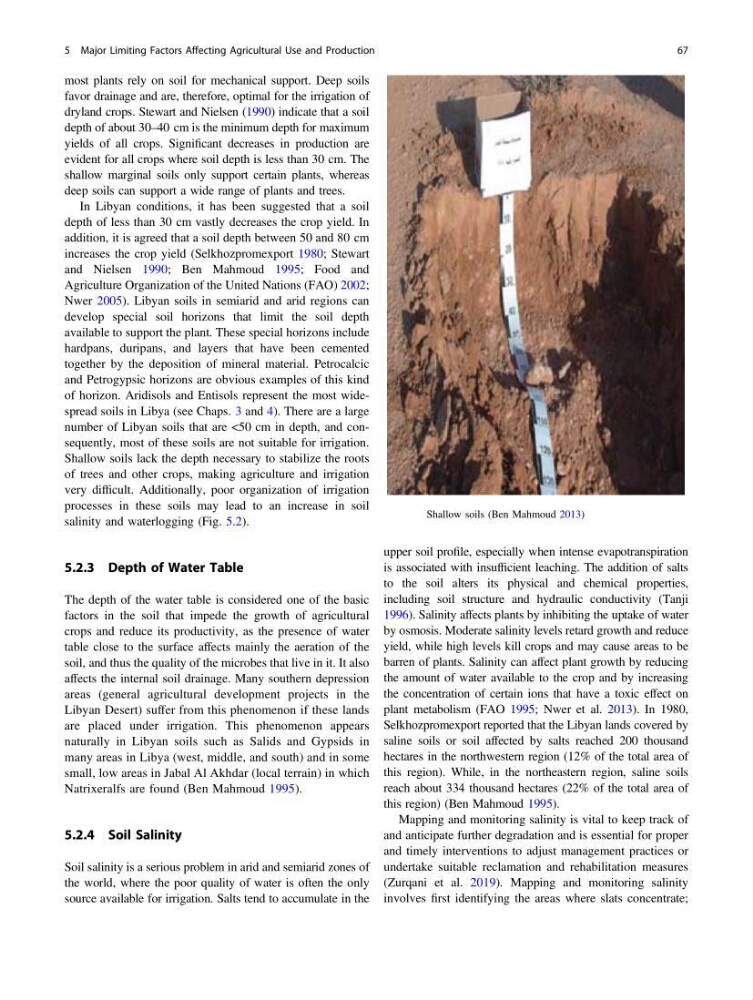
number of Libyan soils that are <50 cm in depth, and consequently, most of these soils are not suitable for irrigation.
Shallow soils lack the depth necessary to stabilize the roots
of trees and other crops, making agriculture and irrigation
very difficult. Additionally, poor organization of irrigation
processes in these soils may lead to an increase in soil
salinity and waterlogging (Fig. 5.2).
5.2.3 Depth of Water Table
The depth of the water table is considered one of the basic
factors in the soil that impede the growth of agricultural
crops and reduce its productivity, as the presence of water
table close to the surface affects mainly the aeration of the
soil, and thus the quality of the microbes that live in it. It also
affects the internal soil drainage. Many southern depression
areas (general agricultural development projects in the
Libyan Desert) suffer from this phenomenon if these lands
are placed under irrigation. This phenomenon appears
naturally in Libyan soils such as Salids and Gypsids in
many areas in Libya (west, middle, and south) and in some
small, low areas in Jabal Al Akhdar (local terrain) in which
Natrixeralfs are found (Ben Mahmoud 1995).
5.2.4 Soil Salinity
Soil salinity is a serious problem in arid and semiarid zones of
the world, where the poor quality of water is often the only
source available for irrigation. Salts tend to accumulate in the
upper soil profile, especially when intense evapotranspiration
is associated with insufficient leaching. The addition of salts
to the soil alters its physical and chemical properties,
including soil structure and hydraulic conductivity (Tanji
1996). Salinity affects plants by inhibiting the uptake of water
by osmosis. Moderate salinity levels retard growth and reduce
yield, while high levels kill crops and may cause areas to be
barren of plants. Salinity can affect plant growth by reducing
the amount of water available to the crop and by increasing
the concentration of certain ions that have a toxic effect on
plant metabolism (FAO 1995; Nwer et al. 2013). In 1980,
Selkhozpromexport reported that the Libyan lands covered by
saline soils or soil affected by salts reached 200 thousand
hectares in the northwestern region (12% of the total area of
this region). While, in the northeastern region, saline soils
reach about 334 thousand hectares (22% of the total area of
this region) (Ben Mahmoud 1995).
Mapping and monitoring salinity is vital to keep track of
and anticipate further degradation and is essential for proper
and timely interventions to adjust management practices or
undertake suitable reclamation and rehabilitation measures
(Zurqani et al. 2019). Mapping and monitoring salinity
involves first identifying the areas where slats concentrate;
Fig. 5.2 Shallow soils (Ben Mahmoud 2013)
5 Major Limiting Factors Affecting Agricultural Use and Production
67
favor drainage and are, therefore, optimal for the irrigation of
dryland crops. Stewart and Nielsen (1990) indicate that a soil
depth of about 30–40 cm is the minimum depth for maximum
yields of all crops. Significant decreases in production are
evident for all crops where soil depth is less than 30 cm. The
shallow marginal soils only support certain plants, whereas
deep soils can support a wide range of plants and trees.
In Libyan conditions, it has been suggested that a soil
depth of less than 30 cm vastly decreases the crop yield. In
addition, it is agreed that a soil depth between 50 and 80 cm
increases the crop yield (Selkhozpromexport 1980; Stewart
and Nielsen 1990; Ben Mahmoud 1995; Food and
Agriculture Organization of the United Nations (FAO) 2002;
Nwer 2005). Libyan soils in semiarid and arid regions can
develop special soil horizons that limit the soil depth
available to support the plant. These special horizons include
hardpans, duripans, and layers that have been cemented
together by the deposition of mineral material. Petrocalcic
and Petrogypsic horizons are obvious examples of this kind
of horizon. Aridisols and Entisols represent the most widespread soils in Libya (see Chaps. 3 and 4). There are a large
number of Libyan soils that are <50 cm in depth, and consequently, most of these soils are not suitable for irrigation.
Shallow soils lack the depth necessary to stabilize the roots
of trees and other crops, making agriculture and irrigation
very difficult. Additionally, poor organization of irrigation
processes in these soils may lead to an increase in soil
salinity and waterlogging (Fig. 5.2).
5.2.3 Depth of Water Table
The depth of the water table is considered one of the basic
factors in the soil that impede the growth of agricultural
crops and reduce its productivity, as the presence of water
table close to the surface affects mainly the aeration of the
soil, and thus the quality of the microbes that live in it. It also
affects the internal soil drainage. Many southern depression
areas (general agricultural development projects in the
Libyan Desert) suffer from this phenomenon if these lands
are placed under irrigation. This phenomenon appears
naturally in Libyan soils such as Salids and Gypsids in
many areas in Libya (west, middle, and south) and in some
small, low areas in Jabal Al Akhdar (local terrain) in which
Natrixeralfs are found (Ben Mahmoud 1995).
5.2.4 Soil Salinity
Soil salinity is a serious problem in arid and semiarid zones of
the world, where the poor quality of water is often the only
source available for irrigation. Salts tend to accumulate in the
upper soil profile, especially when intense evapotranspiration
is associated with insufficient leaching. The addition of salts
to the soil alters its physical and chemical properties,
including soil structure and hydraulic conductivity (Tanji
1996). Salinity affects plants by inhibiting the uptake of water
by osmosis. Moderate salinity levels retard growth and reduce
yield, while high levels kill crops and may cause areas to be
barren of plants. Salinity can affect plant growth by reducing
the amount of water available to the crop and by increasing
the concentration of certain ions that have a toxic effect on
plant metabolism (FAO 1995; Nwer et al. 2013). In 1980,
Selkhozpromexport reported that the Libyan lands covered by
saline soils or soil affected by salts reached 200 thousand
hectares in the northwestern region (12% of the total area of
this region). While, in the northeastern region, saline soils
reach about 334 thousand hectares (22% of the total area of
this region) (Ben Mahmoud 1995).
Mapping and monitoring salinity is vital to keep track of
and anticipate further degradation and is essential for proper
and timely interventions to adjust management practices or
undertake suitable reclamation and rehabilitation measures
(Zurqani et al. 2019). Mapping and monitoring salinity
involves first identifying the areas where slats concentrate;
Fig. 5.2 Shallow soils (Ben Mahmoud 2013)
5 Major Limiting Factors Affecting Agricultural Use and Production
67