

• (Cambids): Cambids are soils that contain an alterable
horizon (Cambic horizon) under the surface, and an
Ochric surface horizon usually exists in these soils as
well. Cambids are present in some regions of the Jafara
Plain such as Al Aziziye, Kaser Bin Ghashir, and some
areas in the Nafusa mountains range, where the geomorphologic surfaces are relatively stable. These soils are
characterized by the texture of sandy loam or loamy sand
and are mostly deep to medium depth. They are also
almost completely free from excessive salinity and contain a small percentage of calcium carbonate throughout
the soil profile. Cambids are more suitable than psamments and orthents, but they are also poor in organic
matter and nutrients. There is only one great group level
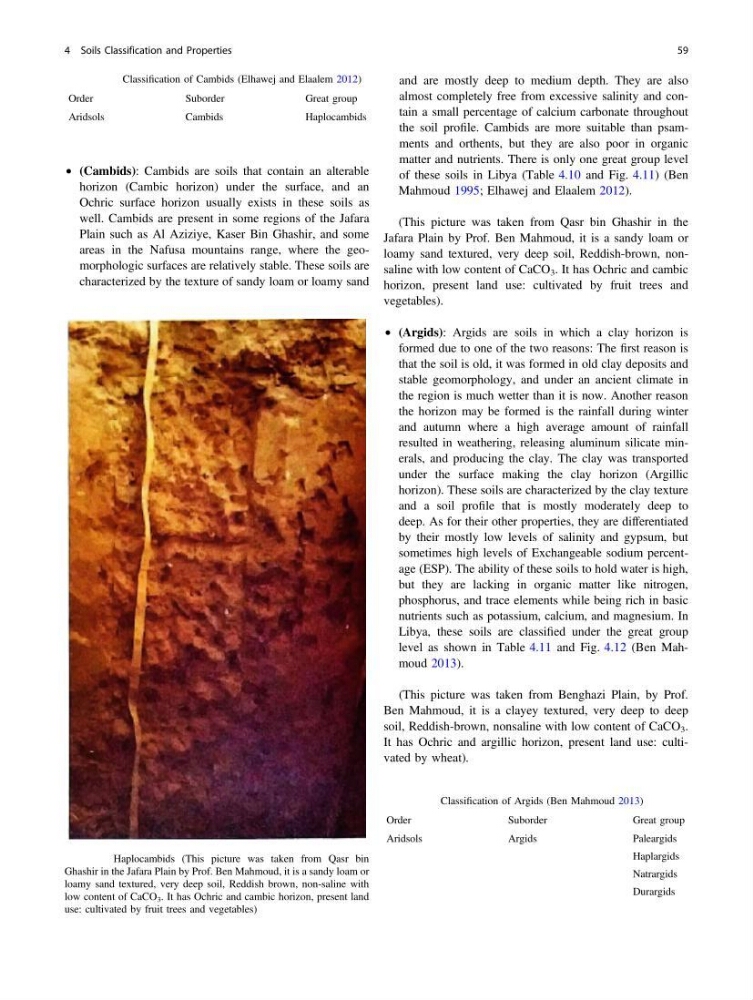
of these soils in Libya (Table 4.10 and Fig. 4.11) (Ben
Mahmoud 1995; Elhawej and Elaalem 2012).
(This picture was taken from Qasr bin Ghashir in the
Jafara Plain by Prof. Ben Mahmoud, it is a sandy loam or
loamy sand textured, very deep soil, Reddish-brown, nonsaline with low content of CaCO 3 . It has Ochric and cambic
horizon, present land use: cultivated by fruit trees and
vegetables).
• (Argids): Argids are soils in which a clay horizon is
formed due to one of the two reasons: The first reason is
that the soil is old, it was formed in old clay deposits and
stable geomorphology, and under an ancient climate in
the region is much wetter than it is now. Another reason
the horizon may be formed is the rainfall during winter
and autumn where a high average amount of rainfall
resulted in weathering, releasing aluminum silicate minerals, and producing the clay. The clay was transported
under the surface making the clay horizon (Argillic
horizon). These soils are characterized by the clay texture
and a soil profile that is mostly moderately deep to
deep. As for their other properties, they are differentiated
by their mostly low levels of salinity and gypsum, but
sometimes high levels of Exchangeable sodium percentage (ESP). The ability of these soils to hold water is high,
but they are lacking in organic matter like nitrogen,
phosphorus, and trace elements while being rich in basic
nutrients such as potassium, calcium, and magnesium. In
Libya, these soils are classified under the great group
level as shown in Table 4.11 and Fig. 4.12 (Ben Mahmoud 2013).
(This picture was taken from Benghazi Plain, by Prof.
Ben Mahmoud, it is a clayey textured, very deep to deep
soil, Reddish-brown, nonsaline with low content of CaCO 3 .
It has Ochric and argillic horizon, present land use: cultivated by wheat).
Table 4.10 Classification of Cambids (Elhawej and Elaalem 2012)
Order
Suborder
Great group
Aridsols
Cambids
Haplocambids
Fig. 4.11 Haplocambids (This picture was taken from Qasr bin
Ghashir in the Jafara Plain by Prof. Ben Mahmoud, it is a sandy loam or
loamy sand textured, very deep soil, Reddish brown, non-saline with
low content of CaCO 3 . It has Ochric and cambic horizon, present land
use: cultivated by fruit trees and vegetables)
Table 4.11 Classification of Argids (Ben Mahmoud 2013)
Order
Suborder
Great group
Aridsols
Argids
Paleargids
Haplargids
Natrargids
Durargids
4 Soils Classification and Properties
59
horizon (Cambic horizon) under the surface, and an
Ochric surface horizon usually exists in these soils as
well. Cambids are present in some regions of the Jafara
Plain such as Al Aziziye, Kaser Bin Ghashir, and some
areas in the Nafusa mountains range, where the geomorphologic surfaces are relatively stable. These soils are
characterized by the texture of sandy loam or loamy sand
and are mostly deep to medium depth. They are also
almost completely free from excessive salinity and contain a small percentage of calcium carbonate throughout
the soil profile. Cambids are more suitable than psamments and orthents, but they are also poor in organic
matter and nutrients. There is only one great group level
of these soils in Libya (Table 4.10 and Fig. 4.11) (Ben
Mahmoud 1995; Elhawej and Elaalem 2012).
(This picture was taken from Qasr bin Ghashir in the
Jafara Plain by Prof. Ben Mahmoud, it is a sandy loam or
loamy sand textured, very deep soil, Reddish-brown, nonsaline with low content of CaCO 3 . It has Ochric and cambic
horizon, present land use: cultivated by fruit trees and
vegetables).
• (Argids): Argids are soils in which a clay horizon is
formed due to one of the two reasons: The first reason is
that the soil is old, it was formed in old clay deposits and
stable geomorphology, and under an ancient climate in
the region is much wetter than it is now. Another reason
the horizon may be formed is the rainfall during winter
and autumn where a high average amount of rainfall
resulted in weathering, releasing aluminum silicate minerals, and producing the clay. The clay was transported
under the surface making the clay horizon (Argillic
horizon). These soils are characterized by the clay texture
and a soil profile that is mostly moderately deep to
deep. As for their other properties, they are differentiated
by their mostly low levels of salinity and gypsum, but
sometimes high levels of Exchangeable sodium percentage (ESP). The ability of these soils to hold water is high,
but they are lacking in organic matter like nitrogen,
phosphorus, and trace elements while being rich in basic
nutrients such as potassium, calcium, and magnesium. In
Libya, these soils are classified under the great group
level as shown in Table 4.11 and Fig. 4.12 (Ben Mahmoud 2013).
(This picture was taken from Benghazi Plain, by Prof.
Ben Mahmoud, it is a clayey textured, very deep to deep
soil, Reddish-brown, nonsaline with low content of CaCO 3 .
It has Ochric and argillic horizon, present land use: cultivated by wheat).
Table 4.10 Classification of Cambids (Elhawej and Elaalem 2012)
Order
Suborder
Great group
Aridsols
Cambids
Haplocambids
Fig. 4.11 Haplocambids (This picture was taken from Qasr bin
Ghashir in the Jafara Plain by Prof. Ben Mahmoud, it is a sandy loam or
loamy sand textured, very deep soil, Reddish brown, non-saline with
low content of CaCO 3 . It has Ochric and cambic horizon, present land
use: cultivated by fruit trees and vegetables)
Table 4.11 Classification of Argids (Ben Mahmoud 2013)
Order
Suborder
Great group
Aridsols
Argids
Paleargids
Haplargids
Natrargids
Durargids
4 Soils Classification and Properties
59