

350 mm/year. Furthermore, in the southern desert regions,
the average precipitation is less than 50 mm/year (Ben
Mahmoud 2013; Fick and Higman 2017) (Fig. 3.3).
3.2.1.2 Temperature
Temperature is one of the most important climate elements
in terms of its direct effect on the physical weathering that
occurs in rocks. The temperature also has an indirect effect
on the processes of soil formation, due to its influence on the
type of plant life. In addition to the variability in average
precipitation, the monthly average temperature for Libyan
regions also shows noticeable variation. Usually, the minimum temperature is recorded in January and it increases
gradually from February until July (Fig. 3.4).
According to (Ben Mahmoud 2013), the temperature
difference in Libya can be summarized as follows:
• Average annual temperatures range 9–32 °C.
• The average maximum monthly temperature ranges 17–
32 °C.
• Average monthly minimum temperatures range 9–23 °C.
• The highest monthly temperature ranges 30–47 °C.
• The lowest monthly temperature ranges 2–16 °C.
Despite the fact that the Libyan climate is hot and dry
(i.e., desert climate) over most of the country, the geographical variation, the difference in terrain, and the direction of the coastal region are reflected in the temperature. As
the climate in this region is moderated along the coastal
littoral by the Mediterranean Sea,thus, the annual maximum
temperature extremes in the coastal areas range 23–25 °C,
while in the semi-desert areas they range 25–28 °C and more
than 30 °C in the heart of the desert. On the contrary, the
monthly range of temperatures is lower in the coastal areas
than in the regions far from the sea. In these areas, the
average monthly temperature ranges 9–11 °C in Tripoli,
Misrata, and Benghazi, and it may reach 12–14 °C in the
mountainous areas such as Gharyan, Yafran, Al Marj, and
Shahat, while it ranges 15–18 °C in the rest of the country.
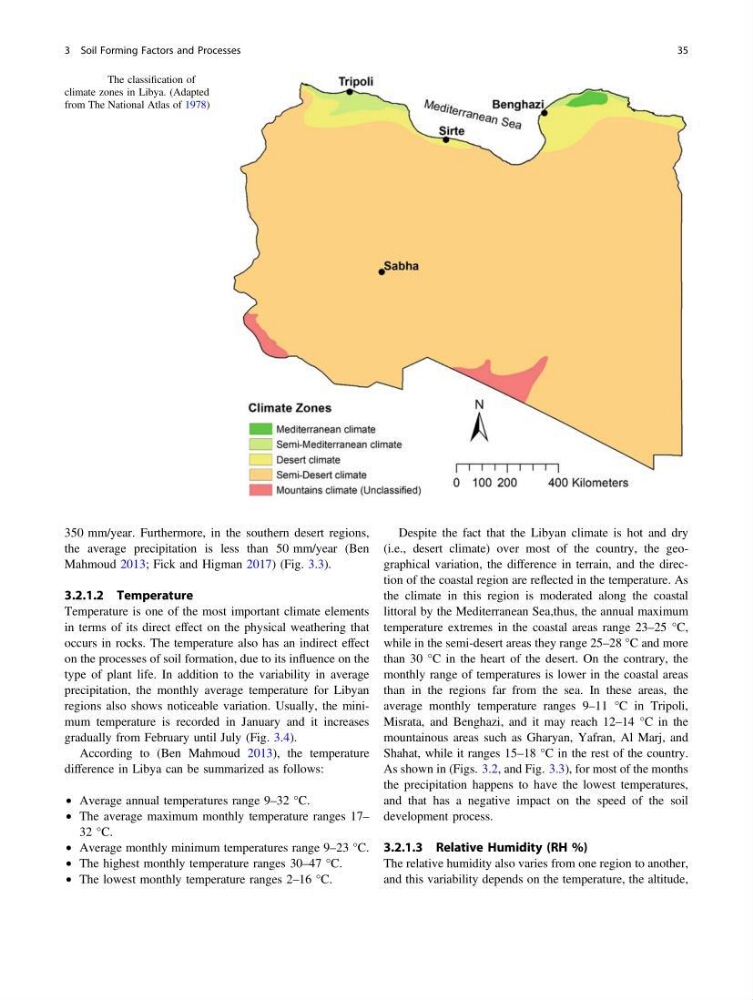
As shown in (Figs. 3.2, and Fig. 3.3), for most of the months
the precipitation happens to have the lowest temperatures,
and that has a negative impact on the speed of the soil
development process.
3.2.1.3 Relative Humidity (RH %)
The relative humidity also varies from one region to another,
and this variability depends on the temperature, the altitude,
Fig. 3.2 The classification of
climate zones in Libya. (Adapted
from The National Atlas of 1978)
3 Soil Forming Factors and Processes
35
the average precipitation is less than 50 mm/year (Ben
Mahmoud 2013; Fick and Higman 2017) (Fig. 3.3).
3.2.1.2 Temperature
Temperature is one of the most important climate elements
in terms of its direct effect on the physical weathering that
occurs in rocks. The temperature also has an indirect effect
on the processes of soil formation, due to its influence on the
type of plant life. In addition to the variability in average
precipitation, the monthly average temperature for Libyan
regions also shows noticeable variation. Usually, the minimum temperature is recorded in January and it increases
gradually from February until July (Fig. 3.4).
According to (Ben Mahmoud 2013), the temperature
difference in Libya can be summarized as follows:
• Average annual temperatures range 9–32 °C.
• The average maximum monthly temperature ranges 17–
32 °C.
• Average monthly minimum temperatures range 9–23 °C.
• The highest monthly temperature ranges 30–47 °C.
• The lowest monthly temperature ranges 2–16 °C.
Despite the fact that the Libyan climate is hot and dry
(i.e., desert climate) over most of the country, the geographical variation, the difference in terrain, and the direction of the coastal region are reflected in the temperature. As
the climate in this region is moderated along the coastal
littoral by the Mediterranean Sea,thus, the annual maximum
temperature extremes in the coastal areas range 23–25 °C,
while in the semi-desert areas they range 25–28 °C and more
than 30 °C in the heart of the desert. On the contrary, the
monthly range of temperatures is lower in the coastal areas
than in the regions far from the sea. In these areas, the
average monthly temperature ranges 9–11 °C in Tripoli,
Misrata, and Benghazi, and it may reach 12–14 °C in the
mountainous areas such as Gharyan, Yafran, Al Marj, and
Shahat, while it ranges 15–18 °C in the rest of the country.
As shown in (Figs. 3.2, and Fig. 3.3), for most of the months
the precipitation happens to have the lowest temperatures,
and that has a negative impact on the speed of the soil
development process.
3.2.1.3 Relative Humidity (RH %)
The relative humidity also varies from one region to another,
and this variability depends on the temperature, the altitude,
Fig. 3.2 The classification of
climate zones in Libya. (Adapted
from The National Atlas of 1978)
3 Soil Forming Factors and Processes
35