

The isolates of rhizobia from saline regions were not more
resistant than isolates from non-saline regions; the resistivity
of salinity is not related to plant or isolation site but is considered characteristic associated to rhizobia. Tolerance to
salinity can give rhizobial isolates the advantage of endemism
and reproduction in saline soils, but the formation of nodules
and nitrogen fixation depends on the type of legume plant.
The most salt-tolerant plants can have a symbiotic relationship
with rhizobia and with nitrogen fixation. Some strains may be
candidates for selection to inoculate legumes in saline soils if
their ability to fix nitrogen under saline stress and develop
salinity tolerant plants is proven. It is noted from the results
that the tolerance of isolates to salinity is higher than that
which allows the formation of symbiosis, and this is due to
the sensitivity of the symbiosis process to saline stress.
Some strains of rhizobia not only have a symbiotic
relationship with leguminous plants but also have an ability
to produce enzymes. Like any other living organisms,
rhizobia must be able to perform a set of chemical reactions
to continue to survive, grow, and multiply. These interactions are carried out by enzymes in sequential reactions
known as nutritional metabolism.
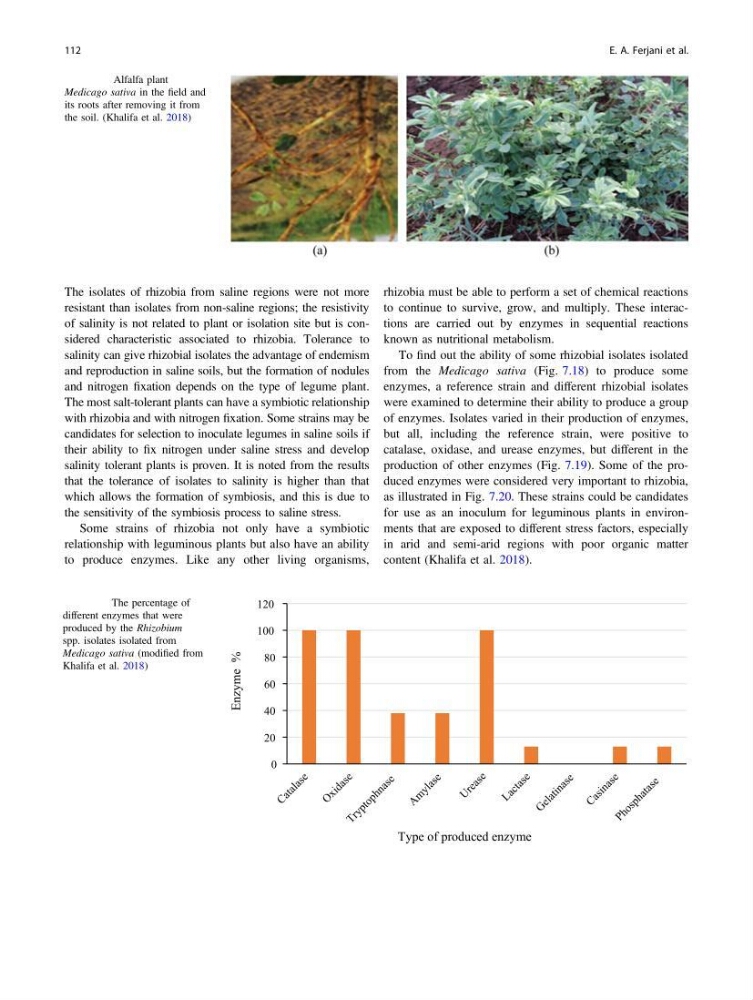
To find out the ability of some rhizobial isolates isolated
from the Medicago sativa (Fig. 7.18) to produce some
enzymes, a reference strain and different rhizobial isolates
were examined to determine their ability to produce a group
of enzymes. Isolates varied in their production of enzymes,
but all, including the reference strain, were positive to
catalase, oxidase, and urease enzymes, but different in the
production of other enzymes (Fig. 7.19). Some of the produced enzymes were considered very important to rhizobia,
as illustrated in Fig. 7.20. These strains could be candidates
for use as an inoculum for leguminous plants in environments that are exposed to different stress factors, especially
in arid and semi-arid regions with poor organic matter
content (Khalifa et al. 2018).
Fig. 7.18 Alfalfa plant
Medicago sativa in the field and
its roots after removing it from
the soil. (Khalifa et al. 2018)
0
20
40
60
80
100
120
Enzyme %
Type of produced enzyme
Fig. 7.19 The percentage of
different enzymes that were
produced by the Rhizobium
spp. isolates isolated from
Medicago sativa (modified from
Khalifa et al. 2018)
112
E. A. Ferjani et al.
resistant than isolates from non-saline regions; the resistivity
of salinity is not related to plant or isolation site but is considered characteristic associated to rhizobia. Tolerance to
salinity can give rhizobial isolates the advantage of endemism
and reproduction in saline soils, but the formation of nodules
and nitrogen fixation depends on the type of legume plant.
The most salt-tolerant plants can have a symbiotic relationship
with rhizobia and with nitrogen fixation. Some strains may be
candidates for selection to inoculate legumes in saline soils if
their ability to fix nitrogen under saline stress and develop
salinity tolerant plants is proven. It is noted from the results
that the tolerance of isolates to salinity is higher than that
which allows the formation of symbiosis, and this is due to
the sensitivity of the symbiosis process to saline stress.
Some strains of rhizobia not only have a symbiotic
relationship with leguminous plants but also have an ability
to produce enzymes. Like any other living organisms,
rhizobia must be able to perform a set of chemical reactions
to continue to survive, grow, and multiply. These interactions are carried out by enzymes in sequential reactions
known as nutritional metabolism.
To find out the ability of some rhizobial isolates isolated
from the Medicago sativa (Fig. 7.18) to produce some
enzymes, a reference strain and different rhizobial isolates
were examined to determine their ability to produce a group
of enzymes. Isolates varied in their production of enzymes,
but all, including the reference strain, were positive to
catalase, oxidase, and urease enzymes, but different in the
production of other enzymes (Fig. 7.19). Some of the produced enzymes were considered very important to rhizobia,
as illustrated in Fig. 7.20. These strains could be candidates
for use as an inoculum for leguminous plants in environments that are exposed to different stress factors, especially
in arid and semi-arid regions with poor organic matter
content (Khalifa et al. 2018).
Fig. 7.18 Alfalfa plant
Medicago sativa in the field and
its roots after removing it from
the soil. (Khalifa et al. 2018)
0
20
40
60
80
100
120
Enzyme %
Type of produced enzyme
Fig. 7.19 The percentage of
different enzymes that were
produced by the Rhizobium
spp. isolates isolated from
Medicago sativa (modified from
Khalifa et al. 2018)
112
E. A. Ferjani et al.