

another. This is especially true of the pathogens, which
increases the transmission of infection. From this standpoint,
several studies have gone into revealing the extent of
infection of seeds with pathogenic fungi and have searched
for ways to treat fungal infections with chemical and biological control.
Local leguminous seeds collected from different sites of
Al Jabal Al Akhdar were tested for infection by pathogenic
fungi accompanied with seeds. Fungal isolation from seed
specimens represent infection of all tested seeds, with 18
different fungal species illustrated in Table 7.3.
Another study was carried out as an attempt for isolation
and testing the pathogenicity of pathogenic fungi carried on
some chickpea cultivars growing at Al Jabal Al Akhdar
(Abdallah 2006). Twelve species of fungi (Aspergillus ustus,
A. candidus, A. niger, Cladosporium sp., Chaetomium bostrychodes, Fusarium oxysporum, Phomopsis sp., Penicillium
frequentans, Pythium ultimum, Thielaviopsis sp., Rhizopus
sp., and Rhizoctonia sp.) were isolated from seeds samples.
Pathogenicity was tested for isolated fungi on their hosts
using a percentage of pre- and post-emergence damping off
disease index (Fig. 7.1). The highest percentage of
pathogenicity was recorded for Fusarium oxysporum and
Penicillium frequentans.
Isolation and identification of fungi associated with food
grains were carried out on 20 food grains including cereals
(wheat, barley, corn, sorghum, fenugreek, millet); legumes
(pea, peanut, chickpea, faba bean, kidney bean, cowpea, red
and green lentil); oil-producing seeds (walnut, almond,
hazelnut, sesame, pistachio); and two animal feeds (diet and
ration) obtained from local markets during 2003–2006 in Al
Bayda, Libya. Ten fungal genera were isolated; 20 species
and two strains of Saccharomyces cerevisiae were isolated
and identified. These species were Aspergillus flavus, A.
ochraceus, A. terreus, A. niger, A. candidus, A. clavatus, A.
fumigatus, Penicillium chrysogenum, P. canescens,
P. waksmanii, Fusarium oxysporum, F. graminearum, F.
sporotrichioides, Rhizopus stolonifer, Mucor piriformis,
Alternaria tenuissima, Rhizoctonia solani, Pythium ultimum,
Phyllactinia rigida, and Saccharomyces cerevisiae. The
percentage of some fungal contamination is illustrated in
Fig. 7.2.
The Bayoud disease caused by Fusarium oxysporum, f.
sp. albedinis of the date palm tree is one of the most dangerous diseases in the world and is difficult to control. It has
now spread in some countries of North Africa. In the frame
of a regional project on Bayoud disease of date palm in 15
Arab countries, results showed that nearly all Arab soils
present high to middle levels of receptivity to the fungus and
that some soils are important, for example soil of Al Ghamr
in Libya. This research gives an idea, not about the disease
spread, but it permits us to imagine the map of spread risk of
the disease according to counties that are still free and
threatened by the contamination (Sedra 2010).
Chemical control of Fusarium solani isolated from Local
Bean was treated by using five fungicides: Roveral, Rizolex,
Vitavax, Benlate, and Cabtan. Results (Table 7.4) indicated
that fungal growth was completely inhibited after 192 hours
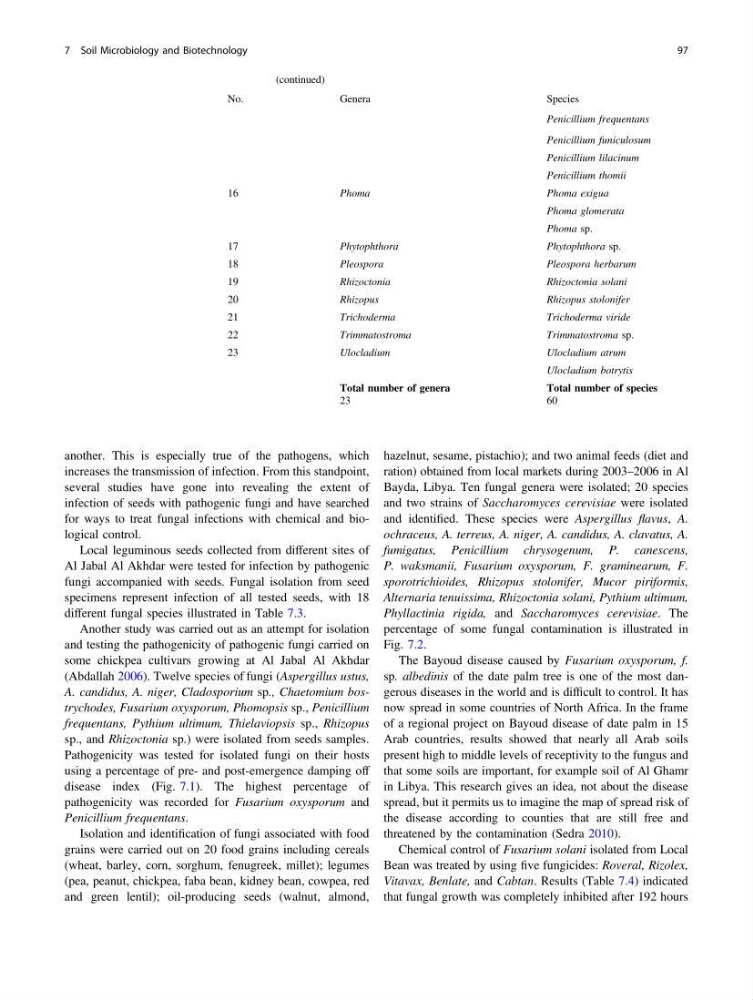
Table 7.2 (continued)
No.
Genera
Species
Penicillium frequentans
Penicillium funiculosum
Penicillium lilacinum
Penicillium thomii
16
Phoma
Phoma exigua
Phoma glomerata
Phoma sp.
17
Phytophthora
Phytophthora sp.
18
Pleospora
Pleospora herbarum
19
Rhizoctonia
Rhizoctonia solani
20
Rhizopus
Rhizopus stolonifer
21
Trichoderma
Trichoderma viride
22
Trimmatostroma
Trimmatostroma sp.
23
Ulocladium
Ulocladium atrum
Ulocladium botrytis
Total number of genera
23
Total number of species
60
7 Soil Microbiology and Biotechnology
97
increases the transmission of infection. From this standpoint,
several studies have gone into revealing the extent of
infection of seeds with pathogenic fungi and have searched
for ways to treat fungal infections with chemical and biological control.
Local leguminous seeds collected from different sites of
Al Jabal Al Akhdar were tested for infection by pathogenic
fungi accompanied with seeds. Fungal isolation from seed
specimens represent infection of all tested seeds, with 18
different fungal species illustrated in Table 7.3.
Another study was carried out as an attempt for isolation
and testing the pathogenicity of pathogenic fungi carried on
some chickpea cultivars growing at Al Jabal Al Akhdar
(Abdallah 2006). Twelve species of fungi (Aspergillus ustus,
A. candidus, A. niger, Cladosporium sp., Chaetomium bostrychodes, Fusarium oxysporum, Phomopsis sp., Penicillium
frequentans, Pythium ultimum, Thielaviopsis sp., Rhizopus
sp., and Rhizoctonia sp.) were isolated from seeds samples.
Pathogenicity was tested for isolated fungi on their hosts
using a percentage of pre- and post-emergence damping off
disease index (Fig. 7.1). The highest percentage of
pathogenicity was recorded for Fusarium oxysporum and
Penicillium frequentans.
Isolation and identification of fungi associated with food
grains were carried out on 20 food grains including cereals
(wheat, barley, corn, sorghum, fenugreek, millet); legumes
(pea, peanut, chickpea, faba bean, kidney bean, cowpea, red
and green lentil); oil-producing seeds (walnut, almond,
hazelnut, sesame, pistachio); and two animal feeds (diet and
ration) obtained from local markets during 2003–2006 in Al
Bayda, Libya. Ten fungal genera were isolated; 20 species
and two strains of Saccharomyces cerevisiae were isolated
and identified. These species were Aspergillus flavus, A.
ochraceus, A. terreus, A. niger, A. candidus, A. clavatus, A.
fumigatus, Penicillium chrysogenum, P. canescens,
P. waksmanii, Fusarium oxysporum, F. graminearum, F.
sporotrichioides, Rhizopus stolonifer, Mucor piriformis,
Alternaria tenuissima, Rhizoctonia solani, Pythium ultimum,
Phyllactinia rigida, and Saccharomyces cerevisiae. The
percentage of some fungal contamination is illustrated in
Fig. 7.2.
The Bayoud disease caused by Fusarium oxysporum, f.
sp. albedinis of the date palm tree is one of the most dangerous diseases in the world and is difficult to control. It has
now spread in some countries of North Africa. In the frame
of a regional project on Bayoud disease of date palm in 15
Arab countries, results showed that nearly all Arab soils
present high to middle levels of receptivity to the fungus and
that some soils are important, for example soil of Al Ghamr
in Libya. This research gives an idea, not about the disease
spread, but it permits us to imagine the map of spread risk of
the disease according to counties that are still free and
threatened by the contamination (Sedra 2010).
Chemical control of Fusarium solani isolated from Local
Bean was treated by using five fungicides: Roveral, Rizolex,
Vitavax, Benlate, and Cabtan. Results (Table 7.4) indicated
that fungal growth was completely inhibited after 192 hours
Table 7.2 (continued)
No.
Genera
Species
Penicillium frequentans
Penicillium funiculosum
Penicillium lilacinum
Penicillium thomii
16
Phoma
Phoma exigua
Phoma glomerata
Phoma sp.
17
Phytophthora
Phytophthora sp.
18
Pleospora
Pleospora herbarum
19
Rhizoctonia
Rhizoctonia solani
20
Rhizopus
Rhizopus stolonifer
21
Trichoderma
Trichoderma viride
22
Trimmatostroma
Trimmatostroma sp.
23
Ulocladium
Ulocladium atrum
Ulocladium botrytis
Total number of genera
23
Total number of species
60
7 Soil Microbiology and Biotechnology
97