

due to the advancement of peat decomposition is suggested
to follow the modified method proposed by Kaila (1956),
which is an index based on the extraction by the shaking of
peat samples in 0.025 M sodium pyrophosphate solution
overnight and measuring the absorbance of centrifuged and
filtered extracts at 340 and 550 nm (Kondo and Endo 1993).
The degree of decomposition and humification of peat
increases from High-moor Peat soil to Transitional Peat soil
and to Low-moor Peat soil in Hokkaido, when their
physicochemical characteristics and the degree of decomposition are compared (Kondo 1997). Following the same
sequence, ash and total nitrogen (N) contents also increase,
while total carbon (C) and C:N ratio decrease (Table 4.1).
The formation of Low-moor Peat soil occurs under eutrophic
conditions with the supply of surface water and groundwater
recharge and is strongly influenced by the addition of
incoming inorganic materials, leading to high N and ash
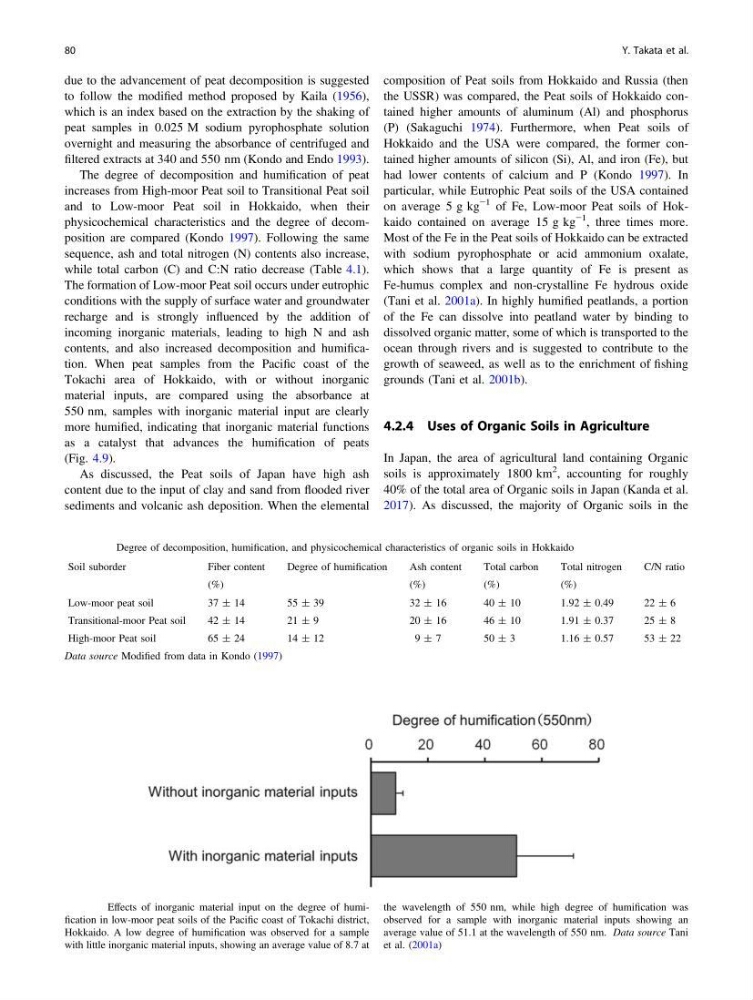
contents, and also increased decomposition and humification. When peat samples from the Pacific coast of the
Tokachi area of Hokkaido, with or without inorganic
material inputs, are compared using the absorbance at
550 nm, samples with inorganic material input are clearly
more humified, indicating that inorganic material functions
as a catalyst that advances the humification of peats
(Fig. 4.9).
As discussed, the Peat soils of Japan have high ash
content due to the input of clay and sand from flooded river
sediments and volcanic ash deposition. When the elemental
composition of Peat soils from Hokkaido and Russia (then
the USSR) was compared, the Peat soils of Hokkaido contained higher amounts of aluminum (Al) and phosphorus
(P) (Sakaguchi 1974). Furthermore, when Peat soils of
Hokkaido and the USA were compared, the former contained higher amounts of silicon (Si), Al, and iron (Fe), but
had lower contents of calcium and P (Kondo 1997). In
particular, while Eutrophic Peat soils of the USA contained
on average 5 g kg
−1 of Fe, Low-moor Peat soils of Hokkaido contained on average 15 g kg
−1 , three times more.
Most of the Fe in the Peat soils of Hokkaido can be extracted
with sodium pyrophosphate or acid ammonium oxalate,
which shows that a large quantity of Fe is present as
Fe-humus complex and non-crystalline Fe hydrous oxide
(Tani et al. 2001a). In highly humified peatlands, a portion
of the Fe can dissolve into peatland water by binding to
dissolved organic matter, some of which is transported to the
ocean through rivers and is suggested to contribute to the
growth of seaweed, as well as to the enrichment of fishing
grounds (Tani et al. 2001b).
4.2.4 Uses of Organic Soils in Agriculture
In Japan, the area of agricultural land containing Organic
soils is approximately 1800 km
2 , accounting for roughly
40% of the total area of Organic soils in Japan (Kanda et al.
2017). As discussed, the majority of Organic soils in the
Table 4.1 Degree of decomposition, humification, and physicochemical characteristics of organic soils in Hokkaido
Soil suborder
Fiber content
Degree of humification
Ash content
Total carbon
Total nitrogen
C/N ratio
(%)
(%)
(%)
(%)
Low-moor peat soil
37 ± 14
55 ± 39
32 ± 16
40 ± 10
1.92 ± 0.49
22 ± 6
Transitional-moor Peat soil
42 ± 14
21 ± 9
2 0 ± 16
46 ± 10
1.91 ± 0.37
25 ± 8
High-moor Peat soil
65 ± 24
14 ± 12
9 ± 7
5 0± 3
1.16 ± 0.57
53 ± 22
Data source Modified from data in Kondo (1997)
Fig. 4.9 Effects of inorganic material input on the degree of humification in low-moor peat soils of the Pacific coast of Tokachi district,
Hokkaido. A low degree of humification was observed for a sample
with little inorganic material inputs, showing an average value of 8.7 at
the wavelength of 550 nm, while high degree of humification was
observed for a sample with inorganic material inputs showing an
average value of 51.1 at the wavelength of 550 nm. Data source Tani
et al. (2001a)
80
Y. Takata et al.
to follow the modified method proposed by Kaila (1956),
which is an index based on the extraction by the shaking of
peat samples in 0.025 M sodium pyrophosphate solution
overnight and measuring the absorbance of centrifuged and
filtered extracts at 340 and 550 nm (Kondo and Endo 1993).
The degree of decomposition and humification of peat
increases from High-moor Peat soil to Transitional Peat soil
and to Low-moor Peat soil in Hokkaido, when their
physicochemical characteristics and the degree of decomposition are compared (Kondo 1997). Following the same
sequence, ash and total nitrogen (N) contents also increase,
while total carbon (C) and C:N ratio decrease (Table 4.1).
The formation of Low-moor Peat soil occurs under eutrophic
conditions with the supply of surface water and groundwater
recharge and is strongly influenced by the addition of
incoming inorganic materials, leading to high N and ash
contents, and also increased decomposition and humification. When peat samples from the Pacific coast of the
Tokachi area of Hokkaido, with or without inorganic
material inputs, are compared using the absorbance at
550 nm, samples with inorganic material input are clearly
more humified, indicating that inorganic material functions
as a catalyst that advances the humification of peats
(Fig. 4.9).
As discussed, the Peat soils of Japan have high ash
content due to the input of clay and sand from flooded river
sediments and volcanic ash deposition. When the elemental
composition of Peat soils from Hokkaido and Russia (then
the USSR) was compared, the Peat soils of Hokkaido contained higher amounts of aluminum (Al) and phosphorus
(P) (Sakaguchi 1974). Furthermore, when Peat soils of
Hokkaido and the USA were compared, the former contained higher amounts of silicon (Si), Al, and iron (Fe), but
had lower contents of calcium and P (Kondo 1997). In
particular, while Eutrophic Peat soils of the USA contained
on average 5 g kg
−1 of Fe, Low-moor Peat soils of Hokkaido contained on average 15 g kg
−1 , three times more.
Most of the Fe in the Peat soils of Hokkaido can be extracted
with sodium pyrophosphate or acid ammonium oxalate,
which shows that a large quantity of Fe is present as
Fe-humus complex and non-crystalline Fe hydrous oxide
(Tani et al. 2001a). In highly humified peatlands, a portion
of the Fe can dissolve into peatland water by binding to
dissolved organic matter, some of which is transported to the
ocean through rivers and is suggested to contribute to the
growth of seaweed, as well as to the enrichment of fishing
grounds (Tani et al. 2001b).
4.2.4 Uses of Organic Soils in Agriculture
In Japan, the area of agricultural land containing Organic
soils is approximately 1800 km
2 , accounting for roughly
40% of the total area of Organic soils in Japan (Kanda et al.
2017). As discussed, the majority of Organic soils in the
Table 4.1 Degree of decomposition, humification, and physicochemical characteristics of organic soils in Hokkaido
Soil suborder
Fiber content
Degree of humification
Ash content
Total carbon
Total nitrogen
C/N ratio
(%)
(%)
(%)
(%)
Low-moor peat soil
37 ± 14
55 ± 39
32 ± 16
40 ± 10
1.92 ± 0.49
22 ± 6
Transitional-moor Peat soil
42 ± 14
21 ± 9
2 0 ± 16
46 ± 10
1.91 ± 0.37
25 ± 8
High-moor Peat soil
65 ± 24
14 ± 12
9 ± 7
5 0± 3
1.16 ± 0.57
53 ± 22
Data source Modified from data in Kondo (1997)
Fig. 4.9 Effects of inorganic material input on the degree of humification in low-moor peat soils of the Pacific coast of Tokachi district,
Hokkaido. A low degree of humification was observed for a sample
with little inorganic material inputs, showing an average value of 8.7 at
the wavelength of 550 nm, while high degree of humification was
observed for a sample with inorganic material inputs showing an
average value of 51.1 at the wavelength of 550 nm. Data source Tani
et al. (2001a)
80
Y. Takata et al.