

4.2.2 Distribution and Formation of Organic
Soils in Japan
In Japan, Organic soils cover approximately 4400 km
2 and
account for roughly 1.2% of the land area. The majority of
the Organic soils are found in the Hokkaido and Tohoku
regions of Northern Japan, where the climate is relatively
cool. These soils are rare in the Kyushu and Shikoku regions
of Western Japan, where the climate is warm (Obara et al.
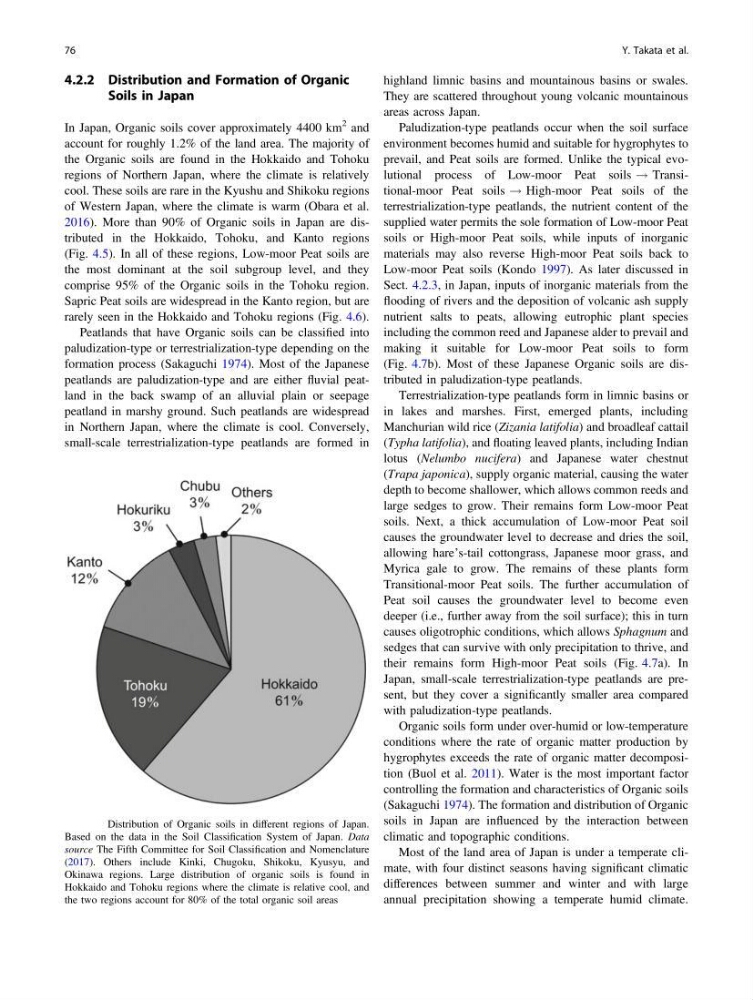
2016). More than 90% of Organic soils in Japan are distributed in the Hokkaido, Tohoku, and Kanto regions
(Fig. 4.5). In all of these regions, Low-moor Peat soils are
the most dominant at the soil subgroup level, and they
comprise 95% of the Organic soils in the Tohoku region.
Sapric Peat soils are widespread in the Kanto region, but are
rarely seen in the Hokkaido and Tohoku regions (Fig. 4.6).
Peatlands that have Organic soils can be classified into
paludization-type or terrestrialization-type depending on the
formation process (Sakaguchi 1974). Most of the Japanese
peatlands are paludization-type and are either fluvial peatland in the back swamp of an alluvial plain or seepage
peatland in marshy ground. Such peatlands are widespread
in Northern Japan, where the climate is cool. Conversely,
small-scale terrestrialization-type peatlands are formed in
highland limnic basins and mountainous basins or swales.
They are scattered throughout young volcanic mountainous
areas across Japan.
Paludization-type peatlands occur when the soil surface
environment becomes humid and suitable for hygrophytes to
prevail, and Peat soils are formed. Unlike the typical evolutional process of Low-moor Peat soils ! Transitional-moor Peat soils ! High-moor Peat soils of the
terrestrialization-type peatlands, the nutrient content of the
supplied water permits the sole formation of Low-moor Peat
soils or High-moor Peat soils, while inputs of inorganic
materials may also reverse High-moor Peat soils back to
Low-moor Peat soils (Kondo 1997). As later discussed in
Sect. 4.2.3, in Japan, inputs of inorganic materials from the
flooding of rivers and the deposition of volcanic ash supply
nutrient salts to peats, allowing eutrophic plant species
including the common reed and Japanese alder to prevail and
making it suitable for Low-moor Peat soils to form
(Fig. 4.7b). Most of these Japanese Organic soils are distributed in paludization-type peatlands.
Terrestrialization-type peatlands form in limnic basins or
in lakes and marshes. First, emerged plants, including
Manchurian wild rice (Zizania latifolia) and broadleaf cattail
(Typha latifolia), and floating leaved plants, including Indian
lotus (Nelumbo nucifera) and Japanese water chestnut
(Trapa japonica), supply organic material, causing the water
depth to become shallower, which allows common reeds and
large sedges to grow. Their remains form Low-moor Peat
soils. Next, a thick accumulation of Low-moor Peat soil
causes the groundwater level to decrease and dries the soil,
allowing hare’s-tail cottongrass, Japanese moor grass, and
Myrica gale to grow. The remains of these plants form
Transitional-moor Peat soils. The further accumulation of
Peat soil causes the groundwater level to become even
deeper (i.e., further away from the soil surface); this in turn
causes oligotrophic conditions, which allows Sphagnum and
sedges that can survive with only precipitation to thrive, and
their remains form High-moor Peat soils (Fig. 4.7a). In
Japan, small-scale terrestrialization-type peatlands are present, but they cover a significantly smaller area compared
with paludization-type peatlands.
Organic soils form under over-humid or low-temperature
conditions where the rate of organic matter production by
hygrophytes exceeds the rate of organic matter decomposition (Buol et al. 2011). Water is the most important factor
controlling the formation and characteristics of Organic soils
(Sakaguchi 1974). The formation and distribution of Organic
soils in Japan are influenced by the interaction between
climatic and topographic conditions.
Most of the land area of Japan is under a temperate climate, with four distinct seasons having significant climatic
differences between summer and winter and with large
annual precipitation showing a temperate humid climate.
Fig. 4.5 Distribution of Organic soils in different regions of Japan.
Based on the data in the Soil Classification System of Japan. Data
source The Fifth Committee for Soil Classification and Nomenclature
(2017). Others include Kinki, Chugoku, Shikoku, Kyusyu, and
Okinawa regions. Large distribution of organic soils is found in
Hokkaido and Tohoku regions where the climate is relative cool, and
the two regions account for 80% of the total organic soil areas
76
Y. Takata et al.
Soils in Japan
In Japan, Organic soils cover approximately 4400 km
2 and
account for roughly 1.2% of the land area. The majority of
the Organic soils are found in the Hokkaido and Tohoku
regions of Northern Japan, where the climate is relatively
cool. These soils are rare in the Kyushu and Shikoku regions
of Western Japan, where the climate is warm (Obara et al.
2016). More than 90% of Organic soils in Japan are distributed in the Hokkaido, Tohoku, and Kanto regions
(Fig. 4.5). In all of these regions, Low-moor Peat soils are
the most dominant at the soil subgroup level, and they
comprise 95% of the Organic soils in the Tohoku region.
Sapric Peat soils are widespread in the Kanto region, but are
rarely seen in the Hokkaido and Tohoku regions (Fig. 4.6).
Peatlands that have Organic soils can be classified into
paludization-type or terrestrialization-type depending on the
formation process (Sakaguchi 1974). Most of the Japanese
peatlands are paludization-type and are either fluvial peatland in the back swamp of an alluvial plain or seepage
peatland in marshy ground. Such peatlands are widespread
in Northern Japan, where the climate is cool. Conversely,
small-scale terrestrialization-type peatlands are formed in
highland limnic basins and mountainous basins or swales.
They are scattered throughout young volcanic mountainous
areas across Japan.
Paludization-type peatlands occur when the soil surface
environment becomes humid and suitable for hygrophytes to
prevail, and Peat soils are formed. Unlike the typical evolutional process of Low-moor Peat soils ! Transitional-moor Peat soils ! High-moor Peat soils of the
terrestrialization-type peatlands, the nutrient content of the
supplied water permits the sole formation of Low-moor Peat
soils or High-moor Peat soils, while inputs of inorganic
materials may also reverse High-moor Peat soils back to
Low-moor Peat soils (Kondo 1997). As later discussed in
Sect. 4.2.3, in Japan, inputs of inorganic materials from the
flooding of rivers and the deposition of volcanic ash supply
nutrient salts to peats, allowing eutrophic plant species
including the common reed and Japanese alder to prevail and
making it suitable for Low-moor Peat soils to form
(Fig. 4.7b). Most of these Japanese Organic soils are distributed in paludization-type peatlands.
Terrestrialization-type peatlands form in limnic basins or
in lakes and marshes. First, emerged plants, including
Manchurian wild rice (Zizania latifolia) and broadleaf cattail
(Typha latifolia), and floating leaved plants, including Indian
lotus (Nelumbo nucifera) and Japanese water chestnut
(Trapa japonica), supply organic material, causing the water
depth to become shallower, which allows common reeds and
large sedges to grow. Their remains form Low-moor Peat
soils. Next, a thick accumulation of Low-moor Peat soil
causes the groundwater level to decrease and dries the soil,
allowing hare’s-tail cottongrass, Japanese moor grass, and
Myrica gale to grow. The remains of these plants form
Transitional-moor Peat soils. The further accumulation of
Peat soil causes the groundwater level to become even
deeper (i.e., further away from the soil surface); this in turn
causes oligotrophic conditions, which allows Sphagnum and
sedges that can survive with only precipitation to thrive, and
their remains form High-moor Peat soils (Fig. 4.7a). In
Japan, small-scale terrestrialization-type peatlands are present, but they cover a significantly smaller area compared
with paludization-type peatlands.
Organic soils form under over-humid or low-temperature
conditions where the rate of organic matter production by
hygrophytes exceeds the rate of organic matter decomposition (Buol et al. 2011). Water is the most important factor
controlling the formation and characteristics of Organic soils
(Sakaguchi 1974). The formation and distribution of Organic
soils in Japan are influenced by the interaction between
climatic and topographic conditions.
Most of the land area of Japan is under a temperate climate, with four distinct seasons having significant climatic
differences between summer and winter and with large
annual precipitation showing a temperate humid climate.
Fig. 4.5 Distribution of Organic soils in different regions of Japan.
Based on the data in the Soil Classification System of Japan. Data
source The Fifth Committee for Soil Classification and Nomenclature
(2017). Others include Kinki, Chugoku, Shikoku, Kyusyu, and
Okinawa regions. Large distribution of organic soils is found in
Hokkaido and Tohoku regions where the climate is relative cool, and
the two regions account for 80% of the total organic soil areas
76
Y. Takata et al.