

The gentan policy was continued for over 40 years, though
it was abolished in 2018. Under the gentan policy, many
paddy fields were converted to upland field, and some of
them were used as paddy–upland rotational fields.
The area of upland fields was 2.69 million ha in 1960 and
2.04 million ha in 2016. The production of upland crops
(vegetables and other in Fig. 2.31) was 3.6 trillion yen
(equal to 39% of all agricultural production). The growing
areas (in ha) for major upland crops in 2016 were as follows:
276,000 for wheat and barley, 150,000 for soybean, 77,000
for potato, 36,000 for sweet potato, 32,000 for radish,
18,000 for carrot, 26,000 for onion, 35,000 for cabbage and
24,000 for sweet corn. Some upland crops, especially wheat,
barley and soybean, are also widely cultivated in converted
paddy fields as alternatives to rice.
In livestock farming, headages for dairy cattle, beef cattle,
swine, laying hen and broiler chicken in 2016 were 1.345
million, 2.479 million, 9.313 million, 173.3 million and
134.4 million, respectively. Related to livestock, and especially to cattle, the growing areas for pasture grass and maize
in 2016 were 744,000 and 94,000 ha, respectively. In
orchards, the growing area of mikan (Citrus unshiu; satsuma
mandarin) and apple in 2016 was 44,000 and 38,000 ha,
respectively. The growing areas of grape, chestnut and
persimmon were each around 20,000 ha, while that of tea
fields was 43,000 ha.
The food self-sufficiency ratio of Japan was 78% in 1961.
This gradually decreased during the latter part of the twentieth century and has hovered around 40% in the twenty-first
century. This ratio is very low among industrialized nations
and similar to that of the Republic of Korea.
(2) Cultivated fields and soils
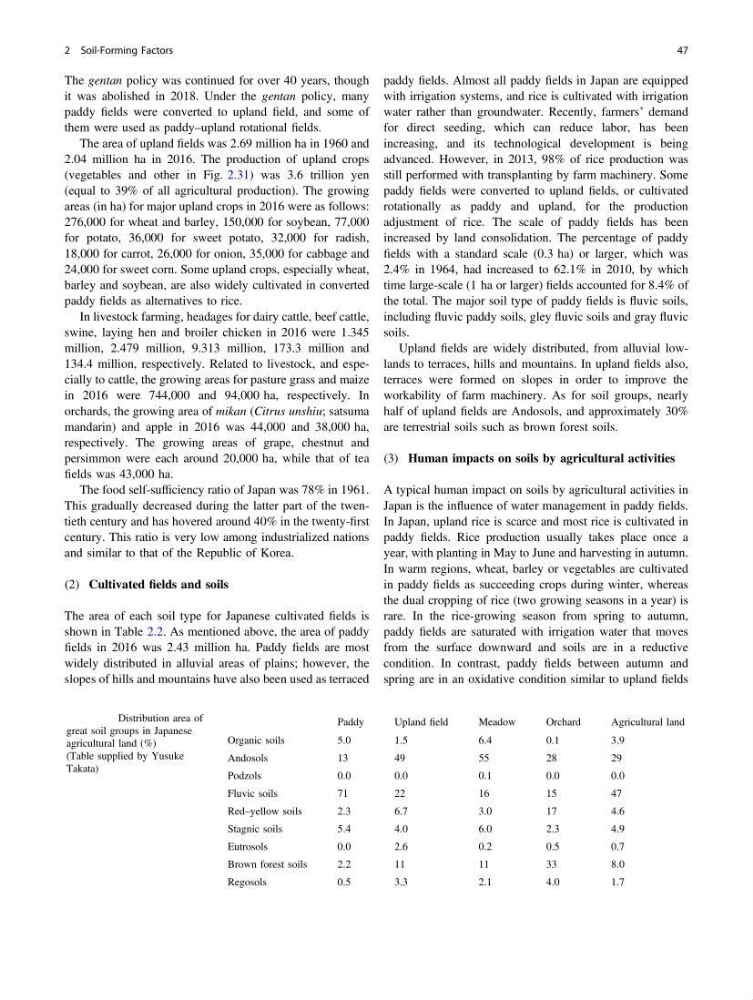
The area of each soil type for Japanese cultivated fields is
shown in Table 2.2. As mentioned above, the area of paddy
fields in 2016 was 2.43 million ha. Paddy fields are most
widely distributed in alluvial areas of plains; however, the
slopes of hills and mountains have also been used as terraced
paddy fields. Almost all paddy fields in Japan are equipped
with irrigation systems, and rice is cultivated with irrigation
water rather than groundwater. Recently, farmers’ demand
for direct seeding, which can reduce labor, has been
increasing, and its technological development is being
advanced. However, in 2013, 98% of rice production was
still performed with transplanting by farm machinery. Some
paddy fields were converted to upland fields, or cultivated
rotationally as paddy and upland, for the production
adjustment of rice. The scale of paddy fields has been
increased by land consolidation. The percentage of paddy
fields with a standard scale (0.3 ha) or larger, which was
2.4% in 1964, had increased to 62.1% in 2010, by which
time large-scale (1 ha or larger) fields accounted for 8.4% of
the total. The major soil type of paddy fields is fluvic soils,
including fluvic paddy soils, gley fluvic soils and gray fluvic
soils.
Upland fields are widely distributed, from alluvial lowlands to terraces, hills and mountains. In upland fields also,
terraces were formed on slopes in order to improve the
workability of farm machinery. As for soil groups, nearly
half of upland fields are Andosols, and approximately 30%
are terrestrial soils such as brown forest soils.
(3) Human impacts on soils by agricultural activities
A typical human impact on soils by agricultural activities in
Japan is the influence of water management in paddy fields.
In Japan, upland rice is scarce and most rice is cultivated in
paddy fields. Rice production usually takes place once a
year, with planting in May to June and harvesting in autumn.
In warm regions, wheat, barley or vegetables are cultivated
in paddy fields as succeeding crops during winter, whereas
the dual cropping of rice (two growing seasons in a year) is
rare. In the rice-growing season from spring to autumn,
paddy fields are saturated with irrigation water that moves
from the surface downward and soils are in a reductive
condition. In contrast, paddy fields between autumn and
spring are in an oxidative condition similar to upland fields
Table 2.2 Distribution area of
great soil groups in Japanese
agricultural land (%)
(Table supplied by Yusuke
Takata)
Paddy
Upland field
Meadow
Orchard
Agricultural land
Organic soils
5.0
1.5
6.4
0.1
3.9
Andosols
13
49
55
28
29
Podzols
0.0
0.0
0.1
0.0
0.0
Fluvic soils
71
22
16
15
47
Red–yellow soils
2.3
6.7
3.0
17
4.6
Stagnic soils
5.4
4.0
6.0
2.3
4.9
Eutrosols
0.0
2.6
0.2
0.5
0.7
Brown forest soils
2.2
11
11
33
8.0
Regosols
0.5
3.3
2.1
4.0
1.7
2 Soil-Forming Factors
47
it was abolished in 2018. Under the gentan policy, many
paddy fields were converted to upland field, and some of
them were used as paddy–upland rotational fields.
The area of upland fields was 2.69 million ha in 1960 and
2.04 million ha in 2016. The production of upland crops
(vegetables and other in Fig. 2.31) was 3.6 trillion yen
(equal to 39% of all agricultural production). The growing
areas (in ha) for major upland crops in 2016 were as follows:
276,000 for wheat and barley, 150,000 for soybean, 77,000
for potato, 36,000 for sweet potato, 32,000 for radish,
18,000 for carrot, 26,000 for onion, 35,000 for cabbage and
24,000 for sweet corn. Some upland crops, especially wheat,
barley and soybean, are also widely cultivated in converted
paddy fields as alternatives to rice.
In livestock farming, headages for dairy cattle, beef cattle,
swine, laying hen and broiler chicken in 2016 were 1.345
million, 2.479 million, 9.313 million, 173.3 million and
134.4 million, respectively. Related to livestock, and especially to cattle, the growing areas for pasture grass and maize
in 2016 were 744,000 and 94,000 ha, respectively. In
orchards, the growing area of mikan (Citrus unshiu; satsuma
mandarin) and apple in 2016 was 44,000 and 38,000 ha,
respectively. The growing areas of grape, chestnut and
persimmon were each around 20,000 ha, while that of tea
fields was 43,000 ha.
The food self-sufficiency ratio of Japan was 78% in 1961.
This gradually decreased during the latter part of the twentieth century and has hovered around 40% in the twenty-first
century. This ratio is very low among industrialized nations
and similar to that of the Republic of Korea.
(2) Cultivated fields and soils
The area of each soil type for Japanese cultivated fields is
shown in Table 2.2. As mentioned above, the area of paddy
fields in 2016 was 2.43 million ha. Paddy fields are most
widely distributed in alluvial areas of plains; however, the
slopes of hills and mountains have also been used as terraced
paddy fields. Almost all paddy fields in Japan are equipped
with irrigation systems, and rice is cultivated with irrigation
water rather than groundwater. Recently, farmers’ demand
for direct seeding, which can reduce labor, has been
increasing, and its technological development is being
advanced. However, in 2013, 98% of rice production was
still performed with transplanting by farm machinery. Some
paddy fields were converted to upland fields, or cultivated
rotationally as paddy and upland, for the production
adjustment of rice. The scale of paddy fields has been
increased by land consolidation. The percentage of paddy
fields with a standard scale (0.3 ha) or larger, which was
2.4% in 1964, had increased to 62.1% in 2010, by which
time large-scale (1 ha or larger) fields accounted for 8.4% of
the total. The major soil type of paddy fields is fluvic soils,
including fluvic paddy soils, gley fluvic soils and gray fluvic
soils.
Upland fields are widely distributed, from alluvial lowlands to terraces, hills and mountains. In upland fields also,
terraces were formed on slopes in order to improve the
workability of farm machinery. As for soil groups, nearly
half of upland fields are Andosols, and approximately 30%
are terrestrial soils such as brown forest soils.
(3) Human impacts on soils by agricultural activities
A typical human impact on soils by agricultural activities in
Japan is the influence of water management in paddy fields.
In Japan, upland rice is scarce and most rice is cultivated in
paddy fields. Rice production usually takes place once a
year, with planting in May to June and harvesting in autumn.
In warm regions, wheat, barley or vegetables are cultivated
in paddy fields as succeeding crops during winter, whereas
the dual cropping of rice (two growing seasons in a year) is
rare. In the rice-growing season from spring to autumn,
paddy fields are saturated with irrigation water that moves
from the surface downward and soils are in a reductive
condition. In contrast, paddy fields between autumn and
spring are in an oxidative condition similar to upland fields
Table 2.2 Distribution area of
great soil groups in Japanese
agricultural land (%)
(Table supplied by Yusuke
Takata)
Paddy
Upland field
Meadow
Orchard
Agricultural land
Organic soils
5.0
1.5
6.4
0.1
3.9
Andosols
13
49
55
28
29
Podzols
0.0
0.0
0.1
0.0
0.0
Fluvic soils
71
22
16
15
47
Red–yellow soils
2.3
6.7
3.0
17
4.6
Stagnic soils
5.4
4.0
6.0
2.3
4.9
Eutrosols
0.0
2.6
0.2
0.5
0.7
Brown forest soils
2.2
11
11
33
8.0
Regosols
0.5
3.3
2.1
4.0
1.7
2 Soil-Forming Factors
47