

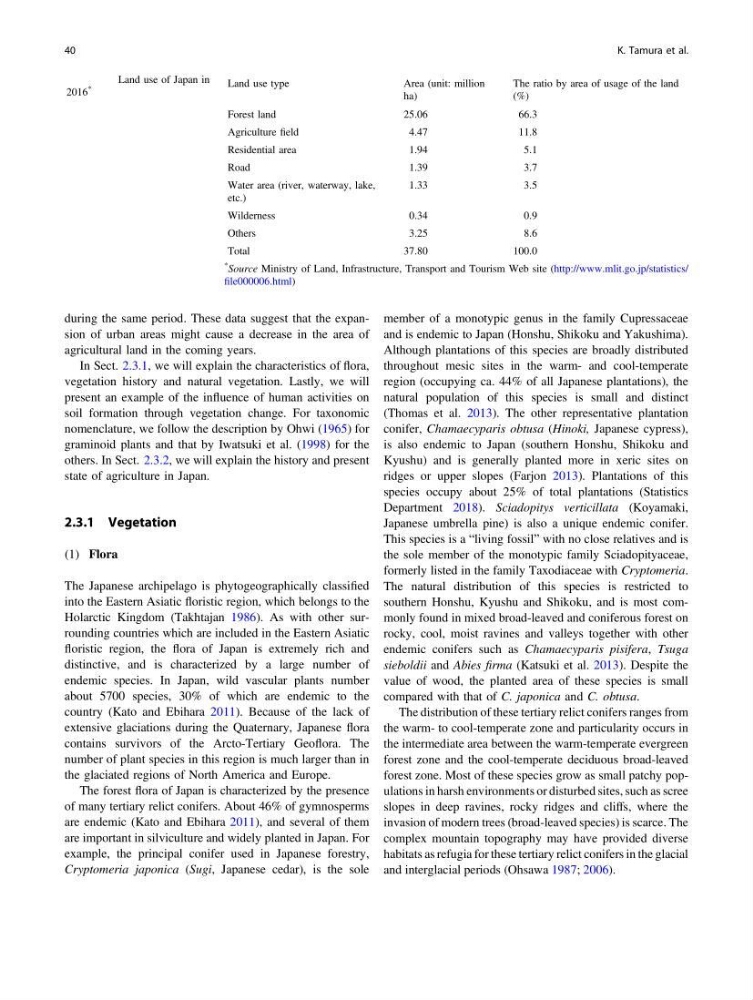
during the same period. These data suggest that the expansion of urban areas might cause a decrease in the area of
agricultural land in the coming years.
In Sect. 2.3.1, we will explain the characteristics of flora,
vegetation history and natural vegetation. Lastly, we will
present an example of the influence of human activities on
soil formation through vegetation change. For taxonomic
nomenclature, we follow the description by Ohwi (1965) for
graminoid plants and that by Iwatsuki et al. (1998) for the
others. In Sect. 2.3.2, we will explain the history and present
state of agriculture in Japan.
2.3.1 Vegetation
(1) Flora
The Japanese archipelago is phytogeographically classified
into the Eastern Asiatic floristic region, which belongs to the
Holarctic Kingdom (Takhtajan 1986). As with other surrounding countries which are included in the Eastern Asiatic
floristic region, the flora of Japan is extremely rich and
distinctive, and is characterized by a large number of
endemic species. In Japan, wild vascular plants number
about 5700 species, 30% of which are endemic to the
country (Kato and Ebihara 2011). Because of the lack of
extensive glaciations during the Quaternary, Japanese flora
contains survivors of the Arcto-Tertiary Geoflora. The
number of plant species in this region is much larger than in
the glaciated regions of North America and Europe.
The forest flora of Japan is characterized by the presence
of many tertiary relict conifers. About 46% of gymnosperms
are endemic (Kato and Ebihara 2011), and several of them
are important in silviculture and widely planted in Japan. For
example, the principal conifer used in Japanese forestry,
Cryptomeria japonica (Sugi, Japanese cedar), is the sole
member of a monotypic genus in the family Cupressaceae
and is endemic to Japan (Honshu, Shikoku and Yakushima).
Although plantations of this species are broadly distributed
throughout mesic sites in the warm- and cool-temperate
region (occupying ca. 44% of all Japanese plantations), the
natural population of this species is small and distinct
(Thomas et al. 2013). The other representative plantation
conifer, Chamaecyparis obtusa (Hinoki, Japanese cypress),
is also endemic to Japan (southern Honshu, Shikoku and
Kyushu) and is generally planted more in xeric sites on
ridges or upper slopes (Farjon 2013). Plantations of this
species occupy about 25% of total plantations (Statistics
Department 2018). Sciadopitys verticillata (Koyamaki,
Japanese umbrella pine) is also a unique endemic conifer.
This species is a “living fossil” with no close relatives and is
the sole member of the monotypic family Sciadopityaceae,
formerly listed in the family Taxodiaceae with Cryptomeria.
The natural distribution of this species is restricted to
southern Honshu, Kyushu and Shikoku, and is most commonly found in mixed broad-leaved and coniferous forest on
rocky, cool, moist ravines and valleys together with other
endemic conifers such as Chamaecyparis pisifera, Tsuga
sieboldii and Abies firma (Katsuki et al. 2013). Despite the
value of wood, the planted area of these species is small
compared with that of C. japonica and C. obtusa.
The distribution of these tertiary relict conifers ranges from
the warm- to cool-temperate zone and particularity occurs in
the intermediate area between the warm-temperate evergreen
forest zone and the cool-temperate deciduous broad-leaved
forest zone. Most of these species grow as small patchy populations in harsh environments or disturbed sites, such as scree
slopes in deep ravines, rocky ridges and cliffs, where the
invasion of modern trees (broad-leaved species) is scarce. The
complex mountain topography may have provided diverse
habitats as refugia for these tertiary relict conifers in the glacial
and interglacial periods (Ohsawa 1987; 2006).
Table 2.1 Land use of Japan in
2016
*
Land use type
Area (unit: million
ha)
The ratio by area of usage of the land
(%)
Forest land
25.06
66.3
Agriculture field
4.47
11.8
Residential area
1.94
5.1
Road
1.39
3.7
Water area (river, waterway, lake,
etc.)
1.33
3.5
Wilderness
0.34
0.9
Others
3.25
8.6
Total
37.80
100.0
*
Source Ministry of Land, Infrastructure, Transport and Tourism Web site (http://www.mlit.go.jp/statistics/
file000006.html)
40
K. Tamura et al.
agricultural land in the coming years.
In Sect. 2.3.1, we will explain the characteristics of flora,
vegetation history and natural vegetation. Lastly, we will
present an example of the influence of human activities on
soil formation through vegetation change. For taxonomic
nomenclature, we follow the description by Ohwi (1965) for
graminoid plants and that by Iwatsuki et al. (1998) for the
others. In Sect. 2.3.2, we will explain the history and present
state of agriculture in Japan.
2.3.1 Vegetation
(1) Flora
The Japanese archipelago is phytogeographically classified
into the Eastern Asiatic floristic region, which belongs to the
Holarctic Kingdom (Takhtajan 1986). As with other surrounding countries which are included in the Eastern Asiatic
floristic region, the flora of Japan is extremely rich and
distinctive, and is characterized by a large number of
endemic species. In Japan, wild vascular plants number
about 5700 species, 30% of which are endemic to the
country (Kato and Ebihara 2011). Because of the lack of
extensive glaciations during the Quaternary, Japanese flora
contains survivors of the Arcto-Tertiary Geoflora. The
number of plant species in this region is much larger than in
the glaciated regions of North America and Europe.
The forest flora of Japan is characterized by the presence
of many tertiary relict conifers. About 46% of gymnosperms
are endemic (Kato and Ebihara 2011), and several of them
are important in silviculture and widely planted in Japan. For
example, the principal conifer used in Japanese forestry,
Cryptomeria japonica (Sugi, Japanese cedar), is the sole
member of a monotypic genus in the family Cupressaceae
and is endemic to Japan (Honshu, Shikoku and Yakushima).
Although plantations of this species are broadly distributed
throughout mesic sites in the warm- and cool-temperate
region (occupying ca. 44% of all Japanese plantations), the
natural population of this species is small and distinct
(Thomas et al. 2013). The other representative plantation
conifer, Chamaecyparis obtusa (Hinoki, Japanese cypress),
is also endemic to Japan (southern Honshu, Shikoku and
Kyushu) and is generally planted more in xeric sites on
ridges or upper slopes (Farjon 2013). Plantations of this
species occupy about 25% of total plantations (Statistics
Department 2018). Sciadopitys verticillata (Koyamaki,
Japanese umbrella pine) is also a unique endemic conifer.
This species is a “living fossil” with no close relatives and is
the sole member of the monotypic family Sciadopityaceae,
formerly listed in the family Taxodiaceae with Cryptomeria.
The natural distribution of this species is restricted to
southern Honshu, Kyushu and Shikoku, and is most commonly found in mixed broad-leaved and coniferous forest on
rocky, cool, moist ravines and valleys together with other
endemic conifers such as Chamaecyparis pisifera, Tsuga
sieboldii and Abies firma (Katsuki et al. 2013). Despite the
value of wood, the planted area of these species is small
compared with that of C. japonica and C. obtusa.
The distribution of these tertiary relict conifers ranges from
the warm- to cool-temperate zone and particularity occurs in
the intermediate area between the warm-temperate evergreen
forest zone and the cool-temperate deciduous broad-leaved
forest zone. Most of these species grow as small patchy populations in harsh environments or disturbed sites, such as scree
slopes in deep ravines, rocky ridges and cliffs, where the
invasion of modern trees (broad-leaved species) is scarce. The
complex mountain topography may have provided diverse
habitats as refugia for these tertiary relict conifers in the glacial
and interglacial periods (Ohsawa 1987; 2006).
Table 2.1 Land use of Japan in
2016
*
Land use type
Area (unit: million
ha)
The ratio by area of usage of the land
(%)
Forest land
25.06
66.3
Agriculture field
4.47
11.8
Residential area
1.94
5.1
Road
1.39
3.7
Water area (river, waterway, lake,
etc.)
1.33
3.5
Wilderness
0.34
0.9
Others
3.25
8.6
Total
37.80
100.0
*
Source Ministry of Land, Infrastructure, Transport and Tourism Web site (http://www.mlit.go.jp/statistics/
file000006.html)
40
K. Tamura et al.