

Hida Mountains (Fig. 2.13) without a geological structure
that uplifts the mountains is an example of this magmatic
activity.
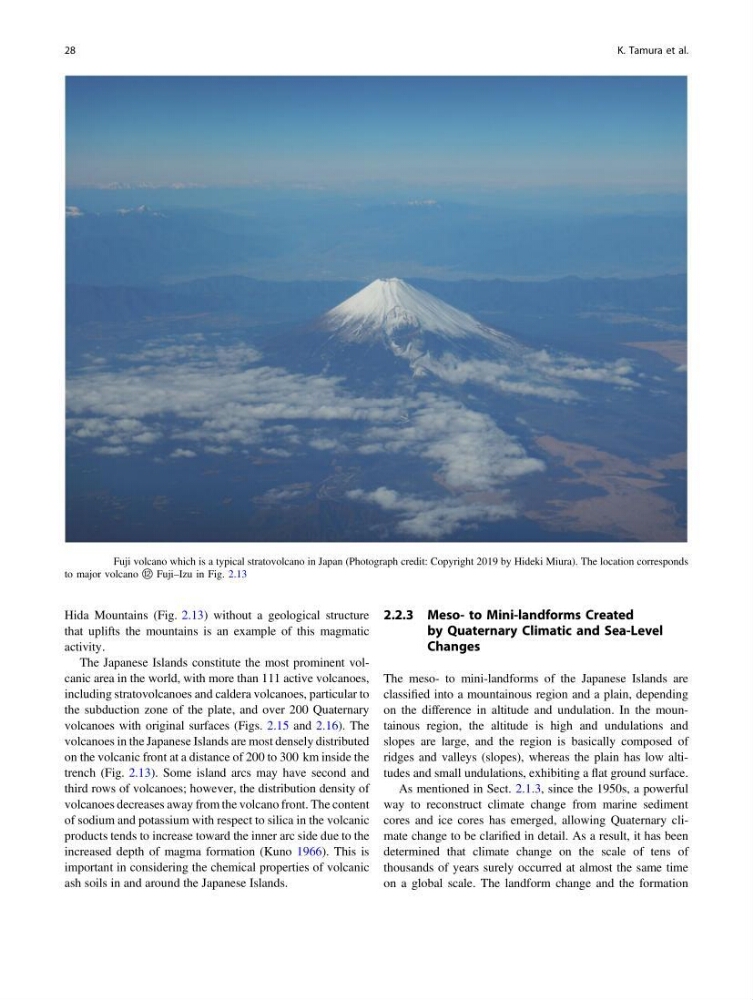
The Japanese Islands constitute the most prominent volcanic area in the world, with more than 111 active volcanoes,
including stratovolcanoes and caldera volcanoes, particular to
the subduction zone of the plate, and over 200 Quaternary
volcanoes with original surfaces (Figs. 2.15 and 2.16). The
volcanoes in the Japanese Islands are most densely distributed
on the volcanic front at a distance of 200 to 300 km inside the
trench (Fig. 2.13). Some island arcs may have second and
third rows of volcanoes; however, the distribution density of
volcanoes decreases away from the volcano front. The content
of sodium and potassium with respect to silica in the volcanic
products tends to increase toward the inner arc side due to the
increased depth of magma formation (Kuno 1966). This is
important in considering the chemical properties of volcanic
ash soils in and around the Japanese Islands.
2.2.3 Meso- to Mini-landforms Created
by Quaternary Climatic and Sea-Level
Changes
The meso- to mini-landforms of the Japanese Islands are
classified into a mountainous region and a plain, depending
on the difference in altitude and undulation. In the mountainous region, the altitude is high and undulations and
slopes are large, and the region is basically composed of
ridges and valleys (slopes), whereas the plain has low altitudes and small undulations, exhibiting a flat ground surface.
As mentioned in Sect. 2.1.3, since the 1950s, a powerful
way to reconstruct climate change from marine sediment
cores and ice cores has emerged, allowing Quaternary climate change to be clarified in detail. As a result, it has been
determined that climate change on the scale of tens of
thousands of years surely occurred at almost the same time
on a global scale. The landform change and the formation
Fig. 2.15 Fuji volcano which is a typical stratovolcano in Japan (Photograph credit: Copyright 2019 by Hideki Miura). The location corresponds
to major volcano ⑫ Fuji–Izu in Fig. 2.13
28
K. Tamura et al.
that uplifts the mountains is an example of this magmatic
activity.
The Japanese Islands constitute the most prominent volcanic area in the world, with more than 111 active volcanoes,
including stratovolcanoes and caldera volcanoes, particular to
the subduction zone of the plate, and over 200 Quaternary
volcanoes with original surfaces (Figs. 2.15 and 2.16). The
volcanoes in the Japanese Islands are most densely distributed
on the volcanic front at a distance of 200 to 300 km inside the
trench (Fig. 2.13). Some island arcs may have second and
third rows of volcanoes; however, the distribution density of
volcanoes decreases away from the volcano front. The content
of sodium and potassium with respect to silica in the volcanic
products tends to increase toward the inner arc side due to the
increased depth of magma formation (Kuno 1966). This is
important in considering the chemical properties of volcanic
ash soils in and around the Japanese Islands.
2.2.3 Meso- to Mini-landforms Created
by Quaternary Climatic and Sea-Level
Changes
The meso- to mini-landforms of the Japanese Islands are
classified into a mountainous region and a plain, depending
on the difference in altitude and undulation. In the mountainous region, the altitude is high and undulations and
slopes are large, and the region is basically composed of
ridges and valleys (slopes), whereas the plain has low altitudes and small undulations, exhibiting a flat ground surface.
As mentioned in Sect. 2.1.3, since the 1950s, a powerful
way to reconstruct climate change from marine sediment
cores and ice cores has emerged, allowing Quaternary climate change to be clarified in detail. As a result, it has been
determined that climate change on the scale of tens of
thousands of years surely occurred at almost the same time
on a global scale. The landform change and the formation
Fig. 2.15 Fuji volcano which is a typical stratovolcano in Japan (Photograph credit: Copyright 2019 by Hideki Miura). The location corresponds
to major volcano ⑫ Fuji–Izu in Fig. 2.13
28
K. Tamura et al.