

after that time (Sasaki 1970); now, shifting cultivation
remains in only a few places, including Shiiba Village. One
of the reasons for the rapid decline in shifting cultivation in
the site is thought to be cedar planting after shifting cultivation, which has been conducted since the 1940s (Shiiba
and Uthumi 2010). According to the traditional method of
shifting cultivation in Shiiba Village, the field is burned on a
sunny day in early August, buckwheat (Fagopyrum esculentum) is cultivated in the first year, Japanese millet
(Echinochloa esculenta) and foxtail millet (Setaria italica)
are cultivated in the second year, and adzuki bean (Vigna
angularis) and soybean (Glycine max) are cultivated in the
third and fourth year, and the fallow period is about 30 years
(Fujiwara 1998).
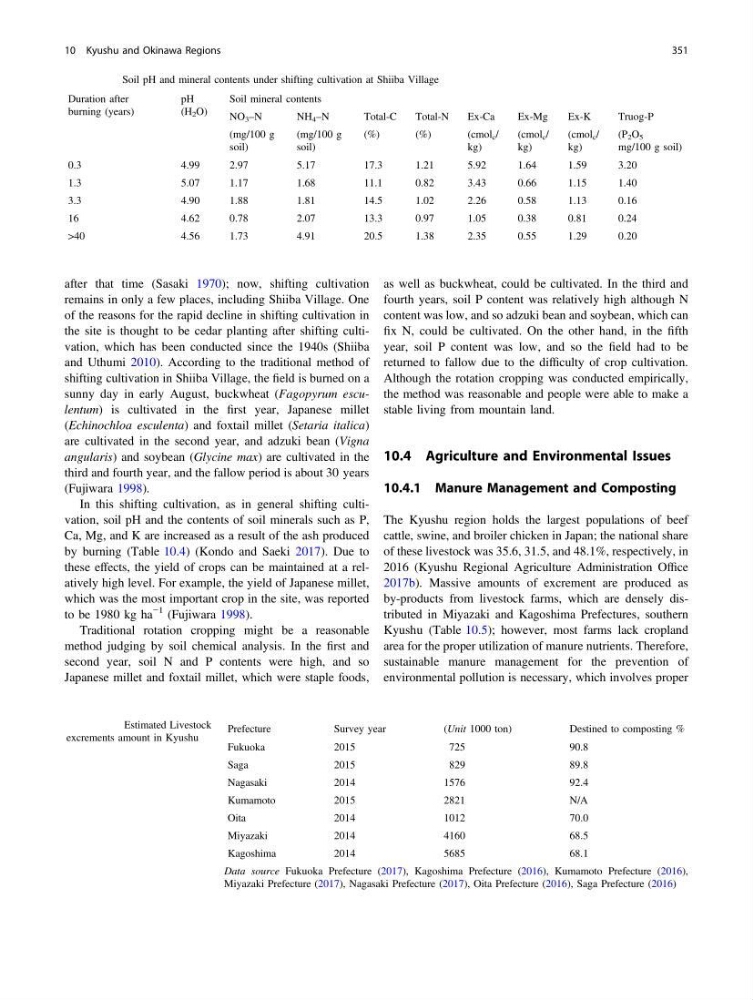
In this shifting cultivation, as in general shifting cultivation, soil pH and the contents of soil minerals such as P,
Ca, Mg, and K are increased as a result of the ash produced
by burning (Table 10.4) (Kondo and Saeki 2017). Due to
these effects, the yield of crops can be maintained at a relatively high level. For example, the yield of Japanese millet,
which was the most important crop in the site, was reported
to be 1980 kg ha
−1 (Fujiwara 1998).
Traditional rotation cropping might be a reasonable
method judging by soil chemical analysis. In the first and
second year, soil N and P contents were high, and so
Japanese millet and foxtail millet, which were staple foods,
as well as buckwheat, could be cultivated. In the third and
fourth years, soil P content was relatively high although N
content was low, and so adzuki bean and soybean, which can
fix N, could be cultivated. On the other hand, in the fifth
year, soil P content was low, and so the field had to be
returned to fallow due to the difficulty of crop cultivation.
Although the rotation cropping was conducted empirically,
the method was reasonable and people were able to make a
stable living from mountain land.
10.4 Agriculture and Environmental Issues
10.4.1 Manure Management and Composting
The Kyushu region holds the largest populations of beef
cattle, swine, and broiler chicken in Japan; the national share
of these livestock was 35.6, 31.5, and 48.1%, respectively, in
2016 (Kyushu Regional Agriculture Administration Office
2017b). Massive amounts of excrement are produced as
by-products from livestock farms, which are densely distributed in Miyazaki and Kagoshima Prefectures, southern
Kyushu (Table 10.5); however, most farms lack cropland
area for the proper utilization of manure nutrients. Therefore,
sustainable manure management for the prevention of
environmental pollution is necessary, which involves proper
Table 10.4 Soil pH and mineral contents under shifting cultivation at Shiiba Village
Duration after
burning (years)
pH
(H 2 O)
Soil mineral contents
NO 3 –N
N H 4 –N
Total-C
Total-N
Ex-Ca
Ex-Mg
Ex-K
Truog-P
(mg/100 g
soil)
(mg/100 g
soil)
(%)
(%)
(cmol c /
kg)
(cmol c /
kg)
(cmol c /
kg)
(P 2 O 5
mg/100 g soil)
0.3
4.99
2.97
5.17
17.3
1.21
5.92
1.64
1.59
3.20
1.3
5.07
1.17
1.68
11.1
0.82
3.43
0.66
1.15
1.40
3.3
4.90
1.88
1.81
14.5
1.02
2.26
0.58
1.13
0.16
16
4.62
0.78
2.07
13.3
0.97
1.05
0.38
0.81
0.24
>40
4.56
1.73
4.91
20.5
1.38
2.35
0.55
1.29
0.20
Table 10.5 Estimated Livestock
excrements amount in Kyushu
Prefecture
Survey year
(Unit 1000 ton)
Destined to composting %
Fukuoka
2015
725
90.8
Saga
2015
829
89.8
Nagasaki
2014
1576
92.4
Kumamoto
2015
2821
N/A
Oita
2014
1012
70.0
Miyazaki
2014
4160
68.5
Kagoshima
2014
5685
68.1
Data source Fukuoka Prefecture (2017), Kagoshima Prefecture (2016), Kumamoto Prefecture (2016),
Miyazaki Prefecture (2017), Nagasaki Prefecture (2017), Oita Prefecture (2016), Saga Prefecture (2016)
10 Kyushu and Okinawa Regions
351
remains in only a few places, including Shiiba Village. One
of the reasons for the rapid decline in shifting cultivation in
the site is thought to be cedar planting after shifting cultivation, which has been conducted since the 1940s (Shiiba
and Uthumi 2010). According to the traditional method of
shifting cultivation in Shiiba Village, the field is burned on a
sunny day in early August, buckwheat (Fagopyrum esculentum) is cultivated in the first year, Japanese millet
(Echinochloa esculenta) and foxtail millet (Setaria italica)
are cultivated in the second year, and adzuki bean (Vigna
angularis) and soybean (Glycine max) are cultivated in the
third and fourth year, and the fallow period is about 30 years
(Fujiwara 1998).
In this shifting cultivation, as in general shifting cultivation, soil pH and the contents of soil minerals such as P,
Ca, Mg, and K are increased as a result of the ash produced
by burning (Table 10.4) (Kondo and Saeki 2017). Due to
these effects, the yield of crops can be maintained at a relatively high level. For example, the yield of Japanese millet,
which was the most important crop in the site, was reported
to be 1980 kg ha
−1 (Fujiwara 1998).
Traditional rotation cropping might be a reasonable
method judging by soil chemical analysis. In the first and
second year, soil N and P contents were high, and so
Japanese millet and foxtail millet, which were staple foods,
as well as buckwheat, could be cultivated. In the third and
fourth years, soil P content was relatively high although N
content was low, and so adzuki bean and soybean, which can
fix N, could be cultivated. On the other hand, in the fifth
year, soil P content was low, and so the field had to be
returned to fallow due to the difficulty of crop cultivation.
Although the rotation cropping was conducted empirically,
the method was reasonable and people were able to make a
stable living from mountain land.
10.4 Agriculture and Environmental Issues
10.4.1 Manure Management and Composting
The Kyushu region holds the largest populations of beef
cattle, swine, and broiler chicken in Japan; the national share
of these livestock was 35.6, 31.5, and 48.1%, respectively, in
2016 (Kyushu Regional Agriculture Administration Office
2017b). Massive amounts of excrement are produced as
by-products from livestock farms, which are densely distributed in Miyazaki and Kagoshima Prefectures, southern
Kyushu (Table 10.5); however, most farms lack cropland
area for the proper utilization of manure nutrients. Therefore,
sustainable manure management for the prevention of
environmental pollution is necessary, which involves proper
Table 10.4 Soil pH and mineral contents under shifting cultivation at Shiiba Village
Duration after
burning (years)
pH
(H 2 O)
Soil mineral contents
NO 3 –N
N H 4 –N
Total-C
Total-N
Ex-Ca
Ex-Mg
Ex-K
Truog-P
(mg/100 g
soil)
(mg/100 g
soil)
(%)
(%)
(cmol c /
kg)
(cmol c /
kg)
(cmol c /
kg)
(P 2 O 5
mg/100 g soil)
0.3
4.99
2.97
5.17
17.3
1.21
5.92
1.64
1.59
3.20
1.3
5.07
1.17
1.68
11.1
0.82
3.43
0.66
1.15
1.40
3.3
4.90
1.88
1.81
14.5
1.02
2.26
0.58
1.13
0.16
16
4.62
0.78
2.07
13.3
0.97
1.05
0.38
0.81
0.24
>40
4.56
1.73
4.91
20.5
1.38
2.35
0.55
1.29
0.20
Table 10.5 Estimated Livestock
excrements amount in Kyushu
Prefecture
Survey year
(Unit 1000 ton)
Destined to composting %
Fukuoka
2015
725
90.8
Saga
2015
829
89.8
Nagasaki
2014
1576
92.4
Kumamoto
2015
2821
N/A
Oita
2014
1012
70.0
Miyazaki
2014
4160
68.5
Kagoshima
2014
5685
68.1
Data source Fukuoka Prefecture (2017), Kagoshima Prefecture (2016), Kumamoto Prefecture (2016),
Miyazaki Prefecture (2017), Nagasaki Prefecture (2017), Oita Prefecture (2016), Saga Prefecture (2016)
10 Kyushu and Okinawa Regions
351