

After ten years of farming, the groundwater level in the
soils was lowered, and the soil became Gray Fluvic soils.
The soil content of available phosphate and exchangeable
calcium was observed to be reduced.
10.3.4 Horticulture and Soil Management
in Northern Kyushu
The greenhouse cultivation of vegetables such as strawberry
and asparagus is successfully conducted in northern Kyushu.
(1) Strawberry
The total area of strawberry cultivation in Kyushu is
1477 ha, accounting for 27.1% of the agricultural land area
in Kyushu and 33% of strawberry production in Japan. This
cultivation obtains a high productivity of 3.57 t ha
−1 .
Although soil culture is predominant in northern Kyushu,
table top culture was developed ahead of Japan due to the
requirements of saving labor (Fig. 10.10).
Strawberry can be cultivated in any soil, but prefers that
with suitable air permeability and water-holding capacity.
Strawberry is shallow-rooted, and its roots have a large
oxygen demand. Since continuous rotary tilling tends to
make the topsoil layer shallow, the effective soil layer must
be expanded by forming high ridges or conducting deep
tillage.
The appropriate range of the soil chemical properties for
strawberry cultivation is 5.5–6.5 for pH, 45–75% for base
saturation percentage, and 200–600 mg P 2 O 5 kg
−1 for
available phosphate concentration. The appropriate range of
electrical conductivity (EC) is 0.3–0.5 dS m
−1 (the upper
limit is 1.0) for volcanic ash soils and 0.2–0.4 dS m
−1 (the
upper limit is 0.8) for non-volcanic ash soils. Strawberry is
one of the most sensitive crops to salt injury, and soil
solutions with low salt concentration are therefore suitable
for strawberry roots. In the case of soil culture, as the
strawberry variety changed from “Toyonoka” through
“Sachinoka” to “Yumenoka,” the rate of nitrogen fertilizer
application for the basal dressing has been reduced, which
has resulted in the emphasis of side dressing.
(2) Asparagus
The area of agricultural land under asparagus cultivation in
Kyushu is 461 ha, producing an annual yield of 9178 t,
accounting for 8.4 and 31.5%, respectively, of the total in
Japan. Asparagus productivity is extremely high, at 19.9 t
ha
−1 (Inoue 2008). Asparagus used to be cropped only in
early spring because the microthermal climate in this period
is suitable; however, in about 1990, mother stem standing
cultivation was developed in northern Kyushu, which
allowed for cropping up to October, thus increasing the
number of crops per unit area fivefold or more (Inoue 2001).
This is the greatest technical revolution that has been
achieved for asparagus cultivation, and the technology is
becoming widespread both domestically and internationally.
Green asparagus semi-forcing cultivation is a type of
mother stem cultivation in which a few stems per stock are
elongated at the end of the crop of buds in spring and buds
that sprout on the base of the standing stems in summer and
autumn are cropped (Fig. 10.11; Inoue 1996). It is important
to nurture stumps and encourage the accumulation of
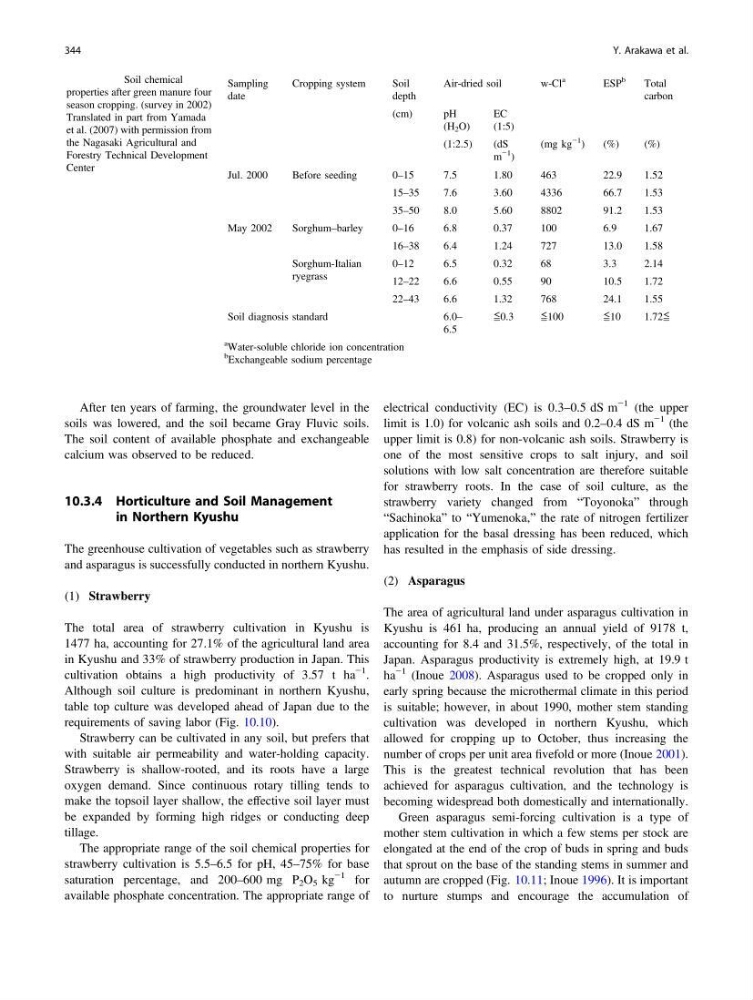
Table 10.3 Soil chemical
properties after green manure four
season cropping. (survey in 2002)
Translated in part from Yamada
et al. (2007) with permission from
the Nagasaki Agricultural and
Forestry Technical Development
Center
Sampling
date
Cropping system
Soil
depth
Air-dried soil
w-Cl
a
ESP
b
Total
carbon
(cm)
pH
(H 2 O)
EC
(1:5)
(1:2.5)
(dS
m
−1
)
(mg kg
−1
)
(%)
(%)
Jul. 2000
Before seeding
0–15
7.5
1.80
463
22.9
1.52
15–35
7.6
3.60
4336
66.7
1.53
35–50
8.0
5.60
8802
91.2
1.53
May 2002
Sorghum–barley
0–16
6.8
0.37
100
6.9
1.67
16–38
6.4
1.24
727
13.0
1.58
Sorghum-Italian
ryegrass
0–12
6.5
0.32
68
3.3
2.14
12–22
6.6
0.55
90
10.5
1.72
22–43
6.6
1.32
768
24.1
1.55
Soil diagnosis standard
6.0–
6.5
≦0.3
≦100
≦10
1.72≦
a Water-soluble chloride ion concentration
b
Exchangeable sodium percentage
344
Y. Arakawa et al.
soils was lowered, and the soil became Gray Fluvic soils.
The soil content of available phosphate and exchangeable
calcium was observed to be reduced.
10.3.4 Horticulture and Soil Management
in Northern Kyushu
The greenhouse cultivation of vegetables such as strawberry
and asparagus is successfully conducted in northern Kyushu.
(1) Strawberry
The total area of strawberry cultivation in Kyushu is
1477 ha, accounting for 27.1% of the agricultural land area
in Kyushu and 33% of strawberry production in Japan. This
cultivation obtains a high productivity of 3.57 t ha
−1 .
Although soil culture is predominant in northern Kyushu,
table top culture was developed ahead of Japan due to the
requirements of saving labor (Fig. 10.10).
Strawberry can be cultivated in any soil, but prefers that
with suitable air permeability and water-holding capacity.
Strawberry is shallow-rooted, and its roots have a large
oxygen demand. Since continuous rotary tilling tends to
make the topsoil layer shallow, the effective soil layer must
be expanded by forming high ridges or conducting deep
tillage.
The appropriate range of the soil chemical properties for
strawberry cultivation is 5.5–6.5 for pH, 45–75% for base
saturation percentage, and 200–600 mg P 2 O 5 kg
−1 for
available phosphate concentration. The appropriate range of
electrical conductivity (EC) is 0.3–0.5 dS m
−1 (the upper
limit is 1.0) for volcanic ash soils and 0.2–0.4 dS m
−1 (the
upper limit is 0.8) for non-volcanic ash soils. Strawberry is
one of the most sensitive crops to salt injury, and soil
solutions with low salt concentration are therefore suitable
for strawberry roots. In the case of soil culture, as the
strawberry variety changed from “Toyonoka” through
“Sachinoka” to “Yumenoka,” the rate of nitrogen fertilizer
application for the basal dressing has been reduced, which
has resulted in the emphasis of side dressing.
(2) Asparagus
The area of agricultural land under asparagus cultivation in
Kyushu is 461 ha, producing an annual yield of 9178 t,
accounting for 8.4 and 31.5%, respectively, of the total in
Japan. Asparagus productivity is extremely high, at 19.9 t
ha
−1 (Inoue 2008). Asparagus used to be cropped only in
early spring because the microthermal climate in this period
is suitable; however, in about 1990, mother stem standing
cultivation was developed in northern Kyushu, which
allowed for cropping up to October, thus increasing the
number of crops per unit area fivefold or more (Inoue 2001).
This is the greatest technical revolution that has been
achieved for asparagus cultivation, and the technology is
becoming widespread both domestically and internationally.
Green asparagus semi-forcing cultivation is a type of
mother stem cultivation in which a few stems per stock are
elongated at the end of the crop of buds in spring and buds
that sprout on the base of the standing stems in summer and
autumn are cropped (Fig. 10.11; Inoue 1996). It is important
to nurture stumps and encourage the accumulation of
Table 10.3 Soil chemical
properties after green manure four
season cropping. (survey in 2002)
Translated in part from Yamada
et al. (2007) with permission from
the Nagasaki Agricultural and
Forestry Technical Development
Center
Sampling
date
Cropping system
Soil
depth
Air-dried soil
w-Cl
a
ESP
b
Total
carbon
(cm)
pH
(H 2 O)
EC
(1:5)
(1:2.5)
(dS
m
−1
)
(mg kg
−1
)
(%)
(%)
Jul. 2000
Before seeding
0–15
7.5
1.80
463
22.9
1.52
15–35
7.6
3.60
4336
66.7
1.53
35–50
8.0
5.60
8802
91.2
1.53
May 2002
Sorghum–barley
0–16
6.8
0.37
100
6.9
1.67
16–38
6.4
1.24
727
13.0
1.58
Sorghum-Italian
ryegrass
0–12
6.5
0.32
68
3.3
2.14
12–22
6.6
0.55
90
10.5
1.72
22–43
6.6
1.32
768
24.1
1.55
Soil diagnosis standard
6.0–
6.5
≦0.3
≦100
≦10
1.72≦
a Water-soluble chloride ion concentration
b
Exchangeable sodium percentage
344
Y. Arakawa et al.