

outflow of N by lowering the rates of decomposition of rice
straw and nitrification.
9.3.2 Environmental Impacts Associated
with Agricultural Activities
1. Generation of carbon dioxide, methane gas, and
nitrous oxide
(1) Generation of carbon dioxide and methane gas in
paddy fields
The Kansai region, a mild temperate area within Japan
which includes the Kinki, Chugoku, and Shikoku regions,
has many areas with low precipitation, and in general has
conditions that are conducive to the decomposition of
organic matter. Especially in the Setouchi region, rainfall is
low, and in the four prefectures of Ehime, Kagawa,
Okayama, and Hiroshima, the proportion of Gley Fluvic
soils (developed in the rainy climate) to the total paddy field
area is about 15% (Ishibashi 2004; Tanabe 2007; Tanimoto
2006), which is lower than the average of 23% in the Kansai
region. Meanwhile, in the four prefectures affected by the
climate of the Sea of Japan, namely, Kyoto, Shiga, Tottori,
and Shimane, the proportion of Gley Fluvic soils in paddy
fields is as high as 40% (Ito 2005; Miyata 2007; Nakajima
2007). It can be seen that there is a regional difference in the
generation of carbon dioxide and methane gas accompanying the decomposition of organic matter in the soil. The
generation of these greenhouse gases depends not only on
the climate and the type of soil but also on the input quantity
of organic materials, water management, and so on.
Although no comprehensive investigation has been made
into the carbon balance of the agricultural soil, Kanazawa
(1998) estimated the potential generation of carbon dioxide
during the inundation of paddy fields in the Kansai area to be
7.97–8.17 Â 10
11 g. Soil carbon stocks, which result from
soil carbon balance, are continuously being investigated in
each prefecture. Looking at the results from the National
Agricultural Land Soil Guidebook (Council of Investigation
for Soil Conservation 2012), the carbon content of the soil in
the Kansai region tends to decline in three prefectures,
remain constant or decrease in one prefecture, remain constant in two prefectures, and increase in two prefectures.
(2) Generation of nitrous oxide
In addition to spontaneous generation, nitrous oxide is
produced from the combustion of substances, by the chemical industry, and so on, and from excess nitrogen in agriculture. The generation of nitrous oxide from farmland
occurs when nitrate–nitrogen is denitrified in anaerobic
conditions and when ammonia is nitrified in aerobic conditions. In wetland rice cultivation, fertilizer and nitrogen in
soil are generally mainly in the ammonia state, and the
amount is also small, and it is considered that generation of
nitrous oxide there is not high. On the other hand, in farmland, the generation of this gas occurs more frequently when
fertilizer is applied in large quantities. In the Kansai region,
farmland (including tree gardens) occupies 25% of the total
agricultural land, lower than the Japanese average of 46%,
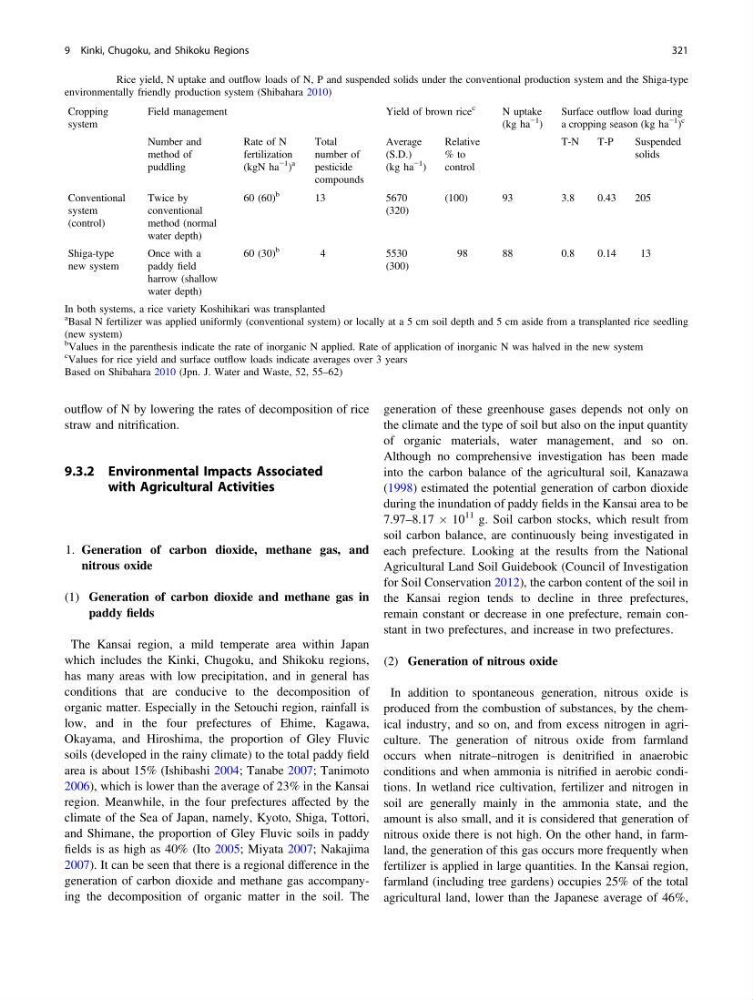
Table 9.8 Rice yield, N uptake and outflow loads of N, P and suspended solids under the conventional production system and the Shiga-type
environmentally friendly production system (Shibahara 2010)
Cropping
system
Field management
Yield of brown rice
c
N uptake
(kg ha
−1
)
Surface outflow load during
a cropping season (kg ha
−1
)
c
Number and
method of
puddling
Rate of N
fertilization
(kgN ha
−1
)
a
Total
number of
pesticide
compounds
Average
(S.D.)
(kg ha
−1
)
Relative
% to
control
T-N
T-P
Suspended
solids
Conventional
system
(control)
Twice by
conventional
method (normal
water depth)
60 (60)
b
13
5670
(320)
(100)
93
3.8
0.43
205
Shiga-type
new system
Once with a
paddy field
harrow (shallow
water depth)
60 (30)
b
4
5530
(300)
98
88
0.8
0.14
13
In both systems, a rice variety Koshihikari was transplanted
a Basal N fertilizer was applied uniformly (conventional system) or locally at a 5 cm soil depth and 5 cm aside from a transplanted rice seedling
(new system)
b
Values in the parenthesis indicate the rate of inorganic N applied. Rate of application of inorganic N was halved in the new system
c Values for rice yield and surface outflow loads indicate averages over 3 years
Based on Shibahara 2010 (Jpn. J. Water and Waste, 52, 55–62)
9 Kinki, Chugoku, and Shikoku Regions
321
straw and nitrification.
9.3.2 Environmental Impacts Associated
with Agricultural Activities
1. Generation of carbon dioxide, methane gas, and
nitrous oxide
(1) Generation of carbon dioxide and methane gas in
paddy fields
The Kansai region, a mild temperate area within Japan
which includes the Kinki, Chugoku, and Shikoku regions,
has many areas with low precipitation, and in general has
conditions that are conducive to the decomposition of
organic matter. Especially in the Setouchi region, rainfall is
low, and in the four prefectures of Ehime, Kagawa,
Okayama, and Hiroshima, the proportion of Gley Fluvic
soils (developed in the rainy climate) to the total paddy field
area is about 15% (Ishibashi 2004; Tanabe 2007; Tanimoto
2006), which is lower than the average of 23% in the Kansai
region. Meanwhile, in the four prefectures affected by the
climate of the Sea of Japan, namely, Kyoto, Shiga, Tottori,
and Shimane, the proportion of Gley Fluvic soils in paddy
fields is as high as 40% (Ito 2005; Miyata 2007; Nakajima
2007). It can be seen that there is a regional difference in the
generation of carbon dioxide and methane gas accompanying the decomposition of organic matter in the soil. The
generation of these greenhouse gases depends not only on
the climate and the type of soil but also on the input quantity
of organic materials, water management, and so on.
Although no comprehensive investigation has been made
into the carbon balance of the agricultural soil, Kanazawa
(1998) estimated the potential generation of carbon dioxide
during the inundation of paddy fields in the Kansai area to be
7.97–8.17 Â 10
11 g. Soil carbon stocks, which result from
soil carbon balance, are continuously being investigated in
each prefecture. Looking at the results from the National
Agricultural Land Soil Guidebook (Council of Investigation
for Soil Conservation 2012), the carbon content of the soil in
the Kansai region tends to decline in three prefectures,
remain constant or decrease in one prefecture, remain constant in two prefectures, and increase in two prefectures.
(2) Generation of nitrous oxide
In addition to spontaneous generation, nitrous oxide is
produced from the combustion of substances, by the chemical industry, and so on, and from excess nitrogen in agriculture. The generation of nitrous oxide from farmland
occurs when nitrate–nitrogen is denitrified in anaerobic
conditions and when ammonia is nitrified in aerobic conditions. In wetland rice cultivation, fertilizer and nitrogen in
soil are generally mainly in the ammonia state, and the
amount is also small, and it is considered that generation of
nitrous oxide there is not high. On the other hand, in farmland, the generation of this gas occurs more frequently when
fertilizer is applied in large quantities. In the Kansai region,
farmland (including tree gardens) occupies 25% of the total
agricultural land, lower than the Japanese average of 46%,
Table 9.8 Rice yield, N uptake and outflow loads of N, P and suspended solids under the conventional production system and the Shiga-type
environmentally friendly production system (Shibahara 2010)
Cropping
system
Field management
Yield of brown rice
c
N uptake
(kg ha
−1
)
Surface outflow load during
a cropping season (kg ha
−1
)
c
Number and
method of
puddling
Rate of N
fertilization
(kgN ha
−1
)
a
Total
number of
pesticide
compounds
Average
(S.D.)
(kg ha
−1
)
Relative
% to
control
T-N
T-P
Suspended
solids
Conventional
system
(control)
Twice by
conventional
method (normal
water depth)
60 (60)
b
13
5670
(320)
(100)
93
3.8
0.43
205
Shiga-type
new system
Once with a
paddy field
harrow (shallow
water depth)
60 (30)
b
4
5530
(300)
98
88
0.8
0.14
13
In both systems, a rice variety Koshihikari was transplanted
a Basal N fertilizer was applied uniformly (conventional system) or locally at a 5 cm soil depth and 5 cm aside from a transplanted rice seedling
(new system)
b
Values in the parenthesis indicate the rate of inorganic N applied. Rate of application of inorganic N was halved in the new system
c Values for rice yield and surface outflow loads indicate averages over 3 years
Based on Shibahara 2010 (Jpn. J. Water and Waste, 52, 55–62)
9 Kinki, Chugoku, and Shikoku Regions
321