

3. For the non-cropping period
The net efflux load of N during the non-cropping period can
be greater than that during the cropping period, as has been
reported by many researchers (e.g., Kobayashi et al. 2005).
This is because the non-irrigation (non-cropping) period is
longer than the irrigation (cropping) period when the field is
used for the mono-cropping of rice. Besides this, soil management practices during the fallow period, such as plowing
and making ridges by which crop residues on the ground are
incorporated into soil, are known to accelerate the rates of
mineralization of organic N and nitrification, thereby causing
the leaching of nitrate after rainfall events (Tanaka 2001).
It is therefore important to prevent the outflow of N
during the non-cropping period in addition to conducting the
environmentally friendly practices during the cropping period. We carried out field experiments and found that two
countermeasures can be performed effectively during the
non-cropping period (Hasukawa et al. 2011). The proposed
methods are: (1) the plowing and incorporation of rice straw
in December, which is one month later than the normal
plowing season in Shiga Prefecture; and (2) capping the
underground drainage pipe and closing the water outlet with
a cut-off board. A combination of these practices would
make it possible to keep the soil conditions moist to wet
throughout the non-cropping season and to reduce the
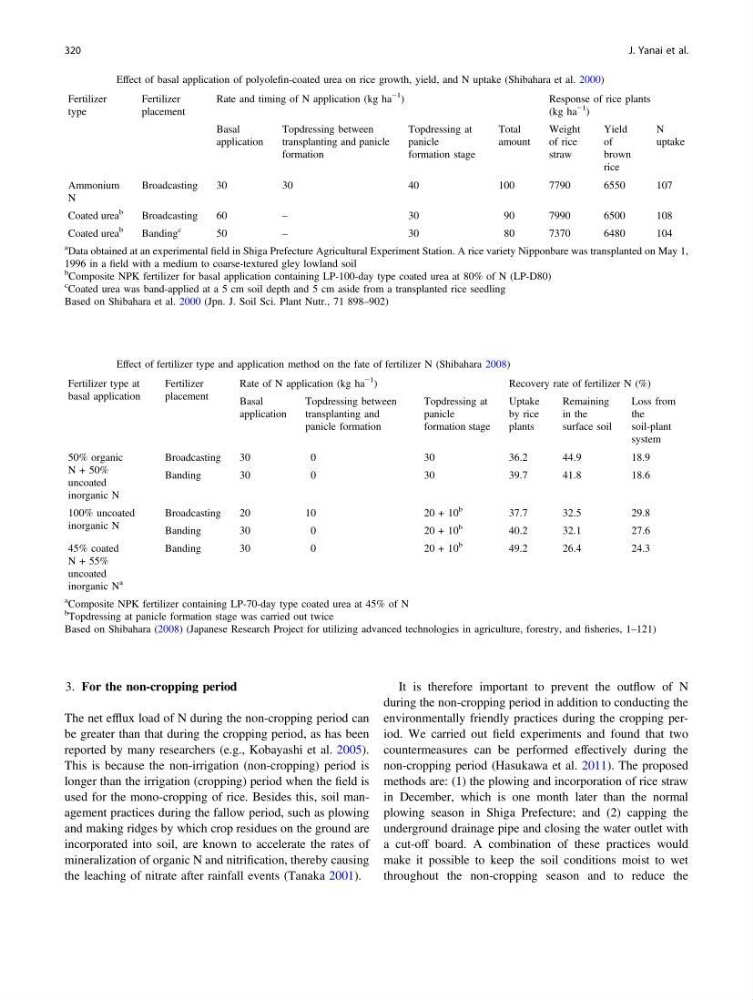
Table 9.6 Effect of basal application of polyolefin-coated urea on rice growth, yield, and N uptake (Shibahara et al. 2000)
Fertilizer
type
Fertilizer
placement
Rate and timing of N application (kg ha
−1
)
Response of rice plants
(kg ha
−1
)
Basal
application
Topdressing between
transplanting and panicle
formation
Topdressing at
panicle
formation stage
Total
amount
Weight
of rice
straw
Yield
of
brown
rice
N
uptake
Ammonium
N
Broadcasting
30
30
40
100
7790
6550
107
Coated urea
b
Broadcasting
60
–
30
90
7990
6500
108
Coated urea
b
Banding
c
50
–
30
80
7370
6480
104
a Data obtained at an experimental field in Shiga Prefecture Agricultural Experiment Station. A rice variety Nipponbare was transplanted on May 1,
1996 in a field with a medium to coarse-textured gley lowland soil
b
Composite NPK fertilizer for basal application containing LP-100-day type coated urea at 80% of N (LP-D80)
c Coated urea was band-applied at a 5 cm soil depth and 5 cm aside from a transplanted rice seedling
Based on Shibahara et al. 2000 (Jpn. J. Soil Sci. Plant Nutr., 71 898–902)
Table 9.7 Effect of fertilizer type and application method on the fate of fertilizer N (Shibahara 2008)
Fertilizer type at
basal application
Fertilizer
placement
Rate of N application (kg ha
−1
)
Recovery rate of fertilizer N (%)
Basal
application
Topdressing between
transplanting and
panicle formation
Topdressing at
panicle
formation stage
Uptake
by rice
plants
Remaining
in the
surface soil
Loss from
the
soil-plant
system
50% organic
N + 50%
uncoated
inorganic N
Broadcasting
30
0
30
36.2
44.9
18.9
Banding
30
0
30
39.7
41.8
18.6
100% uncoated
inorganic N
Broadcasting
20
10
20 + 10
b
37.7
32.5
29.8
Banding
30
0
20 + 10
b
40.2
32.1
27.6
45% coated
N + 55%
uncoated
inorganic N
a
Banding
30
0
20 + 10
b
49.2
26.4
24.3
a Composite NPK fertilizer containing LP-70-day type coated urea at 45% of N
b
Topdressing at panicle formation stage was carried out twice
Based on Shibahara (2008) (Japanese Research Project for utilizing advanced technologies in agriculture, forestry, and fisheries, 1–121)
320
J. Yanai et al.
The net efflux load of N during the non-cropping period can
be greater than that during the cropping period, as has been
reported by many researchers (e.g., Kobayashi et al. 2005).
This is because the non-irrigation (non-cropping) period is
longer than the irrigation (cropping) period when the field is
used for the mono-cropping of rice. Besides this, soil management practices during the fallow period, such as plowing
and making ridges by which crop residues on the ground are
incorporated into soil, are known to accelerate the rates of
mineralization of organic N and nitrification, thereby causing
the leaching of nitrate after rainfall events (Tanaka 2001).
It is therefore important to prevent the outflow of N
during the non-cropping period in addition to conducting the
environmentally friendly practices during the cropping period. We carried out field experiments and found that two
countermeasures can be performed effectively during the
non-cropping period (Hasukawa et al. 2011). The proposed
methods are: (1) the plowing and incorporation of rice straw
in December, which is one month later than the normal
plowing season in Shiga Prefecture; and (2) capping the
underground drainage pipe and closing the water outlet with
a cut-off board. A combination of these practices would
make it possible to keep the soil conditions moist to wet
throughout the non-cropping season and to reduce the
Table 9.6 Effect of basal application of polyolefin-coated urea on rice growth, yield, and N uptake (Shibahara et al. 2000)
Fertilizer
type
Fertilizer
placement
Rate and timing of N application (kg ha
−1
)
Response of rice plants
(kg ha
−1
)
Basal
application
Topdressing between
transplanting and panicle
formation
Topdressing at
panicle
formation stage
Total
amount
Weight
of rice
straw
Yield
of
brown
rice
N
uptake
Ammonium
N
Broadcasting
30
30
40
100
7790
6550
107
Coated urea
b
Broadcasting
60
–
30
90
7990
6500
108
Coated urea
b
Banding
c
50
–
30
80
7370
6480
104
a Data obtained at an experimental field in Shiga Prefecture Agricultural Experiment Station. A rice variety Nipponbare was transplanted on May 1,
1996 in a field with a medium to coarse-textured gley lowland soil
b
Composite NPK fertilizer for basal application containing LP-100-day type coated urea at 80% of N (LP-D80)
c Coated urea was band-applied at a 5 cm soil depth and 5 cm aside from a transplanted rice seedling
Based on Shibahara et al. 2000 (Jpn. J. Soil Sci. Plant Nutr., 71 898–902)
Table 9.7 Effect of fertilizer type and application method on the fate of fertilizer N (Shibahara 2008)
Fertilizer type at
basal application
Fertilizer
placement
Rate of N application (kg ha
−1
)
Recovery rate of fertilizer N (%)
Basal
application
Topdressing between
transplanting and
panicle formation
Topdressing at
panicle
formation stage
Uptake
by rice
plants
Remaining
in the
surface soil
Loss from
the
soil-plant
system
50% organic
N + 50%
uncoated
inorganic N
Broadcasting
30
0
30
36.2
44.9
18.9
Banding
30
0
30
39.7
41.8
18.6
100% uncoated
inorganic N
Broadcasting
20
10
20 + 10
b
37.7
32.5
29.8
Banding
30
0
20 + 10
b
40.2
32.1
27.6
45% coated
N + 55%
uncoated
inorganic N
a
Banding
30
0
20 + 10
b
49.2
26.4
24.3
a Composite NPK fertilizer containing LP-70-day type coated urea at 45% of N
b
Topdressing at panicle formation stage was carried out twice
Based on Shibahara (2008) (Japanese Research Project for utilizing advanced technologies in agriculture, forestry, and fisheries, 1–121)
320
J. Yanai et al.