

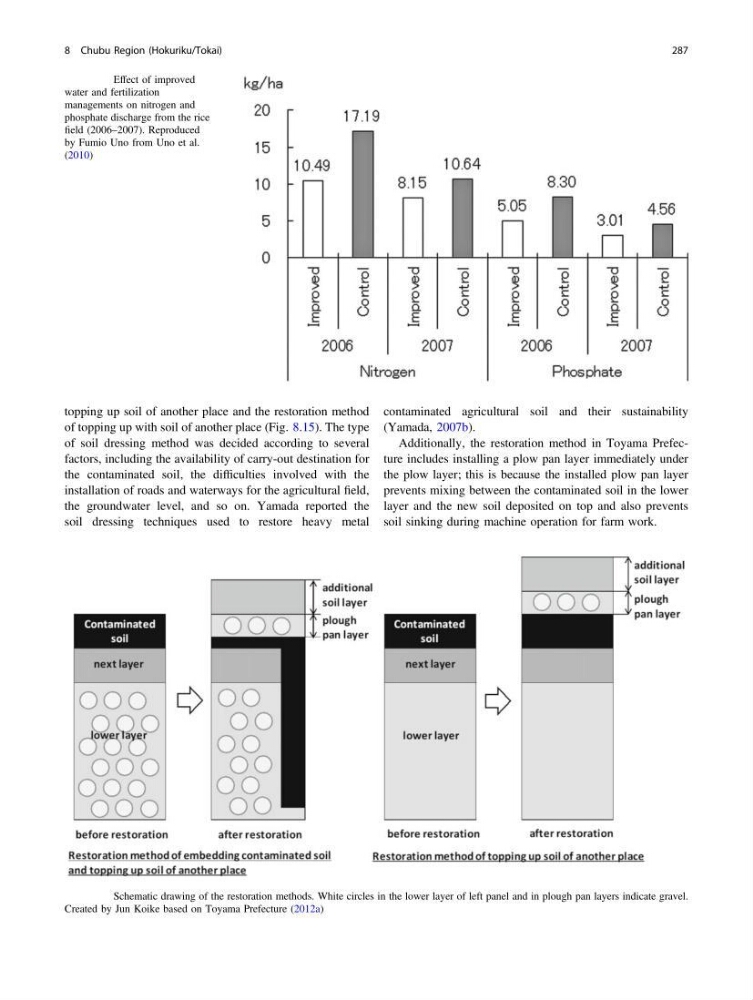
topping up soil of another place and the restoration method
of topping up with soil of another place (Fig. 8.15). The type
of soil dressing method was decided according to several
factors, including the availability of carry-out destination for
the contaminated soil, the difficulties involved with the
installation of roads and waterways for the agricultural field,
the groundwater level, and so on. Yamada reported the
soil dressing techniques used to restore heavy metal
contaminated agricultural soil and their sustainability
(Yamada, 2007b).
Additionally, the restoration method in Toyama Prefecture includes installing a plow pan layer immediately under
the plow layer; this is because the installed plow pan layer
prevents mixing between the contaminated soil in the lower
layer and the new soil deposited on top and also prevents
soil sinking during machine operation for farm work.
Fig. 8.14 Effect of improved
water and fertilization
managements on nitrogen and
phosphate discharge from the rice
field (2006–2007). Reproduced
by Fumio Uno from Uno et al.
(2010)
Fig. 8.15 Schematic drawing of the restoration methods. White circles in the lower layer of left panel and in plough pan layers indicate gravel.
Created by Jun Koike based on Toyama Prefecture (2012a)
8 Chubu Region (Hokuriku/Tokai)
287
of topping up with soil of another place (Fig. 8.15). The type
of soil dressing method was decided according to several
factors, including the availability of carry-out destination for
the contaminated soil, the difficulties involved with the
installation of roads and waterways for the agricultural field,
the groundwater level, and so on. Yamada reported the
soil dressing techniques used to restore heavy metal
contaminated agricultural soil and their sustainability
(Yamada, 2007b).
Additionally, the restoration method in Toyama Prefecture includes installing a plow pan layer immediately under
the plow layer; this is because the installed plow pan layer
prevents mixing between the contaminated soil in the lower
layer and the new soil deposited on top and also prevents
soil sinking during machine operation for farm work.
Fig. 8.14 Effect of improved
water and fertilization
managements on nitrogen and
phosphate discharge from the rice
field (2006–2007). Reproduced
by Fumio Uno from Uno et al.
(2010)
Fig. 8.15 Schematic drawing of the restoration methods. White circles in the lower layer of left panel and in plough pan layers indicate gravel.
Created by Jun Koike based on Toyama Prefecture (2012a)
8 Chubu Region (Hokuriku/Tokai)
287