

materials such as steelmaking slag and gypsum suppress Na
uptake and improve the K nutrient condition of rice plants by
promoting Ca absorption.
It is well known that the supplementation of Ca reduces
Na absorption and enhances K absorption (Khan et al. 1992;
Song et al. 2006). Additionally, silicate is taken up by rice
plants, which increases photosynthetic capacity, resistance to
insects, and salt resistance (Ma 2004). Silicate is deposited in
the leaves and restricts moisture loss from the leaf cuticle,
thus improving water use efficiency. Furthermore, the
enhanced physical strength of leaves and stems after silicate
accumulation improves the plant’s ability to remain upright,
as well as its light absorption. Together, these physical and
physiological changes result in enhanced photosynthetic
capacity. Moreover, silicate application reduces Na uptake in
rice and thus mitigates Na toxicity (Gong et al. 2006; Matoh
et al. 1986). The application of slag and gypsum did not
accelerate Na leaching from plow layer soils, but did increase
the content of plant-available Ca (exchangeable Ca).
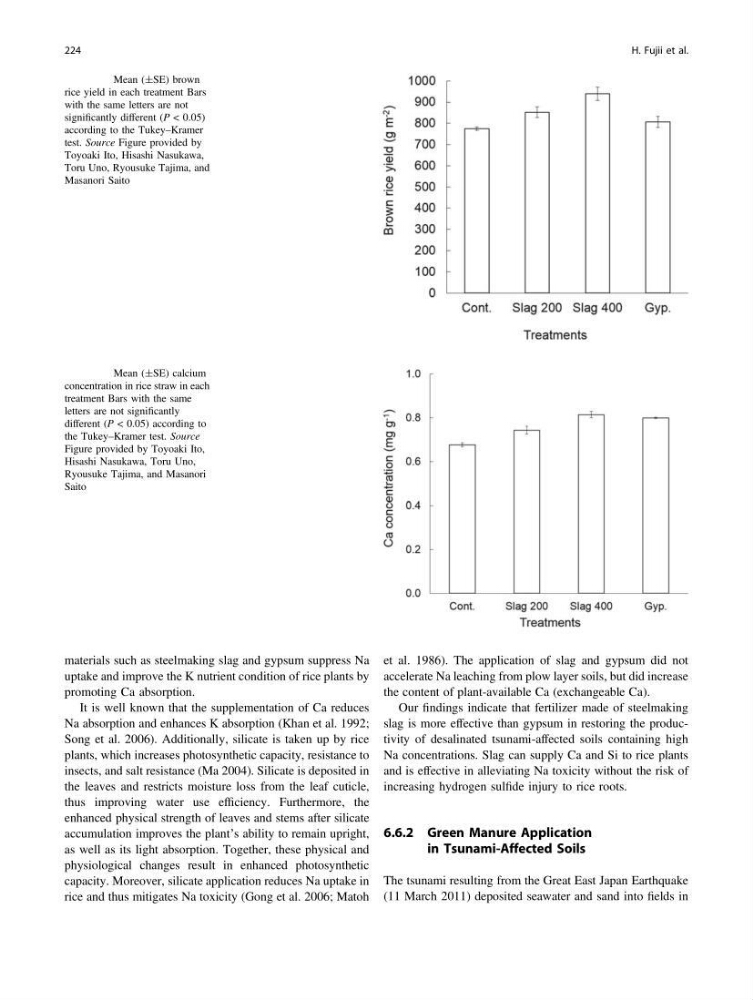
Our findings indicate that fertilizer made of steelmaking
slag is more effective than gypsum in restoring the productivity of desalinated tsunami-affected soils containing high
Na concentrations. Slag can supply Ca and Si to rice plants
and is effective in alleviating Na toxicity without the risk of
increasing hydrogen sulfide injury to rice roots.
6.6.2 Green Manure Application
in Tsunami-Affected Soils
The tsunami resulting from the Great East Japan Earthquake
(11 March 2011) deposited seawater and sand into fields in
Fig. 6.30 Mean (±SE) brown
rice yield in each treatment Bars
with the same letters are not
significantly different (P < 0.05)
according to the Tukey–Kramer
test. Source Figure provided by
Toyoaki Ito, Hisashi Nasukawa,
Toru Uno, Ryousuke Tajima, and
Masanori Saito
Fig. 6.31 Mean (±SE) calcium
concentration in rice straw in each
treatment Bars with the same
letters are not significantly
different (P < 0.05) according to
the Tukey–Kramer test. Source
Figure provided by Toyoaki Ito,
Hisashi Nasukawa, Toru Uno,
Ryousuke Tajima, and Masanori
Saito
224
H. Fujii et al.
uptake and improve the K nutrient condition of rice plants by
promoting Ca absorption.
It is well known that the supplementation of Ca reduces
Na absorption and enhances K absorption (Khan et al. 1992;
Song et al. 2006). Additionally, silicate is taken up by rice
plants, which increases photosynthetic capacity, resistance to
insects, and salt resistance (Ma 2004). Silicate is deposited in
the leaves and restricts moisture loss from the leaf cuticle,
thus improving water use efficiency. Furthermore, the
enhanced physical strength of leaves and stems after silicate
accumulation improves the plant’s ability to remain upright,
as well as its light absorption. Together, these physical and
physiological changes result in enhanced photosynthetic
capacity. Moreover, silicate application reduces Na uptake in
rice and thus mitigates Na toxicity (Gong et al. 2006; Matoh
et al. 1986). The application of slag and gypsum did not
accelerate Na leaching from plow layer soils, but did increase
the content of plant-available Ca (exchangeable Ca).
Our findings indicate that fertilizer made of steelmaking
slag is more effective than gypsum in restoring the productivity of desalinated tsunami-affected soils containing high
Na concentrations. Slag can supply Ca and Si to rice plants
and is effective in alleviating Na toxicity without the risk of
increasing hydrogen sulfide injury to rice roots.
6.6.2 Green Manure Application
in Tsunami-Affected Soils
The tsunami resulting from the Great East Japan Earthquake
(11 March 2011) deposited seawater and sand into fields in
Fig. 6.30 Mean (±SE) brown
rice yield in each treatment Bars
with the same letters are not
significantly different (P < 0.05)
according to the Tukey–Kramer
test. Source Figure provided by
Toyoaki Ito, Hisashi Nasukawa,
Toru Uno, Ryousuke Tajima, and
Masanori Saito
Fig. 6.31 Mean (±SE) calcium
concentration in rice straw in each
treatment Bars with the same
letters are not significantly
different (P < 0.05) according to
the Tukey–Kramer test. Source
Figure provided by Toyoaki Ito,
Hisashi Nasukawa, Toru Uno,
Ryousuke Tajima, and Masanori
Saito
224
H. Fujii et al.