

nitrogen through N 2 fixation in their nodules. Accordingly,
incorporating a leguminous green manure crop provides a
large amount of nitrogen and carbon to the soil for subsequent crops. Hairy vetch (Vicia villosa Roth) is one such
leguminous cover crop that is used as green manure, as well
as for weed management. Its symbiosis with Rhizobium
leguminosarum bv. viciae can fix 100–200 kg ha
−1 year
−1
of atmospheric nitrogen. Hairy vetch has recently been used
to improve the physical properties of the soil in the Hachirogata Polder in Akita Prefecture (Sato et al. 2007). Succeeding soybean yield was found to increase when hairy
vetch was planted in an upland field converted from a paddy
field (Sato et al. 2011).
In the Tohoku region, hairy vetch seeds are generally
sown at a density of 3 g m
−2 (approximately 200 seeds per
square meter) in September to October. The hairy vetch in
the field germinates two weeks after sowing and grows until
the winter. The hairy vetch can overwinter in this state and
grows vigorously from April to June the next year. During
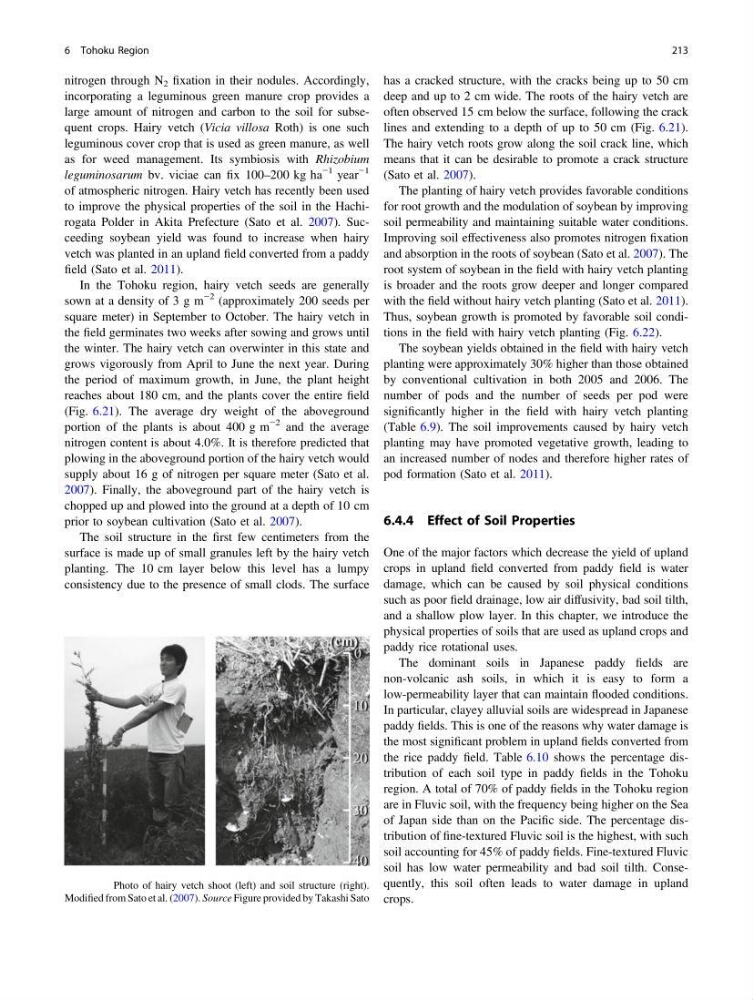
the period of maximum growth, in June, the plant height
reaches about 180 cm, and the plants cover the entire field
(Fig. 6.21). The average dry weight of the aboveground
portion of the plants is about 400 g m
−2 and the average
nitrogen content is about 4.0%. It is therefore predicted that
plowing in the aboveground portion of the hairy vetch would
supply about 16 g of nitrogen per square meter (Sato et al.
2007). Finally, the aboveground part of the hairy vetch is
chopped up and plowed into the ground at a depth of 10 cm
prior to soybean cultivation (Sato et al. 2007).
The soil structure in the first few centimeters from the
surface is made up of small granules left by the hairy vetch
planting. The 10 cm layer below this level has a lumpy
consistency due to the presence of small clods. The surface
has a cracked structure, with the cracks being up to 50 cm
deep and up to 2 cm wide. The roots of the hairy vetch are
often observed 15 cm below the surface, following the crack
lines and extending to a depth of up to 50 cm (Fig. 6.21).
The hairy vetch roots grow along the soil crack line, which
means that it can be desirable to promote a crack structure
(Sato et al. 2007).
The planting of hairy vetch provides favorable conditions
for root growth and the modulation of soybean by improving
soil permeability and maintaining suitable water conditions.
Improving soil effectiveness also promotes nitrogen fixation
and absorption in the roots of soybean (Sato et al. 2007). The
root system of soybean in the field with hairy vetch planting
is broader and the roots grow deeper and longer compared
with the field without hairy vetch planting (Sato et al. 2011).
Thus, soybean growth is promoted by favorable soil conditions in the field with hairy vetch planting (Fig. 6.22).
The soybean yields obtained in the field with hairy vetch
planting were approximately 30% higher than those obtained
by conventional cultivation in both 2005 and 2006. The
number of pods and the number of seeds per pod were
significantly higher in the field with hairy vetch planting
(Table 6.9). The soil improvements caused by hairy vetch
planting may have promoted vegetative growth, leading to
an increased number of nodes and therefore higher rates of
pod formation (Sato et al. 2011).
6.4.4 Effect of Soil Properties
One of the major factors which decrease the yield of upland
crops in upland field converted from paddy field is water
damage, which can be caused by soil physical conditions
such as poor field drainage, low air diffusivity, bad soil tilth,
and a shallow plow layer. In this chapter, we introduce the
physical properties of soils that are used as upland crops and
paddy rice rotational uses.
The dominant soils in Japanese paddy fields are
non-volcanic ash soils, in which it is easy to form a
low-permeability layer that can maintain flooded conditions.
In particular, clayey alluvial soils are widespread in Japanese
paddy fields. This is one of the reasons why water damage is
the most significant problem in upland fields converted from
the rice paddy field. Table 6.10 shows the percentage distribution of each soil type in paddy fields in the Tohoku
region. A total of 70% of paddy fields in the Tohoku region
are in Fluvic soil, with the frequency being higher on the Sea
of Japan side than on the Pacific side. The percentage distribution of fine-textured Fluvic soil is the highest, with such
soil accounting for 45% of paddy fields. Fine-textured Fluvic
soil has low water permeability and bad soil tilth. Consequently, this soil often leads to water damage in upland
crops.
Fig. 6.21 Photo of hairy vetch shoot (left) and soil structure (right).
Modified from Sato et al. (2007). Source Figure provided by Takashi Sato
6 Tohoku Region
213
incorporating a leguminous green manure crop provides a
large amount of nitrogen and carbon to the soil for subsequent crops. Hairy vetch (Vicia villosa Roth) is one such
leguminous cover crop that is used as green manure, as well
as for weed management. Its symbiosis with Rhizobium
leguminosarum bv. viciae can fix 100–200 kg ha
−1 year
−1
of atmospheric nitrogen. Hairy vetch has recently been used
to improve the physical properties of the soil in the Hachirogata Polder in Akita Prefecture (Sato et al. 2007). Succeeding soybean yield was found to increase when hairy
vetch was planted in an upland field converted from a paddy
field (Sato et al. 2011).
In the Tohoku region, hairy vetch seeds are generally
sown at a density of 3 g m
−2 (approximately 200 seeds per
square meter) in September to October. The hairy vetch in
the field germinates two weeks after sowing and grows until
the winter. The hairy vetch can overwinter in this state and
grows vigorously from April to June the next year. During
the period of maximum growth, in June, the plant height
reaches about 180 cm, and the plants cover the entire field
(Fig. 6.21). The average dry weight of the aboveground
portion of the plants is about 400 g m
−2 and the average
nitrogen content is about 4.0%. It is therefore predicted that
plowing in the aboveground portion of the hairy vetch would
supply about 16 g of nitrogen per square meter (Sato et al.
2007). Finally, the aboveground part of the hairy vetch is
chopped up and plowed into the ground at a depth of 10 cm
prior to soybean cultivation (Sato et al. 2007).
The soil structure in the first few centimeters from the
surface is made up of small granules left by the hairy vetch
planting. The 10 cm layer below this level has a lumpy
consistency due to the presence of small clods. The surface
has a cracked structure, with the cracks being up to 50 cm
deep and up to 2 cm wide. The roots of the hairy vetch are
often observed 15 cm below the surface, following the crack
lines and extending to a depth of up to 50 cm (Fig. 6.21).
The hairy vetch roots grow along the soil crack line, which
means that it can be desirable to promote a crack structure
(Sato et al. 2007).
The planting of hairy vetch provides favorable conditions
for root growth and the modulation of soybean by improving
soil permeability and maintaining suitable water conditions.
Improving soil effectiveness also promotes nitrogen fixation
and absorption in the roots of soybean (Sato et al. 2007). The
root system of soybean in the field with hairy vetch planting
is broader and the roots grow deeper and longer compared
with the field without hairy vetch planting (Sato et al. 2011).
Thus, soybean growth is promoted by favorable soil conditions in the field with hairy vetch planting (Fig. 6.22).
The soybean yields obtained in the field with hairy vetch
planting were approximately 30% higher than those obtained
by conventional cultivation in both 2005 and 2006. The
number of pods and the number of seeds per pod were
significantly higher in the field with hairy vetch planting
(Table 6.9). The soil improvements caused by hairy vetch
planting may have promoted vegetative growth, leading to
an increased number of nodes and therefore higher rates of
pod formation (Sato et al. 2011).
6.4.4 Effect of Soil Properties
One of the major factors which decrease the yield of upland
crops in upland field converted from paddy field is water
damage, which can be caused by soil physical conditions
such as poor field drainage, low air diffusivity, bad soil tilth,
and a shallow plow layer. In this chapter, we introduce the
physical properties of soils that are used as upland crops and
paddy rice rotational uses.
The dominant soils in Japanese paddy fields are
non-volcanic ash soils, in which it is easy to form a
low-permeability layer that can maintain flooded conditions.
In particular, clayey alluvial soils are widespread in Japanese
paddy fields. This is one of the reasons why water damage is
the most significant problem in upland fields converted from
the rice paddy field. Table 6.10 shows the percentage distribution of each soil type in paddy fields in the Tohoku
region. A total of 70% of paddy fields in the Tohoku region
are in Fluvic soil, with the frequency being higher on the Sea
of Japan side than on the Pacific side. The percentage distribution of fine-textured Fluvic soil is the highest, with such
soil accounting for 45% of paddy fields. Fine-textured Fluvic
soil has low water permeability and bad soil tilth. Consequently, this soil often leads to water damage in upland
crops.
Fig. 6.21 Photo of hairy vetch shoot (left) and soil structure (right).
Modified from Sato et al. (2007). Source Figure provided by Takashi Sato
6 Tohoku Region
213