

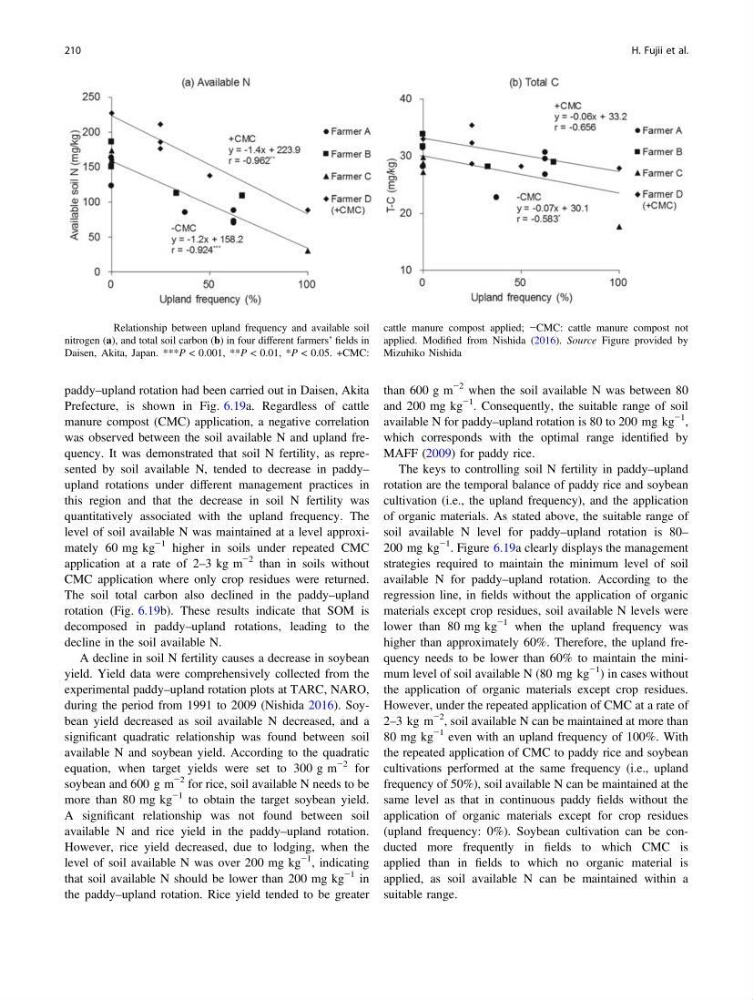
paddy–upland rotation had been carried out in Daisen, Akita
Prefecture, is shown in Fig. 6.19a. Regardless of cattle
manure compost (CMC) application, a negative correlation
was observed between the soil available N and upland frequency. It was demonstrated that soil N fertility, as represented by soil available N, tended to decrease in paddy–
upland rotations under different management practices in
this region and that the decrease in soil N fertility was
quantitatively associated with the upland frequency. The
level of soil available N was maintained at a level approximately 60 mg kg
−1 higher in soils under repeated CMC
application at a rate of 2–3 kg m
−2 than in soils without
CMC application where only crop residues were returned.
The soil total carbon also declined in the paddy–upland
rotation (Fig. 6.19b). These results indicate that SOM is
decomposed in paddy–upland rotations, leading to the
decline in the soil available N.
A decline in soil N fertility causes a decrease in soybean
yield. Yield data were comprehensively collected from the
experimental paddy–upland rotation plots at TARC, NARO,
during the period from 1991 to 2009 (Nishida 2016). Soybean yield decreased as soil available N decreased, and a
significant quadratic relationship was found between soil
available N and soybean yield. According to the quadratic
equation, when target yields were set to 300 g m
−2 for
soybean and 600 g m
−2 for rice, soil available N needs to be
more than 80 mg kg
−1 to obtain the target soybean yield.
A significant relationship was not found between soil
available N and rice yield in the paddy–upland rotation.
However, rice yield decreased, due to lodging, when the
level of soil available N was over 200 mg kg
−1 , indicating
that soil available N should be lower than 200 mg kg
−1 in
the paddy–upland rotation. Rice yield tended to be greater
than 600 g m
−2 when the soil available N was between 80
and 200 mg kg
−1
. Consequently, the suitable range of soil
available N for paddy–upland rotation is 80 to 200 mg kg
−1 ,
which corresponds with the optimal range identified by
MAFF (2009) for paddy rice.
The keys to controlling soil N fertility in paddy–upland
rotation are the temporal balance of paddy rice and soybean
cultivation (i.e., the upland frequency), and the application
of organic materials. As stated above, the suitable range of
soil available N level for paddy–upland rotation is 80–
200 mg kg
−1 . Figure 6.19a clearly displays the management
strategies required to maintain the minimum level of soil
available N for paddy–upland rotation. According to the
regression line, in fields without the application of organic
materials except crop residues, soil available N levels were
lower than 80 mg kg
−1 when the upland frequency was
higher than approximately 60%. Therefore, the upland frequency needs to be lower than 60% to maintain the minimum level of soil available N (80 mg kg
−1 ) in cases without
the application of organic materials except crop residues.
However, under the repeated application of CMC at a rate of
2–3 kg m
−2 , soil available N can be maintained at more than
80 mg kg
−1 even with an upland frequency of 100%. With
the repeated application of CMC to paddy rice and soybean
cultivations performed at the same frequency (i.e., upland
frequency of 50%), soil available N can be maintained at the
same level as that in continuous paddy fields without the
application of organic materials except for crop residues
(upland frequency: 0%). Soybean cultivation can be conducted more frequently in fields to which CMC is
applied than in fields to which no organic material is
applied, as soil available N can be maintained within a
suitable range.
Fig. 6.19 Relationship between upland frequency and available soil
nitrogen (a), and total soil carbon (b) in four different farmers’ fields in
Daisen, Akita, Japan. ***P < 0.001, **P < 0.01, *P < 0.05. +CMC:
cattle manure compost applied; −CMC: cattle manure compost not
applied. Modified from Nishida (2016). Source Figure provided by
Mizuhiko Nishida
210
H. Fujii et al.
Prefecture, is shown in Fig. 6.19a. Regardless of cattle
manure compost (CMC) application, a negative correlation
was observed between the soil available N and upland frequency. It was demonstrated that soil N fertility, as represented by soil available N, tended to decrease in paddy–
upland rotations under different management practices in
this region and that the decrease in soil N fertility was
quantitatively associated with the upland frequency. The
level of soil available N was maintained at a level approximately 60 mg kg
−1 higher in soils under repeated CMC
application at a rate of 2–3 kg m
−2 than in soils without
CMC application where only crop residues were returned.
The soil total carbon also declined in the paddy–upland
rotation (Fig. 6.19b). These results indicate that SOM is
decomposed in paddy–upland rotations, leading to the
decline in the soil available N.
A decline in soil N fertility causes a decrease in soybean
yield. Yield data were comprehensively collected from the
experimental paddy–upland rotation plots at TARC, NARO,
during the period from 1991 to 2009 (Nishida 2016). Soybean yield decreased as soil available N decreased, and a
significant quadratic relationship was found between soil
available N and soybean yield. According to the quadratic
equation, when target yields were set to 300 g m
−2 for
soybean and 600 g m
−2 for rice, soil available N needs to be
more than 80 mg kg
−1 to obtain the target soybean yield.
A significant relationship was not found between soil
available N and rice yield in the paddy–upland rotation.
However, rice yield decreased, due to lodging, when the
level of soil available N was over 200 mg kg
−1 , indicating
that soil available N should be lower than 200 mg kg
−1 in
the paddy–upland rotation. Rice yield tended to be greater
than 600 g m
−2 when the soil available N was between 80
and 200 mg kg
−1
. Consequently, the suitable range of soil
available N for paddy–upland rotation is 80 to 200 mg kg
−1 ,
which corresponds with the optimal range identified by
MAFF (2009) for paddy rice.
The keys to controlling soil N fertility in paddy–upland
rotation are the temporal balance of paddy rice and soybean
cultivation (i.e., the upland frequency), and the application
of organic materials. As stated above, the suitable range of
soil available N level for paddy–upland rotation is 80–
200 mg kg
−1 . Figure 6.19a clearly displays the management
strategies required to maintain the minimum level of soil
available N for paddy–upland rotation. According to the
regression line, in fields without the application of organic
materials except crop residues, soil available N levels were
lower than 80 mg kg
−1 when the upland frequency was
higher than approximately 60%. Therefore, the upland frequency needs to be lower than 60% to maintain the minimum level of soil available N (80 mg kg
−1 ) in cases without
the application of organic materials except crop residues.
However, under the repeated application of CMC at a rate of
2–3 kg m
−2 , soil available N can be maintained at more than
80 mg kg
−1 even with an upland frequency of 100%. With
the repeated application of CMC to paddy rice and soybean
cultivations performed at the same frequency (i.e., upland
frequency of 50%), soil available N can be maintained at the
same level as that in continuous paddy fields without the
application of organic materials except for crop residues
(upland frequency: 0%). Soybean cultivation can be conducted more frequently in fields to which CMC is
applied than in fields to which no organic material is
applied, as soil available N can be maintained within a
suitable range.
Fig. 6.19 Relationship between upland frequency and available soil
nitrogen (a), and total soil carbon (b) in four different farmers’ fields in
Daisen, Akita, Japan. ***P < 0.001, **P < 0.01, *P < 0.05. +CMC:
cattle manure compost applied; −CMC: cattle manure compost not
applied. Modified from Nishida (2016). Source Figure provided by
Mizuhiko Nishida
210
H. Fujii et al.