

maize (Zea mays L.) as a main crop. AM colonization by
indigenous fungi increased the P uptake and growth of corn
(Deguchi et al. 2012). Furthermore, the yield and total
digestible nutritional yield of the corn with living mulch and
with no P application was comparable to the maximum yield
of corn without living mulch and with P application, suggesting that white clover living mulch reduced the need for
the application of P fertilizer to silage corn under field
conditions (Deguchi et al. 2017).
6.4 Paddy–Upland Rotation
6.4.1 Nitrogen Fertility
In Japan, rice supply has exceeded domestic demand and
rice production has been adjusted accordingly for about
40 years. A typical adjustment is the rotation of paddy rice
(Oryza sativa L.) in paddy fields and upland crops in drained
paddy fields, which has been promoted to improve the
self-sufficiency rates in upland crops. Soybean (Glycine max
(L.) Merr.) is a major crop in this rotation sequence in the
Tohoku region. In leading soybean-producing countries,
namely, the United States and Brazil, the yield of soybean
has increased to almost 300 g m
−2 , whereas the yield of
soybean in drained paddy fields in Japan remains as low as
about 150 g m
−2 . The principal problem might be that
soybean plants can easily suffer from water damage in the
poorly drained paddy fields. A decline in the fertility of
paddy soil, where the crop rotation of paddy rice and upland
soybean (paddy–upland rotation) has been continued, has
recently received attention as another reason for the stagnation of soybean yield.
In a long-term field experiment conducted at TARC,
NARO (N39°29′, E140°30′, altitude 30 m a.s.l.), a decline in
the soil available nitrogen (N), which was mineralized from
air-dried soil under submerged conditions at 30 °C for
4 weeks, was observed (Sumida et al. 2005; Nishida 2016).
This field experiment with paddy–upland rotation consisted
of three treatments for upland frequency. The upland frequency was defined as the ratio of the number of soybean
cropping years to total cropping years after initiation of the
paddy–upland rotation. The experimental treatments were
short-term upland rotation, medium-term upland rotation,
and continuously irrigated paddy. In the short-term upland
rotation, soybean and paddy rice were planted with a cycle
of approximately 1 year of upland (soybean cultivation) and
2 years of paddy (rice cultivation) (upland frequency: about
35%). In the medium-term upland rotation, a cycle of
approximately 3 years of upland and 1 year of paddy was
adopted (upland frequency: about 75%). Sub-treatment, with
or without the repeated application of organic matter, was
performed in each treatment for upland frequency. The soil
was classified as fine-textured Gray Fluvic soil (Fluvisol,
United Nations Food and Agriculture Organization 2006).
The level of soil available N declined in the paddy–upland
rotations, regardless of upland frequency, with a greater
decrease in soil available N being observed in the
medium-term upland rotation than in the short-term upland
rotation. The decline in soil available N was alleviated by the
application of organic materials. The level of total carbon in
the soil also decreased in the paddy–upland rotation.
An investigation of the soil fertility in farmers’ fields with
paddy–upland rotation was also conducted (Nishida et al.
2013). The relationship between levels of soil available N
and upland frequency in four different farmers’ fields where
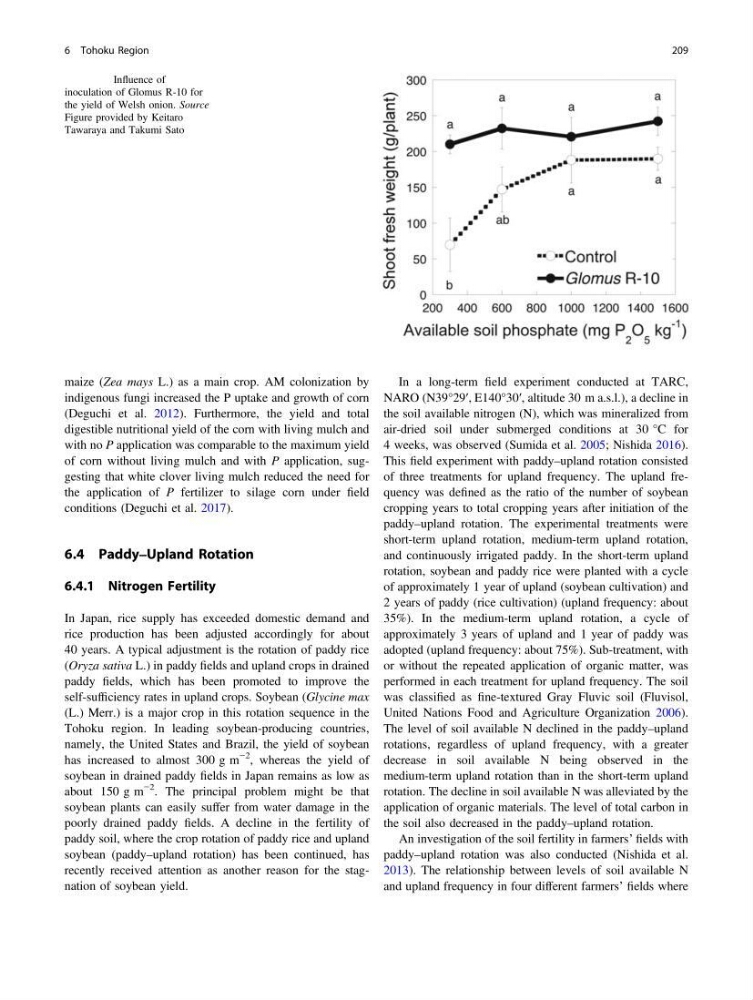
Fig. 6.18 Influence of
inoculation of Glomus R-10 for
the yield of Welsh onion. Source
Figure provided by Keitaro
Tawaraya and Takumi Sato
6 Tohoku Region
209
indigenous fungi increased the P uptake and growth of corn
(Deguchi et al. 2012). Furthermore, the yield and total
digestible nutritional yield of the corn with living mulch and
with no P application was comparable to the maximum yield
of corn without living mulch and with P application, suggesting that white clover living mulch reduced the need for
the application of P fertilizer to silage corn under field
conditions (Deguchi et al. 2017).
6.4 Paddy–Upland Rotation
6.4.1 Nitrogen Fertility
In Japan, rice supply has exceeded domestic demand and
rice production has been adjusted accordingly for about
40 years. A typical adjustment is the rotation of paddy rice
(Oryza sativa L.) in paddy fields and upland crops in drained
paddy fields, which has been promoted to improve the
self-sufficiency rates in upland crops. Soybean (Glycine max
(L.) Merr.) is a major crop in this rotation sequence in the
Tohoku region. In leading soybean-producing countries,
namely, the United States and Brazil, the yield of soybean
has increased to almost 300 g m
−2 , whereas the yield of
soybean in drained paddy fields in Japan remains as low as
about 150 g m
−2 . The principal problem might be that
soybean plants can easily suffer from water damage in the
poorly drained paddy fields. A decline in the fertility of
paddy soil, where the crop rotation of paddy rice and upland
soybean (paddy–upland rotation) has been continued, has
recently received attention as another reason for the stagnation of soybean yield.
In a long-term field experiment conducted at TARC,
NARO (N39°29′, E140°30′, altitude 30 m a.s.l.), a decline in
the soil available nitrogen (N), which was mineralized from
air-dried soil under submerged conditions at 30 °C for
4 weeks, was observed (Sumida et al. 2005; Nishida 2016).
This field experiment with paddy–upland rotation consisted
of three treatments for upland frequency. The upland frequency was defined as the ratio of the number of soybean
cropping years to total cropping years after initiation of the
paddy–upland rotation. The experimental treatments were
short-term upland rotation, medium-term upland rotation,
and continuously irrigated paddy. In the short-term upland
rotation, soybean and paddy rice were planted with a cycle
of approximately 1 year of upland (soybean cultivation) and
2 years of paddy (rice cultivation) (upland frequency: about
35%). In the medium-term upland rotation, a cycle of
approximately 3 years of upland and 1 year of paddy was
adopted (upland frequency: about 75%). Sub-treatment, with
or without the repeated application of organic matter, was
performed in each treatment for upland frequency. The soil
was classified as fine-textured Gray Fluvic soil (Fluvisol,
United Nations Food and Agriculture Organization 2006).
The level of soil available N declined in the paddy–upland
rotations, regardless of upland frequency, with a greater
decrease in soil available N being observed in the
medium-term upland rotation than in the short-term upland
rotation. The decline in soil available N was alleviated by the
application of organic materials. The level of total carbon in
the soil also decreased in the paddy–upland rotation.
An investigation of the soil fertility in farmers’ fields with
paddy–upland rotation was also conducted (Nishida et al.
2013). The relationship between levels of soil available N
and upland frequency in four different farmers’ fields where
Fig. 6.18 Influence of
inoculation of Glomus R-10 for
the yield of Welsh onion. Source
Figure provided by Keitaro
Tawaraya and Takumi Sato
6 Tohoku Region
209