

The compression and re-plowing of the plowed field
using large machinery have contributed to the thickening of
the soil. Compressed and thickened soil suppresses the
elongation of crop roots and promotes excessive wetness,
thus hampering the growth and harvest of crops and the
conversion of rice paddies into other crop fields. At the
Hachirogata reclamation area, the physical properties of the
soil remain a major factor determining the adaptability of
machines to fields as well as the growth rates and yields of
crops. Therefore, it is essential to continue to develop soil
structures and improve the physical properties of the soil.
6.1.3 Andosols in the Tohoku Region
(1) Formation and distribution of Andosols
(1) Distribution of Andosols in the Tohoku region
A total of 111 active volcanoes are identified in Japan (Japan
Meteorological Agency 2017). Among them, 18 volcanoes
are located in the Tohoku region (Fig. 6.2). As a result,
Andosols—whose parent material is volcanic ejecta—are the
most widely distributed soils in the Tohoku region
(Fig. 6.2.); Andosols cover 36% of its total land territory,
followed by Brown Forest soils (28%), Fluvic soils (14%),
and other soil types.
Because volcanic ejecta tend to be carried towards the
eastern sides of volcanoes by westerlies in Japan, Andosols
are concentrated in areas on the Pacific Ocean side. For
instance, in Aomori Prefecture, the Towada volcano (Lake
Towada) has produced repeated huge explosions, and
Andosols are widely distributed on the stable Sanbongihara
Plateau. Additionally, in Iwate Prefecture, many volcanoes
in the Ohu Mountains and the Kitakami peneplain also
contributed to the formation of Andosols.
(2) Distribution of Andosols in arable lands
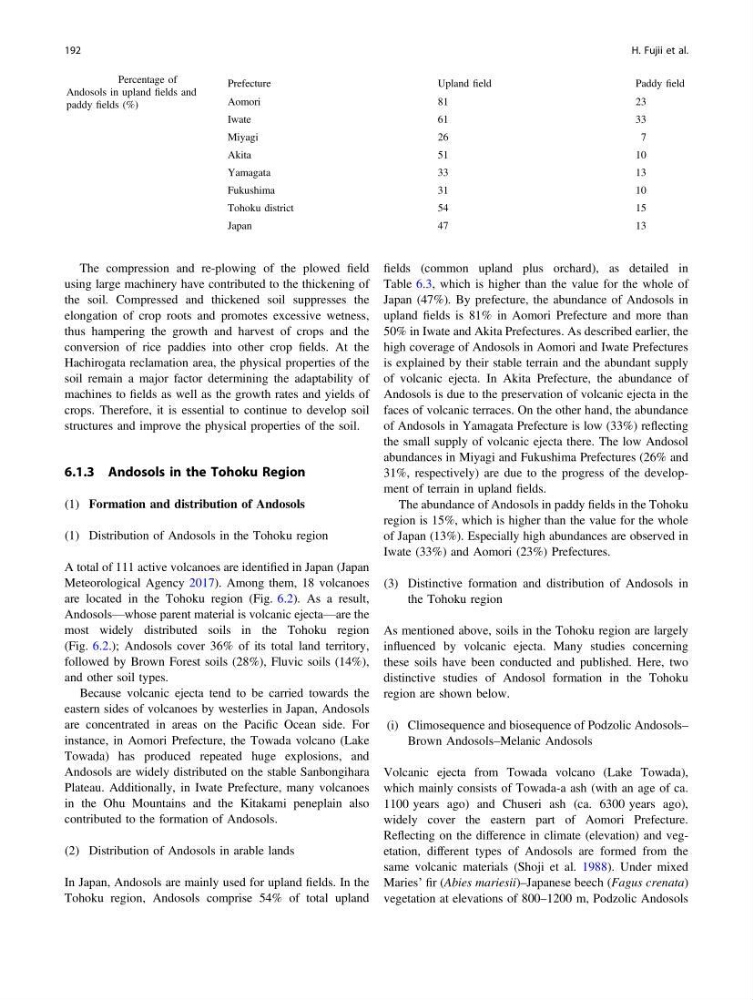
In Japan, Andosols are mainly used for upland fields. In the
Tohoku region, Andosols comprise 54% of total upland
fields (common upland plus orchard), as detailed in
Table 6.3, which is higher than the value for the whole of
Japan (47%). By prefecture, the abundance of Andosols in
upland fields is 81% in Aomori Prefecture and more than
50% in Iwate and Akita Prefectures. As described earlier, the
high coverage of Andosols in Aomori and Iwate Prefectures
is explained by their stable terrain and the abundant supply
of volcanic ejecta. In Akita Prefecture, the abundance of
Andosols is due to the preservation of volcanic ejecta in the
faces of volcanic terraces. On the other hand, the abundance
of Andosols in Yamagata Prefecture is low (33%) reflecting
the small supply of volcanic ejecta there. The low Andosol
abundances in Miyagi and Fukushima Prefectures (26% and
31%, respectively) are due to the progress of the development of terrain in upland fields.
The abundance of Andosols in paddy fields in the Tohoku
region is 15%, which is higher than the value for the whole
of Japan (13%). Especially high abundances are observed in
Iwate (33%) and Aomori (23%) Prefectures.
(3) Distinctive formation and distribution of Andosols in
the Tohoku region
As mentioned above, soils in the Tohoku region are largely
influenced by volcanic ejecta. Many studies concerning
these soils have been conducted and published. Here, two
distinctive studies of Andosol formation in the Tohoku
region are shown below.
(i) Climosequence and biosequence of Podzolic Andosols–
Brown Andosols–Melanic Andosols
Volcanic ejecta from Towada volcano (Lake Towada),
which mainly consists of Towada-a ash (with an age of ca.
1100 years ago) and Chuseri ash (ca. 6300 years ago),
widely cover the eastern part of Aomori Prefecture.
Reflecting on the difference in climate (elevation) and vegetation, different types of Andosols are formed from the
same volcanic materials (Shoji et al. 1988). Under mixed
Maries’ fir (Abies mariesii)–Japanese beech (Fagus crenata)
vegetation at elevations of 800–1200 m, Podzolic Andosols
Table 6.3 Percentage of
Andosols in upland fields and
paddy fields (%)
Prefecture
Upland field
Paddy field
Aomori
81
23
Iwate
61
33
Miyagi
26
7
Akita
51
10
Yamagata
33
13
Fukushima
31
10
Tohoku district
54
15
Japan
47
13
192
H. Fujii et al.
using large machinery have contributed to the thickening of
the soil. Compressed and thickened soil suppresses the
elongation of crop roots and promotes excessive wetness,
thus hampering the growth and harvest of crops and the
conversion of rice paddies into other crop fields. At the
Hachirogata reclamation area, the physical properties of the
soil remain a major factor determining the adaptability of
machines to fields as well as the growth rates and yields of
crops. Therefore, it is essential to continue to develop soil
structures and improve the physical properties of the soil.
6.1.3 Andosols in the Tohoku Region
(1) Formation and distribution of Andosols
(1) Distribution of Andosols in the Tohoku region
A total of 111 active volcanoes are identified in Japan (Japan
Meteorological Agency 2017). Among them, 18 volcanoes
are located in the Tohoku region (Fig. 6.2). As a result,
Andosols—whose parent material is volcanic ejecta—are the
most widely distributed soils in the Tohoku region
(Fig. 6.2.); Andosols cover 36% of its total land territory,
followed by Brown Forest soils (28%), Fluvic soils (14%),
and other soil types.
Because volcanic ejecta tend to be carried towards the
eastern sides of volcanoes by westerlies in Japan, Andosols
are concentrated in areas on the Pacific Ocean side. For
instance, in Aomori Prefecture, the Towada volcano (Lake
Towada) has produced repeated huge explosions, and
Andosols are widely distributed on the stable Sanbongihara
Plateau. Additionally, in Iwate Prefecture, many volcanoes
in the Ohu Mountains and the Kitakami peneplain also
contributed to the formation of Andosols.
(2) Distribution of Andosols in arable lands
In Japan, Andosols are mainly used for upland fields. In the
Tohoku region, Andosols comprise 54% of total upland
fields (common upland plus orchard), as detailed in
Table 6.3, which is higher than the value for the whole of
Japan (47%). By prefecture, the abundance of Andosols in
upland fields is 81% in Aomori Prefecture and more than
50% in Iwate and Akita Prefectures. As described earlier, the
high coverage of Andosols in Aomori and Iwate Prefectures
is explained by their stable terrain and the abundant supply
of volcanic ejecta. In Akita Prefecture, the abundance of
Andosols is due to the preservation of volcanic ejecta in the
faces of volcanic terraces. On the other hand, the abundance
of Andosols in Yamagata Prefecture is low (33%) reflecting
the small supply of volcanic ejecta there. The low Andosol
abundances in Miyagi and Fukushima Prefectures (26% and
31%, respectively) are due to the progress of the development of terrain in upland fields.
The abundance of Andosols in paddy fields in the Tohoku
region is 15%, which is higher than the value for the whole
of Japan (13%). Especially high abundances are observed in
Iwate (33%) and Aomori (23%) Prefectures.
(3) Distinctive formation and distribution of Andosols in
the Tohoku region
As mentioned above, soils in the Tohoku region are largely
influenced by volcanic ejecta. Many studies concerning
these soils have been conducted and published. Here, two
distinctive studies of Andosol formation in the Tohoku
region are shown below.
(i) Climosequence and biosequence of Podzolic Andosols–
Brown Andosols–Melanic Andosols
Volcanic ejecta from Towada volcano (Lake Towada),
which mainly consists of Towada-a ash (with an age of ca.
1100 years ago) and Chuseri ash (ca. 6300 years ago),
widely cover the eastern part of Aomori Prefecture.
Reflecting on the difference in climate (elevation) and vegetation, different types of Andosols are formed from the
same volcanic materials (Shoji et al. 1988). Under mixed
Maries’ fir (Abies mariesii)–Japanese beech (Fagus crenata)
vegetation at elevations of 800–1200 m, Podzolic Andosols
Table 6.3 Percentage of
Andosols in upland fields and
paddy fields (%)
Prefecture
Upland field
Paddy field
Aomori
81
23
Iwate
61
33
Miyagi
26
7
Akita
51
10
Yamagata
33
13
Fukushima
31
10
Tohoku district
54
15
Japan
47
13
192
H. Fujii et al.