

The annual upper limit of compost application amount is
30 Mg ha
−1 for field crops and vegetables grown outdoors
(single harvest per year) and 50 Mg ha
−1 for vegetables
grown outdoors (two harvests per year).
5.9 Recent Topics on Soil Management
5.9.1 ICT for Soil Management
Currently, ICT is utilized in large-scale upland fields in
Hokkaido. For example, wheat harvesting is carried out
based on early-late maps of wheat maturity created using
satellite images, and tractors are equipped with automatic
steering.
Under such circumstances, variable fertilizer application
using ICT is expected as a new soil management technology.
Hara et al. (2015) constructed a system for the variable
application of nitrogen fertilizer on wheat by mounting an
optical sensor in a tractor. This system can perform variable
fertilizer application in real time based on variations in crop
growth (which corresponds to N absorption) obtained from
the sensor. The experimental results of a study using the
above system in eight fields showed that the average wheat
yield with variable fertilizer application increased by 4.0%
compared with conventional uniform fertilizer application.
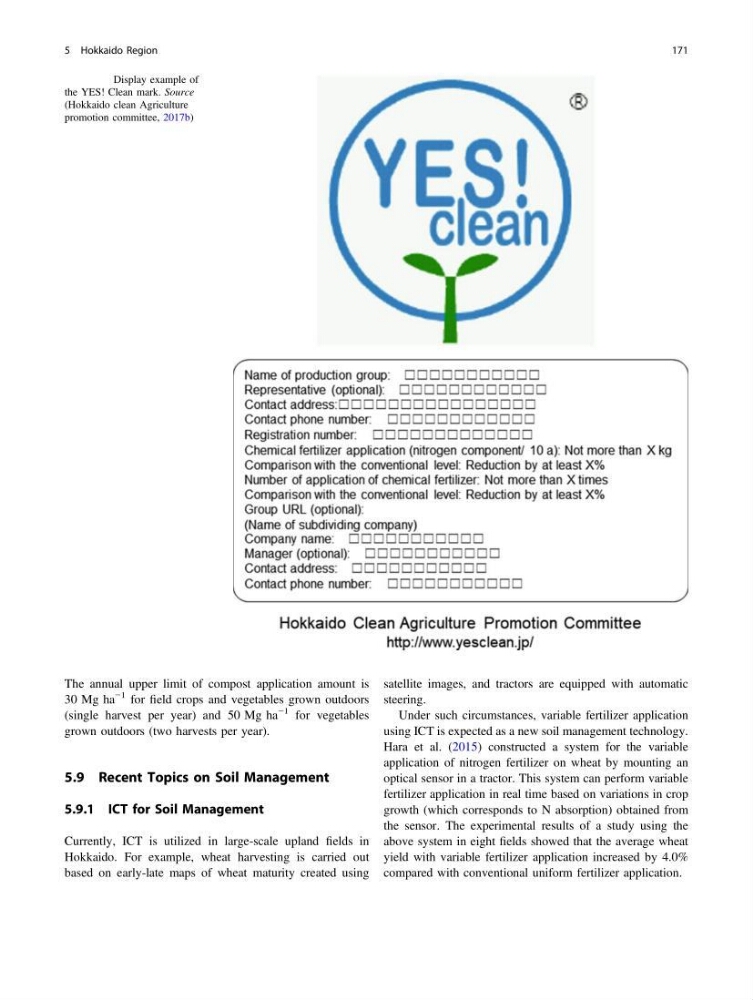
Fig. 5.13 Display example of
the YES! Clean mark. Source
(Hokkaido clean Agriculture
promotion committee, 2017b)
5 Hokkaido Region
171
30 Mg ha
−1 for field crops and vegetables grown outdoors
(single harvest per year) and 50 Mg ha
−1 for vegetables
grown outdoors (two harvests per year).
5.9 Recent Topics on Soil Management
5.9.1 ICT for Soil Management
Currently, ICT is utilized in large-scale upland fields in
Hokkaido. For example, wheat harvesting is carried out
based on early-late maps of wheat maturity created using
satellite images, and tractors are equipped with automatic
steering.
Under such circumstances, variable fertilizer application
using ICT is expected as a new soil management technology.
Hara et al. (2015) constructed a system for the variable
application of nitrogen fertilizer on wheat by mounting an
optical sensor in a tractor. This system can perform variable
fertilizer application in real time based on variations in crop
growth (which corresponds to N absorption) obtained from
the sensor. The experimental results of a study using the
above system in eight fields showed that the average wheat
yield with variable fertilizer application increased by 4.0%
compared with conventional uniform fertilizer application.
Fig. 5.13 Display example of
the YES! Clean mark. Source
(Hokkaido clean Agriculture
promotion committee, 2017b)
5 Hokkaido Region
171