

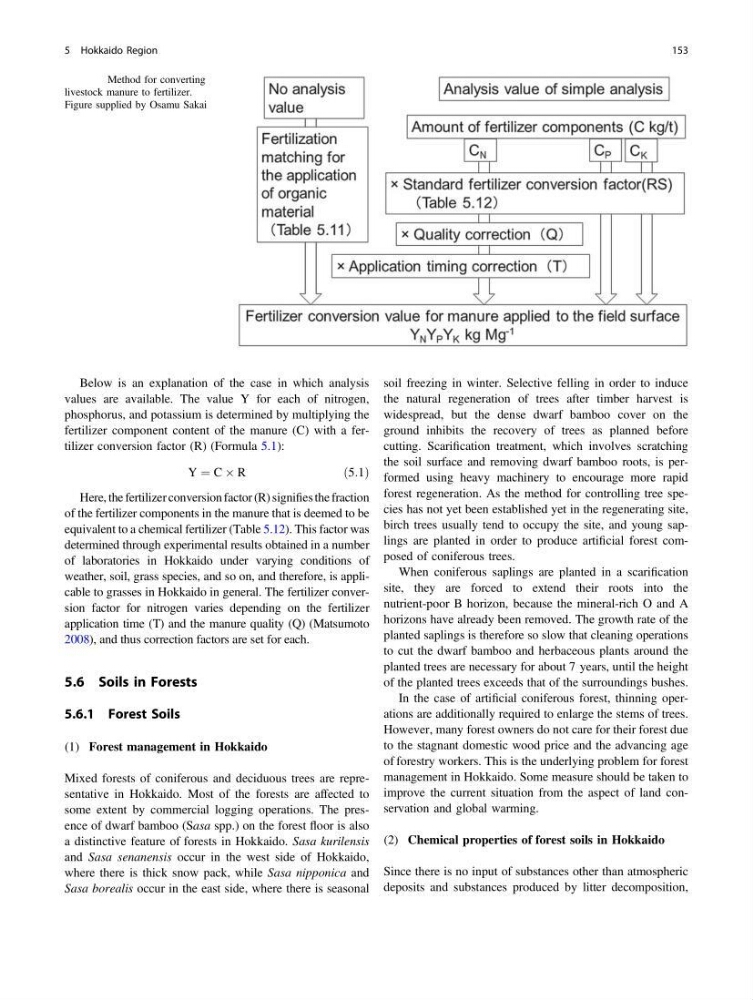
Below is an explanation of the case in which analysis
values are available. The value Y for each of nitrogen,
phosphorus, and potassium is determined by multiplying the
fertilizer component content of the manure (C) with a fertilizer conversion factor (R) (Formula 5.1):
Y ¼ C Â R
ð5:1Þ
Here, the fertilizer conversion factor (R) signifies the fraction
of the fertilizer components in the manure that is deemed to be
equivalent to a chemical fertilizer (Table 5.12). This factor was
determined through experimental results obtained in a number
of laboratories in Hokkaido under varying conditions of
weather, soil, grass species, and so on, and therefore, is applicable to grasses in Hokkaido in general. The fertilizer conversion factor for nitrogen varies depending on the fertilizer
application time (T) and the manure quality (Q) (Matsumoto
2008), and thus correction factors are set for each.
5.6 Soils in Forests
5.6.1 Forest Soils
(1) Forest management in Hokkaido
Mixed forests of coniferous and deciduous trees are representative in Hokkaido. Most of the forests are affected to
some extent by commercial logging operations. The presence of dwarf bamboo (Sasa spp.) on the forest floor is also
a distinctive feature of forests in Hokkaido. Sasa kurilensis
and Sasa senanensis occur in the west side of Hokkaido,
where there is thick snow pack, while Sasa nipponica and
Sasa borealis occur in the east side, where there is seasonal
soil freezing in winter. Selective felling in order to induce
the natural regeneration of trees after timber harvest is
widespread, but the dense dwarf bamboo cover on the
ground inhibits the recovery of trees as planned before
cutting. Scarification treatment, which involves scratching
the soil surface and removing dwarf bamboo roots, is performed using heavy machinery to encourage more rapid
forest regeneration. As the method for controlling tree species has not yet been established yet in the regenerating site,
birch trees usually tend to occupy the site, and young saplings are planted in order to produce artificial forest composed of coniferous trees.
When coniferous saplings are planted in a scarification
site, they are forced to extend their roots into the
nutrient-poor B horizon, because the mineral-rich O and A
horizons have already been removed. The growth rate of the
planted saplings is therefore so slow that cleaning operations
to cut the dwarf bamboo and herbaceous plants around the
planted trees are necessary for about 7 years, until the height
of the planted trees exceeds that of the surroundings bushes.
In the case of artificial coniferous forest, thinning operations are additionally required to enlarge the stems of trees.
However, many forest owners do not care for their forest due
to the stagnant domestic wood price and the advancing age
of forestry workers. This is the underlying problem for forest
management in Hokkaido. Some measure should be taken to
improve the current situation from the aspect of land conservation and global warming.
(2) Chemical properties of forest soils in Hokkaido
Since there is no input of substances other than atmospheric
deposits and substances produced by litter decomposition,
Fig. 5.6 Method for converting
livestock manure to fertilizer.
Figure supplied by Osamu Sakai
5 Hokkaido Region
153
values are available. The value Y for each of nitrogen,
phosphorus, and potassium is determined by multiplying the
fertilizer component content of the manure (C) with a fertilizer conversion factor (R) (Formula 5.1):
Y ¼ C Â R
ð5:1Þ
Here, the fertilizer conversion factor (R) signifies the fraction
of the fertilizer components in the manure that is deemed to be
equivalent to a chemical fertilizer (Table 5.12). This factor was
determined through experimental results obtained in a number
of laboratories in Hokkaido under varying conditions of
weather, soil, grass species, and so on, and therefore, is applicable to grasses in Hokkaido in general. The fertilizer conversion factor for nitrogen varies depending on the fertilizer
application time (T) and the manure quality (Q) (Matsumoto
2008), and thus correction factors are set for each.
5.6 Soils in Forests
5.6.1 Forest Soils
(1) Forest management in Hokkaido
Mixed forests of coniferous and deciduous trees are representative in Hokkaido. Most of the forests are affected to
some extent by commercial logging operations. The presence of dwarf bamboo (Sasa spp.) on the forest floor is also
a distinctive feature of forests in Hokkaido. Sasa kurilensis
and Sasa senanensis occur in the west side of Hokkaido,
where there is thick snow pack, while Sasa nipponica and
Sasa borealis occur in the east side, where there is seasonal
soil freezing in winter. Selective felling in order to induce
the natural regeneration of trees after timber harvest is
widespread, but the dense dwarf bamboo cover on the
ground inhibits the recovery of trees as planned before
cutting. Scarification treatment, which involves scratching
the soil surface and removing dwarf bamboo roots, is performed using heavy machinery to encourage more rapid
forest regeneration. As the method for controlling tree species has not yet been established yet in the regenerating site,
birch trees usually tend to occupy the site, and young saplings are planted in order to produce artificial forest composed of coniferous trees.
When coniferous saplings are planted in a scarification
site, they are forced to extend their roots into the
nutrient-poor B horizon, because the mineral-rich O and A
horizons have already been removed. The growth rate of the
planted saplings is therefore so slow that cleaning operations
to cut the dwarf bamboo and herbaceous plants around the
planted trees are necessary for about 7 years, until the height
of the planted trees exceeds that of the surroundings bushes.
In the case of artificial coniferous forest, thinning operations are additionally required to enlarge the stems of trees.
However, many forest owners do not care for their forest due
to the stagnant domestic wood price and the advancing age
of forestry workers. This is the underlying problem for forest
management in Hokkaido. Some measure should be taken to
improve the current situation from the aspect of land conservation and global warming.
(2) Chemical properties of forest soils in Hokkaido
Since there is no input of substances other than atmospheric
deposits and substances produced by litter decomposition,
Fig. 5.6 Method for converting
livestock manure to fertilizer.
Figure supplied by Osamu Sakai
5 Hokkaido Region
153