

north Hokkaido, backbone ranges on Honshu, and the
Japanese Alps. Soils which correspond to wet humus
slightly podzolic soils are distributed on gently sloping land
under natural forest vegetation (e.g., Yezo spruce (Picea
jezoensis), Abies sachalinensis, Abies mariesii, Abies
veitchii, Picea jezoensis var. hondoensis, Japanese cypress
(Chamaecyparis obtusa), Japanese thuja (Thuja standishii),
Betula ermanii, and Japanese beech (Fagus crenata) from
upper temperate to subalpine zones.
The soils of the Humic subgroup are distributed in the
upper part of the zonal area of Brown Forest soils close to the
zone of Podzols. These areas of Humic subgroup soils have a
cold and humid climatic condition, which inhibits the
decomposition of litter and soil organic matter. Consequently,
these soils have Oa horizons and store large amounts of soil
organic matter. A small amount of divalent iron is detected in
the Oa and A horizons. This characteristic is similar to that of
the wet humus podzolic soils in the Classification of Forest
Soils in Japan (1976). Humic Brown Forest soils are widely
distributed in mountainous areas on Hokkaido, the mountainous backbone of Honshu, and the Japanese Alps.
The soils of the Thapto-red-yellow subgroup are thought to
correspond to a part of “reddish-brown forest soils” and
“yellowish-brown forest soils” in the Classification of Forest
Soils in Japan (1976) and to “yellow-brown forest soils” in the
Unified Soil Classification System of Japan (second approximation) (The Fourth Committee for Soil Classification and
Nomenclature, the Japanese Society of Pedology 2003). The
distribution areas of “reddish-brown forest soils” overlapped
with those of “red soils.” These soils are distributed mainly in
the Okinawa Islands and are regularly interspersed in low altitude areas due to the topography throughout Japan (Kidachi and
Ohmasa 1963). “Yellowish-brown forest soils” were distributed
with the reddish subgroup on hilly landscapes in the western part
of central Honshu. However, most “yellow-brown forest soils”
are distributed under warm temperate forest in Southwest Japan.
The soils of the Aquic subgroup are distributed in areas
with high groundwater level, such as around lakes and
marshes, plateaus, flat lands, and the bottoms of slopes.
The soils of the Epi-gleyed subgroup are developed on
plateaus on the Sea of Japan and Sea of Okhotsk coasts in
Hokkaido and on the Sea of Japan coast in the Tohoku and
Hokuriku regions.
The soils of the Eutric subgroup are distributed in close
proximity to soils of the Eutrosol great group. These soils are
derived from limestone, calcaric sediments, ultrabasic rocks
such as serpentine, and their alternative sedimentary rocks
such as sandstone.
The soils of the Haplic subgroup are generally distributed
in sloping lands under temperate and warm temperate forests, unlike the above subgroups.
4.9.5 Land Use
In Japan, about 70% of the land area is covered by forest.
Brown Forest soils have been used for tree plantation for
timber production; Japanese cedar (Cryptomeria japonica),
Japanese cypress (Chamaecyparis obtusa), and pine (Pinus
densiflora) are the major planted tree species. Japanese cedar
prefers relatively moist conditions such as those found in
lower slopes and basins. In contrast, Japanese cypress prefers slightly dry conditions because this tree species is
affected by Tokkuri disease, an abnormal overgrowth of
tissues on the lower stem that occurs in moist conditions. In
dry conditions, pine experiences less decline in growth than
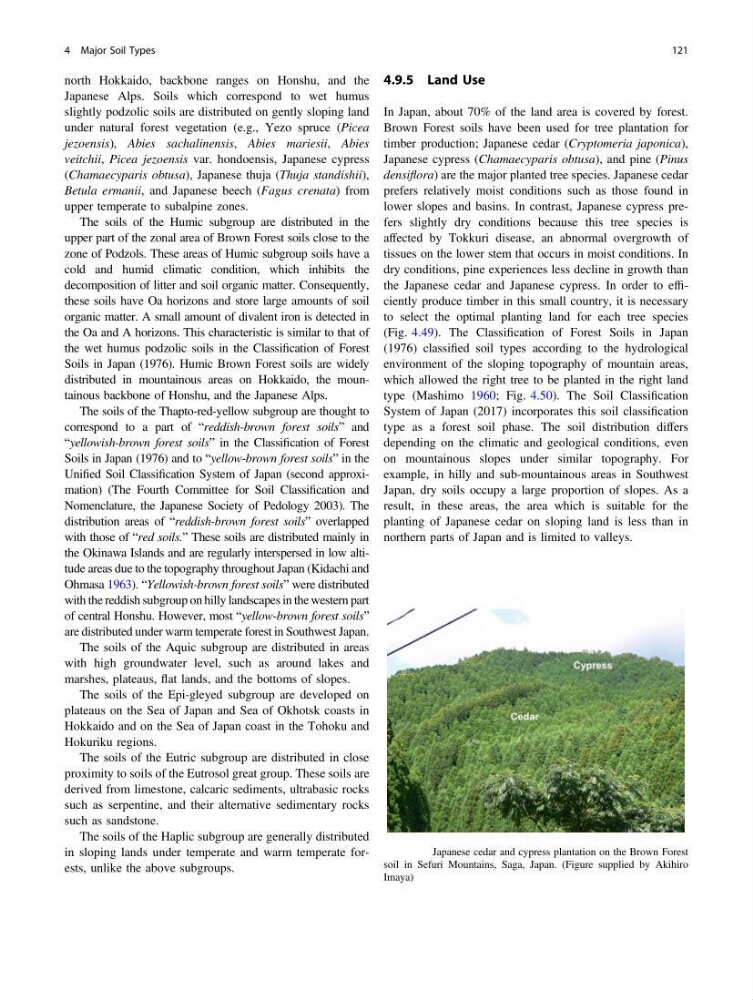
the Japanese cedar and Japanese cypress. In order to efficiently produce timber in this small country, it is necessary
to select the optimal planting land for each tree species
(Fig. 4.49). The Classification of Forest Soils in Japan
(1976) classified soil types according to the hydrological
environment of the sloping topography of mountain areas,
which allowed the right tree to be planted in the right land
type (Mashimo 1960; Fig. 4.50). The Soil Classification
System of Japan (2017) incorporates this soil classification
type as a forest soil phase. The soil distribution differs
depending on the climatic and geological conditions, even
on mountainous slopes under similar topography. For
example, in hilly and sub-mountainous areas in Southwest
Japan, dry soils occupy a large proportion of slopes. As a
result, in these areas, the area which is suitable for the
planting of Japanese cedar on sloping land is less than in
northern parts of Japan and is limited to valleys.
Fig. 4.49 Japanese cedar and cypress plantation on the Brown Forest
soil in Sefuri Mountains, Saga, Japan. (Figure supplied by Akihiro
Imaya)
4 Major Soil Types
121
Japanese Alps. Soils which correspond to wet humus
slightly podzolic soils are distributed on gently sloping land
under natural forest vegetation (e.g., Yezo spruce (Picea
jezoensis), Abies sachalinensis, Abies mariesii, Abies
veitchii, Picea jezoensis var. hondoensis, Japanese cypress
(Chamaecyparis obtusa), Japanese thuja (Thuja standishii),
Betula ermanii, and Japanese beech (Fagus crenata) from
upper temperate to subalpine zones.
The soils of the Humic subgroup are distributed in the
upper part of the zonal area of Brown Forest soils close to the
zone of Podzols. These areas of Humic subgroup soils have a
cold and humid climatic condition, which inhibits the
decomposition of litter and soil organic matter. Consequently,
these soils have Oa horizons and store large amounts of soil
organic matter. A small amount of divalent iron is detected in
the Oa and A horizons. This characteristic is similar to that of
the wet humus podzolic soils in the Classification of Forest
Soils in Japan (1976). Humic Brown Forest soils are widely
distributed in mountainous areas on Hokkaido, the mountainous backbone of Honshu, and the Japanese Alps.
The soils of the Thapto-red-yellow subgroup are thought to
correspond to a part of “reddish-brown forest soils” and
“yellowish-brown forest soils” in the Classification of Forest
Soils in Japan (1976) and to “yellow-brown forest soils” in the
Unified Soil Classification System of Japan (second approximation) (The Fourth Committee for Soil Classification and
Nomenclature, the Japanese Society of Pedology 2003). The
distribution areas of “reddish-brown forest soils” overlapped
with those of “red soils.” These soils are distributed mainly in
the Okinawa Islands and are regularly interspersed in low altitude areas due to the topography throughout Japan (Kidachi and
Ohmasa 1963). “Yellowish-brown forest soils” were distributed
with the reddish subgroup on hilly landscapes in the western part
of central Honshu. However, most “yellow-brown forest soils”
are distributed under warm temperate forest in Southwest Japan.
The soils of the Aquic subgroup are distributed in areas
with high groundwater level, such as around lakes and
marshes, plateaus, flat lands, and the bottoms of slopes.
The soils of the Epi-gleyed subgroup are developed on
plateaus on the Sea of Japan and Sea of Okhotsk coasts in
Hokkaido and on the Sea of Japan coast in the Tohoku and
Hokuriku regions.
The soils of the Eutric subgroup are distributed in close
proximity to soils of the Eutrosol great group. These soils are
derived from limestone, calcaric sediments, ultrabasic rocks
such as serpentine, and their alternative sedimentary rocks
such as sandstone.
The soils of the Haplic subgroup are generally distributed
in sloping lands under temperate and warm temperate forests, unlike the above subgroups.
4.9.5 Land Use
In Japan, about 70% of the land area is covered by forest.
Brown Forest soils have been used for tree plantation for
timber production; Japanese cedar (Cryptomeria japonica),
Japanese cypress (Chamaecyparis obtusa), and pine (Pinus
densiflora) are the major planted tree species. Japanese cedar
prefers relatively moist conditions such as those found in
lower slopes and basins. In contrast, Japanese cypress prefers slightly dry conditions because this tree species is
affected by Tokkuri disease, an abnormal overgrowth of
tissues on the lower stem that occurs in moist conditions. In
dry conditions, pine experiences less decline in growth than
the Japanese cedar and Japanese cypress. In order to efficiently produce timber in this small country, it is necessary
to select the optimal planting land for each tree species
(Fig. 4.49). The Classification of Forest Soils in Japan
(1976) classified soil types according to the hydrological
environment of the sloping topography of mountain areas,
which allowed the right tree to be planted in the right land
type (Mashimo 1960; Fig. 4.50). The Soil Classification
System of Japan (2017) incorporates this soil classification
type as a forest soil phase. The soil distribution differs
depending on the climatic and geological conditions, even
on mountainous slopes under similar topography. For
example, in hilly and sub-mountainous areas in Southwest
Japan, dry soils occupy a large proportion of slopes. As a
result, in these areas, the area which is suitable for the
planting of Japanese cedar on sloping land is less than in
northern parts of Japan and is limited to valleys.
Fig. 4.49 Japanese cedar and cypress plantation on the Brown Forest
soil in Sefuri Mountains, Saga, Japan. (Figure supplied by Akihiro
Imaya)
4 Major Soil Types
121