

classification based on soil genesis rather than classification
based on parent materials (Kurotori and Ohmasa 1963;
Mashimo 1977). For this reason, differences in soil chemical
characteristics due to soil parent materials had not been
systematically clarified. However, forest soils in Japan are
generally young due to the country’s climate and topographic conditions; as such, the influence of the parent
material on soil chemical characteristics could not be
ignored, and the necessity to set the soil class based on
parent material was advocated (Endo 1969; Matsui 1977;
Kato 1979; Wada 1986b). Differences based on the parent
materials of “brown forest soils” were later somewhat clarified by Imaya et al. (2005).
Brown-colored soils which developed under temperate
forest and which were derived from volcanic ash are classified
as Andosols, not Brown Forest soils. Typically, Andosols
have a black surface horizon; however, those which develop
under forest vegetation have a dark brown surface horizon.
Andosols with black horizons are developed under herbaceous vegetation, such as Miscanthus sinensis, contain large
amounts of type A humic acid, and are strongly blackish in
color due to advanced humification. Conversely,
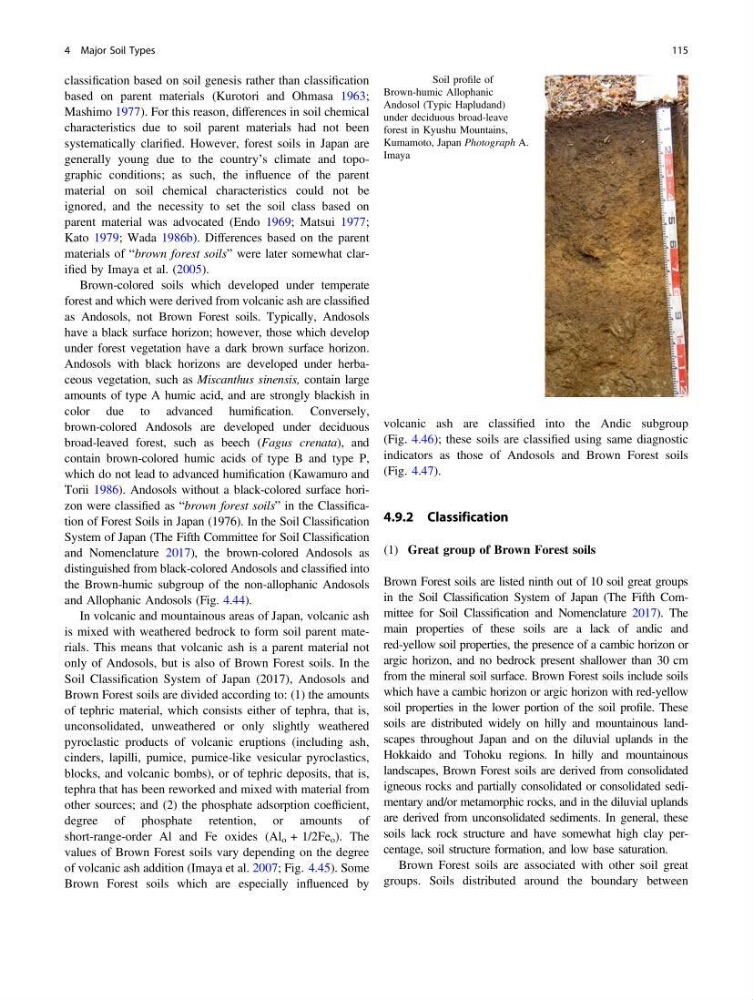
brown-colored Andosols are developed under deciduous
broad-leaved forest, such as beech (Fagus crenata), and
contain brown-colored humic acids of type B and type P,
which do not lead to advanced humification (Kawamuro and
Torii 1986). Andosols without a black-colored surface horizon were classified as “brown forest soils” in the Classification of Forest Soils in Japan (1976). In the Soil Classification
System of Japan (The Fifth Committee for Soil Classification
and Nomenclature 2017), the brown-colored Andosols as
distinguished from black-colored Andosols and classified into
the Brown-humic subgroup of the non-allophanic Andosols
and Allophanic Andosols (Fig. 4.44).
In volcanic and mountainous areas of Japan, volcanic ash
is mixed with weathered bedrock to form soil parent materials. This means that volcanic ash is a parent material not
only of Andosols, but is also of Brown Forest soils. In the
Soil Classification System of Japan (2017), Andosols and
Brown Forest soils are divided according to: (1) the amounts
of tephric material, which consists either of tephra, that is,
unconsolidated, unweathered or only slightly weathered
pyroclastic products of volcanic eruptions (including ash,
cinders, lapilli, pumice, pumice-like vesicular pyroclastics,
blocks, and volcanic bombs), or of tephric deposits, that is,
tephra that has been reworked and mixed with material from
other sources; and (2) the phosphate adsorption coefficient,
degree of phosphate retention, or amounts of
short-range-order Al and Fe oxides (Al o + 1/2Fe o ). The
values of Brown Forest soils vary depending on the degree
of volcanic ash addition (Imaya et al. 2007; Fig. 4.45). Some
Brown Forest soils which are especially influenced by
volcanic ash are classified into the Andic subgroup
(Fig. 4.46); these soils are classified using same diagnostic
indicators as those of Andosols and Brown Forest soils
(Fig. 4.47).
4.9.2 Classification
(1) Great group of Brown Forest soils
Brown Forest soils are listed ninth out of 10 soil great groups
in the Soil Classification System of Japan (The Fifth Committee for Soil Classification and Nomenclature 2017). The
main properties of these soils are a lack of andic and
red-yellow soil properties, the presence of a cambic horizon or
argic horizon, and no bedrock present shallower than 30 cm
from the mineral soil surface. Brown Forest soils include soils
which have a cambic horizon or argic horizon with red-yellow
soil properties in the lower portion of the soil profile. These
soils are distributed widely on hilly and mountainous landscapes throughout Japan and on the diluvial uplands in the
Hokkaido and Tohoku regions. In hilly and mountainous
landscapes, Brown Forest soils are derived from consolidated
igneous rocks and partially consolidated or consolidated sedimentary and/or metamorphic rocks, and in the diluvial uplands
are derived from unconsolidated sediments. In general, these
soils lack rock structure and have somewhat high clay percentage, soil structure formation, and low base saturation.
Brown Forest soils are associated with other soil great
groups. Soils distributed around the boundary between
Fig. 4.44 Soil profile of
Brown-humic Allophanic
Andosol (Typic Hapludand)
under deciduous broad-leave
forest in Kyushu Mountains,
Kumamoto, Japan Photograph A.
Imaya
4 Major Soil Types
115
based on parent materials (Kurotori and Ohmasa 1963;
Mashimo 1977). For this reason, differences in soil chemical
characteristics due to soil parent materials had not been
systematically clarified. However, forest soils in Japan are
generally young due to the country’s climate and topographic conditions; as such, the influence of the parent
material on soil chemical characteristics could not be
ignored, and the necessity to set the soil class based on
parent material was advocated (Endo 1969; Matsui 1977;
Kato 1979; Wada 1986b). Differences based on the parent
materials of “brown forest soils” were later somewhat clarified by Imaya et al. (2005).
Brown-colored soils which developed under temperate
forest and which were derived from volcanic ash are classified
as Andosols, not Brown Forest soils. Typically, Andosols
have a black surface horizon; however, those which develop
under forest vegetation have a dark brown surface horizon.
Andosols with black horizons are developed under herbaceous vegetation, such as Miscanthus sinensis, contain large
amounts of type A humic acid, and are strongly blackish in
color due to advanced humification. Conversely,
brown-colored Andosols are developed under deciduous
broad-leaved forest, such as beech (Fagus crenata), and
contain brown-colored humic acids of type B and type P,
which do not lead to advanced humification (Kawamuro and
Torii 1986). Andosols without a black-colored surface horizon were classified as “brown forest soils” in the Classification of Forest Soils in Japan (1976). In the Soil Classification
System of Japan (The Fifth Committee for Soil Classification
and Nomenclature 2017), the brown-colored Andosols as
distinguished from black-colored Andosols and classified into
the Brown-humic subgroup of the non-allophanic Andosols
and Allophanic Andosols (Fig. 4.44).
In volcanic and mountainous areas of Japan, volcanic ash
is mixed with weathered bedrock to form soil parent materials. This means that volcanic ash is a parent material not
only of Andosols, but is also of Brown Forest soils. In the
Soil Classification System of Japan (2017), Andosols and
Brown Forest soils are divided according to: (1) the amounts
of tephric material, which consists either of tephra, that is,
unconsolidated, unweathered or only slightly weathered
pyroclastic products of volcanic eruptions (including ash,
cinders, lapilli, pumice, pumice-like vesicular pyroclastics,
blocks, and volcanic bombs), or of tephric deposits, that is,
tephra that has been reworked and mixed with material from
other sources; and (2) the phosphate adsorption coefficient,
degree of phosphate retention, or amounts of
short-range-order Al and Fe oxides (Al o + 1/2Fe o ). The
values of Brown Forest soils vary depending on the degree
of volcanic ash addition (Imaya et al. 2007; Fig. 4.45). Some
Brown Forest soils which are especially influenced by
volcanic ash are classified into the Andic subgroup
(Fig. 4.46); these soils are classified using same diagnostic
indicators as those of Andosols and Brown Forest soils
(Fig. 4.47).
4.9.2 Classification
(1) Great group of Brown Forest soils
Brown Forest soils are listed ninth out of 10 soil great groups
in the Soil Classification System of Japan (The Fifth Committee for Soil Classification and Nomenclature 2017). The
main properties of these soils are a lack of andic and
red-yellow soil properties, the presence of a cambic horizon or
argic horizon, and no bedrock present shallower than 30 cm
from the mineral soil surface. Brown Forest soils include soils
which have a cambic horizon or argic horizon with red-yellow
soil properties in the lower portion of the soil profile. These
soils are distributed widely on hilly and mountainous landscapes throughout Japan and on the diluvial uplands in the
Hokkaido and Tohoku regions. In hilly and mountainous
landscapes, Brown Forest soils are derived from consolidated
igneous rocks and partially consolidated or consolidated sedimentary and/or metamorphic rocks, and in the diluvial uplands
are derived from unconsolidated sediments. In general, these
soils lack rock structure and have somewhat high clay percentage, soil structure formation, and low base saturation.
Brown Forest soils are associated with other soil great
groups. Soils distributed around the boundary between
Fig. 4.44 Soil profile of
Brown-humic Allophanic
Andosol (Typic Hapludand)
under deciduous broad-leave
forest in Kyushu Mountains,
Kumamoto, Japan Photograph A.
Imaya
4 Major Soil Types
115