

4.9.1 Genesis and Characteristics
Brown Forest soils are zonal soils under temperate to warm
temperate humid climatic conditions in Japan. Based on the
Classification of Forest Soils in Japan (Forest Soil Division
1976), the major forest soils in Japan were classified as
“brown forest soils” and were distributed from Hokkaido to
Kyushu (“Forest Soils of Japan” Editorial Committee 1983).
These “brown forest soils” referred to soils distributed not
only under forest vegetation but also under other land use
types such as grassland and cropland; nevertheless, these
soils were called “forest soils,” because vegetation usually
develops into forest under warm and humid environments in
Japan, and so it represented brown-colored soils that develop
under such circumstances. Under such forests, nutrient elements are taken up by the tree roots, which are widely and
deeply developed in the soil, supplied to the ground surface
as leaf litter, and returned to the soil by decomposition by
small animals and microorganisms. As a result, a layer of
fresh leaf litter is formed on the soil surface overlying the
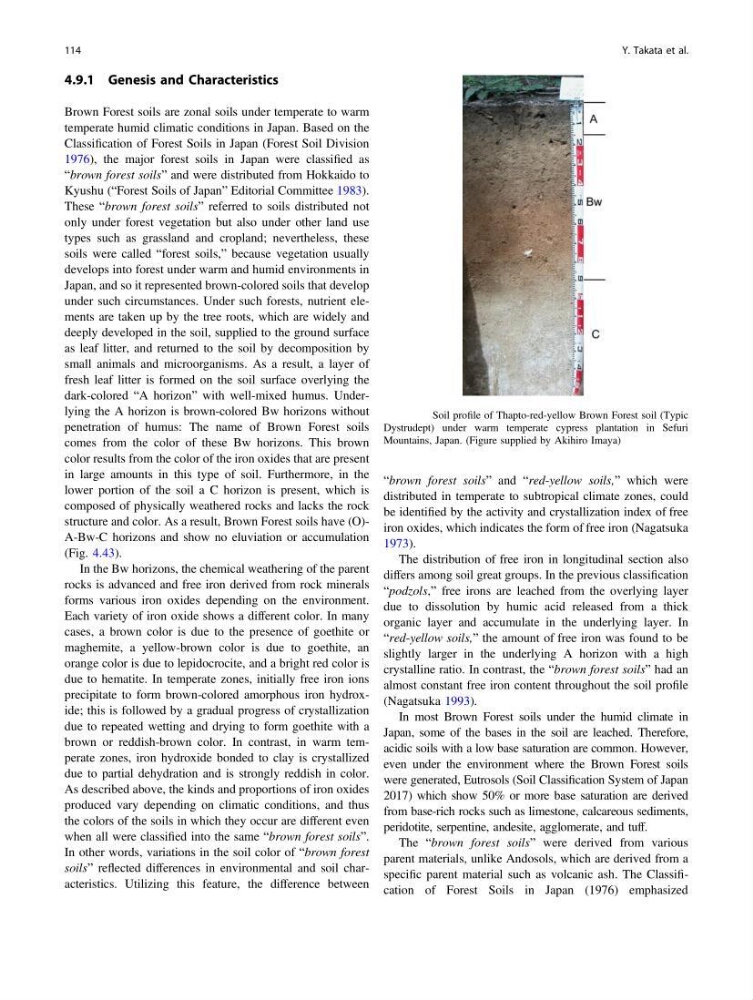
dark-colored “A horizon” with well-mixed humus. Underlying the A horizon is brown-colored Bw horizons without
penetration of humus: The name of Brown Forest soils
comes from the color of these Bw horizons. This brown
color results from the color of the iron oxides that are present
in large amounts in this type of soil. Furthermore, in the
lower portion of the soil a C horizon is present, which is
composed of physically weathered rocks and lacks the rock
structure and color. As a result, Brown Forest soils have (O)A-Bw-C horizons and show no eluviation or accumulation
(Fig. 4.43).
In the Bw horizons, the chemical weathering of the parent
rocks is advanced and free iron derived from rock minerals
forms various iron oxides depending on the environment.
Each variety of iron oxide shows a different color. In many
cases, a brown color is due to the presence of goethite or
maghemite, a yellow-brown color is due to goethite, an
orange color is due to lepidocrocite, and a bright red color is
due to hematite. In temperate zones, initially free iron ions
precipitate to form brown-colored amorphous iron hydroxide; this is followed by a gradual progress of crystallization
due to repeated wetting and drying to form goethite with a
brown or reddish-brown color. In contrast, in warm temperate zones, iron hydroxide bonded to clay is crystallized
due to partial dehydration and is strongly reddish in color.
As described above, the kinds and proportions of iron oxides
produced vary depending on climatic conditions, and thus
the colors of the soils in which they occur are different even
when all were classified into the same “brown forest soils”.
In other words, variations in the soil color of “brown forest
soils” reflected differences in environmental and soil characteristics. Utilizing this feature, the difference between
“brown forest soils” and “red-yellow soils,” which were
distributed in temperate to subtropical climate zones, could
be identified by the activity and crystallization index of free
iron oxides, which indicates the form of free iron (Nagatsuka
1973).
The distribution of free iron in longitudinal section also
differs among soil great groups. In the previous classification
“podzols,” free irons are leached from the overlying layer
due to dissolution by humic acid released from a thick
organic layer and accumulate in the underlying layer. In
“red-yellow soils,” the amount of free iron was found to be
slightly larger in the underlying A horizon with a high
crystalline ratio. In contrast, the “brown forest soils” had an
almost constant free iron content throughout the soil profile
(Nagatsuka 1993).
In most Brown Forest soils under the humid climate in
Japan, some of the bases in the soil are leached. Therefore,
acidic soils with a low base saturation are common. However,
even under the environment where the Brown Forest soils
were generated, Eutrosols (Soil Classification System of Japan
2017) which show 50% or more base saturation are derived
from base-rich rocks such as limestone, calcareous sediments,
peridotite, serpentine, andesite, agglomerate, and tuff.
The “brown forest soils” were derived from various
parent materials, unlike Andosols, which are derived from a
specific parent material such as volcanic ash. The Classification of Forest Soils in Japan (1976) emphasized
Fig. 4.43 Soil profile of Thapto-red-yellow Brown Forest soil (Typic
Dystrudept) under warm temperate cypress plantation in Sefuri
Mountains, Japan. (Figure supplied by Akihiro Imaya)
114
Y. Takata et al.
Brown Forest soils are zonal soils under temperate to warm
temperate humid climatic conditions in Japan. Based on the
Classification of Forest Soils in Japan (Forest Soil Division
1976), the major forest soils in Japan were classified as
“brown forest soils” and were distributed from Hokkaido to
Kyushu (“Forest Soils of Japan” Editorial Committee 1983).
These “brown forest soils” referred to soils distributed not
only under forest vegetation but also under other land use
types such as grassland and cropland; nevertheless, these
soils were called “forest soils,” because vegetation usually
develops into forest under warm and humid environments in
Japan, and so it represented brown-colored soils that develop
under such circumstances. Under such forests, nutrient elements are taken up by the tree roots, which are widely and
deeply developed in the soil, supplied to the ground surface
as leaf litter, and returned to the soil by decomposition by
small animals and microorganisms. As a result, a layer of
fresh leaf litter is formed on the soil surface overlying the
dark-colored “A horizon” with well-mixed humus. Underlying the A horizon is brown-colored Bw horizons without
penetration of humus: The name of Brown Forest soils
comes from the color of these Bw horizons. This brown
color results from the color of the iron oxides that are present
in large amounts in this type of soil. Furthermore, in the
lower portion of the soil a C horizon is present, which is
composed of physically weathered rocks and lacks the rock
structure and color. As a result, Brown Forest soils have (O)A-Bw-C horizons and show no eluviation or accumulation
(Fig. 4.43).
In the Bw horizons, the chemical weathering of the parent
rocks is advanced and free iron derived from rock minerals
forms various iron oxides depending on the environment.
Each variety of iron oxide shows a different color. In many
cases, a brown color is due to the presence of goethite or
maghemite, a yellow-brown color is due to goethite, an
orange color is due to lepidocrocite, and a bright red color is
due to hematite. In temperate zones, initially free iron ions
precipitate to form brown-colored amorphous iron hydroxide; this is followed by a gradual progress of crystallization
due to repeated wetting and drying to form goethite with a
brown or reddish-brown color. In contrast, in warm temperate zones, iron hydroxide bonded to clay is crystallized
due to partial dehydration and is strongly reddish in color.
As described above, the kinds and proportions of iron oxides
produced vary depending on climatic conditions, and thus
the colors of the soils in which they occur are different even
when all were classified into the same “brown forest soils”.
In other words, variations in the soil color of “brown forest
soils” reflected differences in environmental and soil characteristics. Utilizing this feature, the difference between
“brown forest soils” and “red-yellow soils,” which were
distributed in temperate to subtropical climate zones, could
be identified by the activity and crystallization index of free
iron oxides, which indicates the form of free iron (Nagatsuka
1973).
The distribution of free iron in longitudinal section also
differs among soil great groups. In the previous classification
“podzols,” free irons are leached from the overlying layer
due to dissolution by humic acid released from a thick
organic layer and accumulate in the underlying layer. In
“red-yellow soils,” the amount of free iron was found to be
slightly larger in the underlying A horizon with a high
crystalline ratio. In contrast, the “brown forest soils” had an
almost constant free iron content throughout the soil profile
(Nagatsuka 1993).
In most Brown Forest soils under the humid climate in
Japan, some of the bases in the soil are leached. Therefore,
acidic soils with a low base saturation are common. However,
even under the environment where the Brown Forest soils
were generated, Eutrosols (Soil Classification System of Japan
2017) which show 50% or more base saturation are derived
from base-rich rocks such as limestone, calcareous sediments,
peridotite, serpentine, andesite, agglomerate, and tuff.
The “brown forest soils” were derived from various
parent materials, unlike Andosols, which are derived from a
specific parent material such as volcanic ash. The Classification of Forest Soils in Japan (1976) emphasized
Fig. 4.43 Soil profile of Thapto-red-yellow Brown Forest soil (Typic
Dystrudept) under warm temperate cypress plantation in Sefuri
Mountains, Japan. (Figure supplied by Akihiro Imaya)
114
Y. Takata et al.