

also high, and bulk density is 1.2–1.4 Mg m
−3 . Due to the
compactness of the subsoil, several physical conditions of
Pseudogley soils are poor. The soils show a few coarse pores
and low hydraulic conductivity (k = 10
−6
–10
−9 m s
−1 ). As a
result, water stagnates with low rainfall and the water
damage of crops occurs easily. Moreover, as the
water-holding capacity of the soil is also small and root
penetration is limited, droughts occur easily when rainfall is
insufficient.
(3) Distribution and land use
In Japan, Pseudogley soils are mainly distributed in the
Hokkaido, Chubu, and Kinki regions, and are used as paddy
field. As flat topography and low permeability is suitable for
maintaining irrigation water, Pseudogley soils are suitable for
rice cultivation. In northern Hokkaido, which is not suitable
for rice cultivation because of its cool climate, Pseudogley
soil is used for upland and grassland. However, these uses
require the soil’s drainage condition to be improved. In
Hokkaido, subsoiling and sand dressing are common practices used to improve the poor physical conditions of Pseudogley soils. Subsoiling with a pan breaker promotes the
removal of stagnant water and the improvement of soil tilth
by breaking and softening the dense subsoils. Underdrainage
is also essential to remove stagnant water.
4.7.3 Topographic Sequence of the Terrace
The water condition depends on the microrelief of the terraces in which Stagnic soils are distributed. The water
condition influences the soil type. For example, since the
groundwater table is deep and the drainage condition is good
in areas with convex topography, the soil is in an oxidized
condition; Brown Forest soils, which are considered as drier
soils, occur in such areas. On the contrary, in areas with
concave topography or at the bottoms of slopes, surface
water gathers easily, the groundwater table becomes shallower, and soil is in a reductive condition. Hydromorphic
soils such as Stagnogley soils and Peat soils are distributed
in such areas. Pseudogley soils are commonly found in the
middles of slopes.
In the Soil Classification System of Japan (Japanese
Society of Pedology), Brown Forest soils have two subgroups, Aquic Brown Forest soils and Haplic Brown Forest
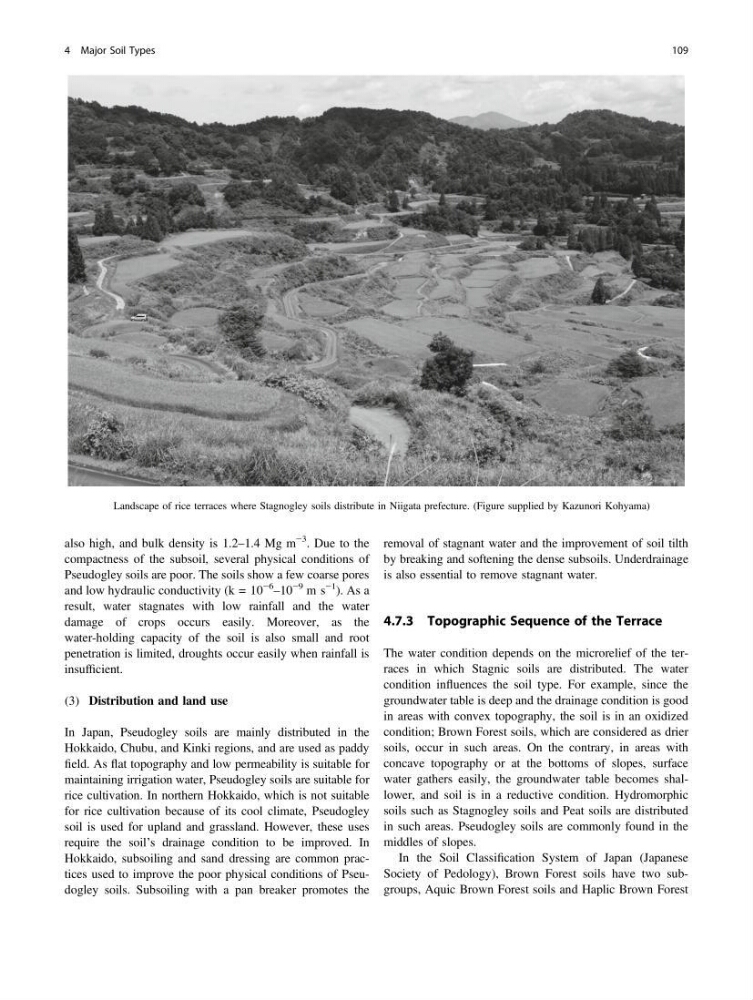
Fig. 4.38 Landscape of rice terraces where Stagnogley soils distribute in Niigata prefecture. (Figure supplied by Kazunori Kohyama)
4 Major Soil Types
109
−3 . Due to the
compactness of the subsoil, several physical conditions of
Pseudogley soils are poor. The soils show a few coarse pores
and low hydraulic conductivity (k = 10
−6
–10
−9 m s
−1 ). As a
result, water stagnates with low rainfall and the water
damage of crops occurs easily. Moreover, as the
water-holding capacity of the soil is also small and root
penetration is limited, droughts occur easily when rainfall is
insufficient.
(3) Distribution and land use
In Japan, Pseudogley soils are mainly distributed in the
Hokkaido, Chubu, and Kinki regions, and are used as paddy
field. As flat topography and low permeability is suitable for
maintaining irrigation water, Pseudogley soils are suitable for
rice cultivation. In northern Hokkaido, which is not suitable
for rice cultivation because of its cool climate, Pseudogley
soil is used for upland and grassland. However, these uses
require the soil’s drainage condition to be improved. In
Hokkaido, subsoiling and sand dressing are common practices used to improve the poor physical conditions of Pseudogley soils. Subsoiling with a pan breaker promotes the
removal of stagnant water and the improvement of soil tilth
by breaking and softening the dense subsoils. Underdrainage
is also essential to remove stagnant water.
4.7.3 Topographic Sequence of the Terrace
The water condition depends on the microrelief of the terraces in which Stagnic soils are distributed. The water
condition influences the soil type. For example, since the
groundwater table is deep and the drainage condition is good
in areas with convex topography, the soil is in an oxidized
condition; Brown Forest soils, which are considered as drier
soils, occur in such areas. On the contrary, in areas with
concave topography or at the bottoms of slopes, surface
water gathers easily, the groundwater table becomes shallower, and soil is in a reductive condition. Hydromorphic
soils such as Stagnogley soils and Peat soils are distributed
in such areas. Pseudogley soils are commonly found in the
middles of slopes.
In the Soil Classification System of Japan (Japanese
Society of Pedology), Brown Forest soils have two subgroups, Aquic Brown Forest soils and Haplic Brown Forest
Fig. 4.38 Landscape of rice terraces where Stagnogley soils distribute in Niigata prefecture. (Figure supplied by Kazunori Kohyama)
4 Major Soil Types
109