

5000 years ago (Chuseri), while podzolization restarted on
newly deposited volcanic ash about 1000 years ago
(Towada-a) under subalpine forests in Hakkoda, Northeast
Japan (Shoji et al. 1982; Ugolini et al. 1988).
Climate: Podzols require conditions of intensive leaching
(perudic to udic soil water regimes) where precipitation
exceeds evapotranspiration. Most forest soils can satisfy this
precondition, but leaching intensity is greater in alpine and
northern areas of Japan. Acidic forest litters from conifers
and a cool climate are favorable for podzolization; this is
consistent with the rarity of Podzols in tropical and subtropical regions and the localization of Podzols in alpine or
subalpine areas in Japan. The location of Podzols on a global
scale and within Japan raises questions regarding the climate
dependence (zonality) of Podzols due to the strong limitation
of Podzol formation by parent materials (Fig. 4.27). Climate
influences Podzol formation through various effects: the
dominance of conifers in alpine and northern ecosystems in
Japan, rates of mineral weathering (clay genesis), and
microbial activities to produce and consume organic acids.
Landscape: Most of the Podzols in Japan are developed
on well-drained positions on slopes, including ridges (Hirai
et al. 1988). Podzols with an ortstein (iron pan) are not
common in Japan because flat landscapes such as continental
shields are required for their formation (Bockheim 2011).
Since the resistance of Fe to acidity is stronger than that of
Al, the clear albic E horizon is also rare in Japan, except in
Podzols on sandy materials (e.g., coastal dunes). In seasonally flooded landscapes, and soils compacted by heavy
snowfall (heavy snowpack pressure), a distinct E horizon
can be formed, possibly due to seasonal Fe reduction.
Parent materials: At a global scale, the majority of Podzols are distributed in boreal forests in Northern Europe and
the East Coast of America. During the Last Glacial Maximum (18,000 years ago), these regions were covered by ice
sheets due to a relatively mild and humid climate (Fig. 4.28).
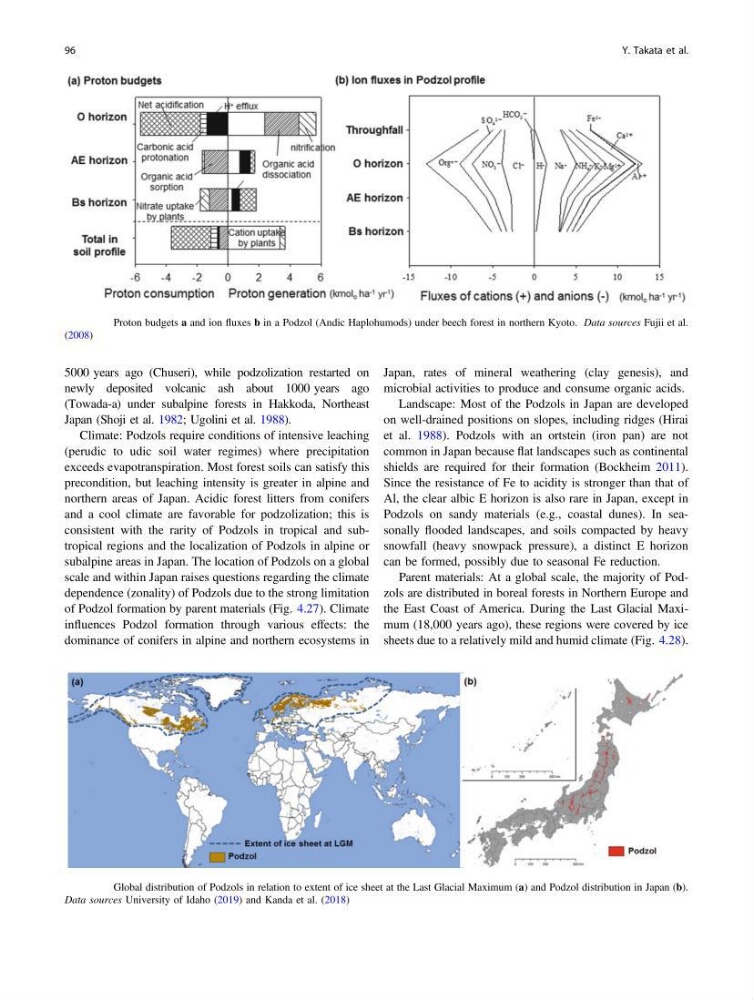
Fig. 4.26 Proton budgets a and ion fluxes b in a Podzol (Andic Haplohumods) under beech forest in northern Kyoto. Data sources Fujii et al.
(2008)
Fig. 4.27 Global distribution of Podzols in relation to extent of ice sheet at the Last Glacial Maximum (a) and Podzol distribution in Japan (b).
Data sources University of Idaho (2019) and Kanda et al. (2018)
96
Y. Takata et al.
newly deposited volcanic ash about 1000 years ago
(Towada-a) under subalpine forests in Hakkoda, Northeast
Japan (Shoji et al. 1982; Ugolini et al. 1988).
Climate: Podzols require conditions of intensive leaching
(perudic to udic soil water regimes) where precipitation
exceeds evapotranspiration. Most forest soils can satisfy this
precondition, but leaching intensity is greater in alpine and
northern areas of Japan. Acidic forest litters from conifers
and a cool climate are favorable for podzolization; this is
consistent with the rarity of Podzols in tropical and subtropical regions and the localization of Podzols in alpine or
subalpine areas in Japan. The location of Podzols on a global
scale and within Japan raises questions regarding the climate
dependence (zonality) of Podzols due to the strong limitation
of Podzol formation by parent materials (Fig. 4.27). Climate
influences Podzol formation through various effects: the
dominance of conifers in alpine and northern ecosystems in
Japan, rates of mineral weathering (clay genesis), and
microbial activities to produce and consume organic acids.
Landscape: Most of the Podzols in Japan are developed
on well-drained positions on slopes, including ridges (Hirai
et al. 1988). Podzols with an ortstein (iron pan) are not
common in Japan because flat landscapes such as continental
shields are required for their formation (Bockheim 2011).
Since the resistance of Fe to acidity is stronger than that of
Al, the clear albic E horizon is also rare in Japan, except in
Podzols on sandy materials (e.g., coastal dunes). In seasonally flooded landscapes, and soils compacted by heavy
snowfall (heavy snowpack pressure), a distinct E horizon
can be formed, possibly due to seasonal Fe reduction.
Parent materials: At a global scale, the majority of Podzols are distributed in boreal forests in Northern Europe and
the East Coast of America. During the Last Glacial Maximum (18,000 years ago), these regions were covered by ice
sheets due to a relatively mild and humid climate (Fig. 4.28).
Fig. 4.26 Proton budgets a and ion fluxes b in a Podzol (Andic Haplohumods) under beech forest in northern Kyoto. Data sources Fujii et al.
(2008)
Fig. 4.27 Global distribution of Podzols in relation to extent of ice sheet at the Last Glacial Maximum (a) and Podzol distribution in Japan (b).
Data sources University of Idaho (2019) and Kanda et al. (2018)
96
Y. Takata et al.