

(a) a y1 (exchangeable acidity) value of 5 or more; or
(b) a Si o (acid oxalate extractable silicon) value of less
than 0.6% or an Al p /Al o (ratio of pyrophosphateextractable aluminum to acid oxalate extractable
aluminum) value of 0.5 or more.
In Japan, about 30% of Andosols are non-allophanic
Andosols, whose crop productivity is markedly different
from that of Allophanic Andosols (Saigusa and Matsuyama
1998). In non-allophanic Andosols, it is difficult for crop
roots to reach the subsoil; accordingly, crops cannot take up
water and nutrients (such as inorganic nitrogen) from the
subsoil, which results in low crop growth and yield. It is
essential to correct not only surface soil acidity but also
subsoil acidity to improve crop productivity in
non-allophanic Andosols.
4.3.3 Correlation with International
Classification Systems
As already noted, the Andosol great group in the Soil
Classification System of Japan consists of six groups
(Table 4.2). In this system, soils with both podzolic and
andic properties are classified as Andosols (Fig. 4.14). These
soils are classified as Podzols in the World Reference Base
for Soil Resources (WRB) (IUSS Working Group WRB
2015). In the WRB classification system, Andosols are
keyed out before Podzols, but soils with spodic horizons are
excluded from Andosols. Similarly, these podzolized soils
are classified as Spodosols in the USDA Soil Taxonomy
(Soil Survey Staff 2014) when they have distinct bleached
horizons (albic horizons). Without albic horizons, they are
classified as Andisols.
Regosolic Andosols are soils that have undergone pedogenesis to some extent from volcanic ejecta and contain
limited amounts of short-range-order minerals and
organo-metallic complexes (Fig. 4.15). This group of
Andosols corresponds to Vitric Andosols in the WRB and
Vitrands, Vitraquands, or Udivitrands in Soil Taxonomy.
Gleyed Andosols are defined as Andosols in which a gley
horizon affected by groundwater appears within a depth of
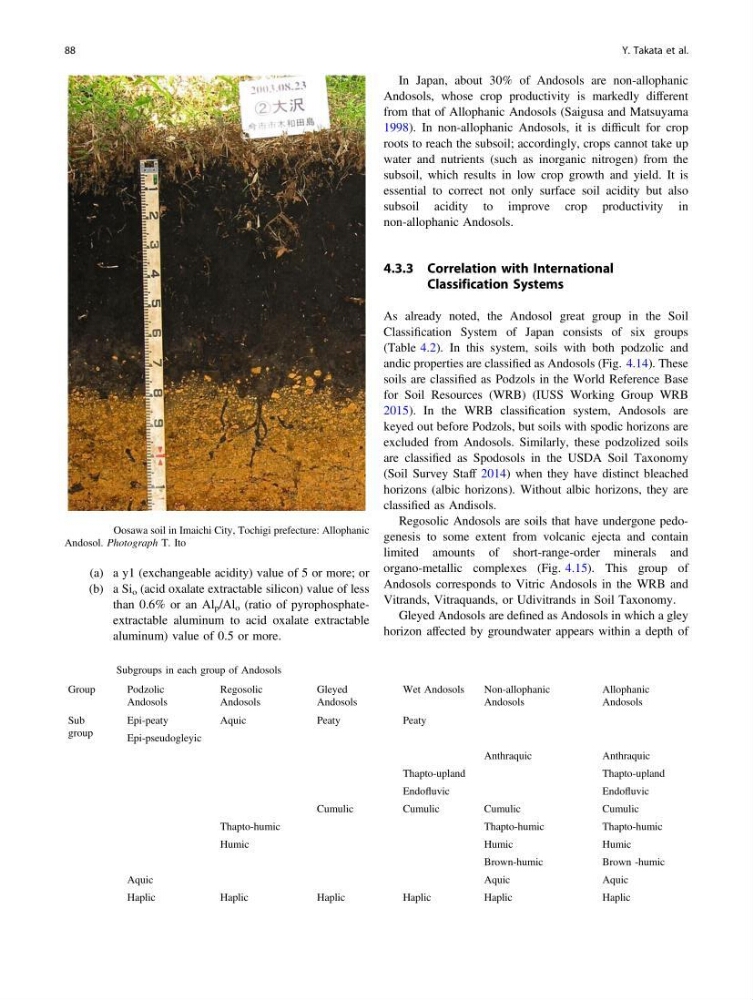
Fig. 4.18 Oosawa soil in Imaichi City, Tochigi prefecture: Allophanic
Andosol. Photograph T. Ito
Table 4.2 Subgroups in each group of Andosols
Group
Podzolic
Andosols
Regosolic
Andosols
Gleyed
Andosols
Wet Andosols
Non-allophanic
Andosols
Allophanic
Andosols
Sub
group
Epi-peaty
Aquic
Peaty
Peaty
Epi-pseudogleyic
Anthraquic
Anthraquic
Thapto-upland
Thapto-upland
Endofluvic
Endofluvic
Cumulic
Cumulic
Cumulic
Cumulic
Thapto-humic
Thapto-humic
Thapto-humic
Humic
Humic
Humic
Brown-humic
Brown -humic
Aquic
Aquic
Aquic
Haplic
Haplic
Haplic
Haplic
Haplic
Haplic
88
Y. Takata et al.
(b) a Si o (acid oxalate extractable silicon) value of less
than 0.6% or an Al p /Al o (ratio of pyrophosphateextractable aluminum to acid oxalate extractable
aluminum) value of 0.5 or more.
In Japan, about 30% of Andosols are non-allophanic
Andosols, whose crop productivity is markedly different
from that of Allophanic Andosols (Saigusa and Matsuyama
1998). In non-allophanic Andosols, it is difficult for crop
roots to reach the subsoil; accordingly, crops cannot take up
water and nutrients (such as inorganic nitrogen) from the
subsoil, which results in low crop growth and yield. It is
essential to correct not only surface soil acidity but also
subsoil acidity to improve crop productivity in
non-allophanic Andosols.
4.3.3 Correlation with International
Classification Systems
As already noted, the Andosol great group in the Soil
Classification System of Japan consists of six groups
(Table 4.2). In this system, soils with both podzolic and
andic properties are classified as Andosols (Fig. 4.14). These
soils are classified as Podzols in the World Reference Base
for Soil Resources (WRB) (IUSS Working Group WRB
2015). In the WRB classification system, Andosols are
keyed out before Podzols, but soils with spodic horizons are
excluded from Andosols. Similarly, these podzolized soils
are classified as Spodosols in the USDA Soil Taxonomy
(Soil Survey Staff 2014) when they have distinct bleached
horizons (albic horizons). Without albic horizons, they are
classified as Andisols.
Regosolic Andosols are soils that have undergone pedogenesis to some extent from volcanic ejecta and contain
limited amounts of short-range-order minerals and
organo-metallic complexes (Fig. 4.15). This group of
Andosols corresponds to Vitric Andosols in the WRB and
Vitrands, Vitraquands, or Udivitrands in Soil Taxonomy.
Gleyed Andosols are defined as Andosols in which a gley
horizon affected by groundwater appears within a depth of
Fig. 4.18 Oosawa soil in Imaichi City, Tochigi prefecture: Allophanic
Andosol. Photograph T. Ito
Table 4.2 Subgroups in each group of Andosols
Group
Podzolic
Andosols
Regosolic
Andosols
Gleyed
Andosols
Wet Andosols
Non-allophanic
Andosols
Allophanic
Andosols
Sub
group
Epi-peaty
Aquic
Peaty
Peaty
Epi-pseudogleyic
Anthraquic
Anthraquic
Thapto-upland
Thapto-upland
Endofluvic
Endofluvic
Cumulic
Cumulic
Cumulic
Cumulic
Thapto-humic
Thapto-humic
Thapto-humic
Humic
Humic
Humic
Brown-humic
Brown -humic
Aquic
Aquic
Aquic
Haplic
Haplic
Haplic
Haplic
Haplic
Haplic
88
Y. Takata et al.