

74
M. Conte Grand
are under the best scenario (strong decoupling) 45% have high incomes while only
3% have low income levels.
Around 70% of the countries that strongly decoupled GHG emissions and GDP
between 1990 and 2012 reduced the industrial sector share of their economies,
and 78% increased the participation of the value added of services. Even if those
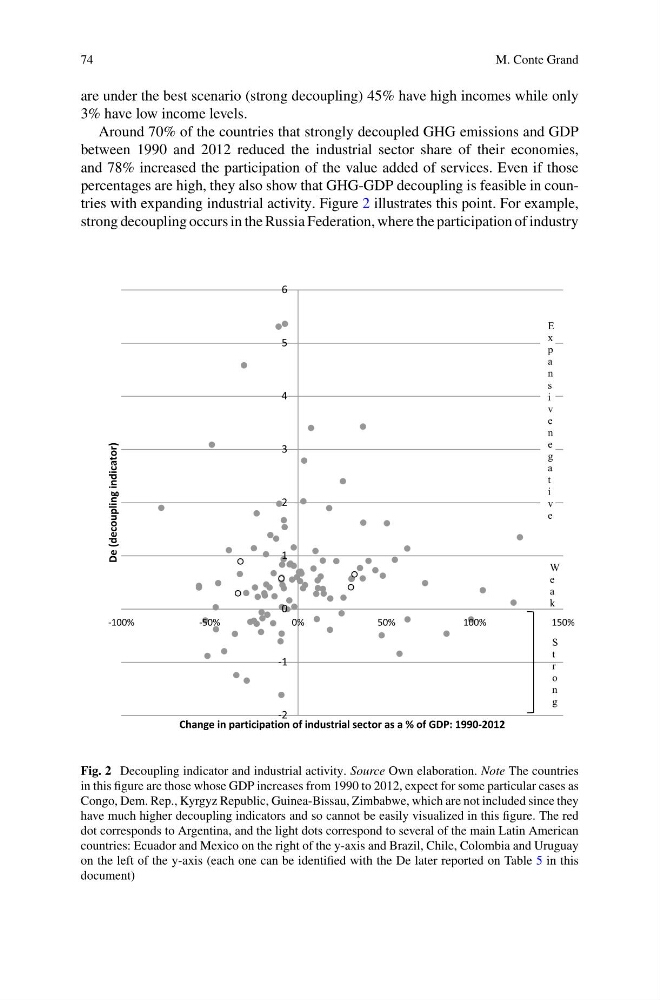
percentages are high, they also show that GHG-GDP decoupling is feasible in countries with expanding industrial activity. Figure 2 illustrates this point. For example,
strong decoupling occurs in the Russia Federation, where the participation of industry
Fig. 2 Decoupling indicator and industrial activity. Source Own elaboration. Note The countries
in this figure are those whose GDP increases from 1990 to 2012, expect for some particular cases as
Congo, Dem. Rep., Kyrgyz Republic, Guinea-Bissau, Zimbabwe, which are not included since they
have much higher decoupling indicators and so cannot be easily visualized in this figure. The red
dot corresponds to Argentina, and the light dots correspond to several of the main Latin American
countries: Ecuador and Mexico on the right of the y-axis and Brazil, Chile, Colombia and Uruguay
on the left of the y-axis (each one can be identified with the De later reported on Table 5 in this
document)
M. Conte Grand
are under the best scenario (strong decoupling) 45% have high incomes while only
3% have low income levels.
Around 70% of the countries that strongly decoupled GHG emissions and GDP
between 1990 and 2012 reduced the industrial sector share of their economies,
and 78% increased the participation of the value added of services. Even if those
percentages are high, they also show that GHG-GDP decoupling is feasible in countries with expanding industrial activity. Figure 2 illustrates this point. For example,
strong decoupling occurs in the Russia Federation, where the participation of industry
Fig. 2 Decoupling indicator and industrial activity. Source Own elaboration. Note The countries
in this figure are those whose GDP increases from 1990 to 2012, expect for some particular cases as
Congo, Dem. Rep., Kyrgyz Republic, Guinea-Bissau, Zimbabwe, which are not included since they
have much higher decoupling indicators and so cannot be easily visualized in this figure. The red
dot corresponds to Argentina, and the light dots correspond to several of the main Latin American
countries: Ecuador and Mexico on the right of the y-axis and Brazil, Chile, Colombia and Uruguay
on the left of the y-axis (each one can be identified with the De later reported on Table 5 in this
document)