

24
H. Ahumada and M. Cornejo
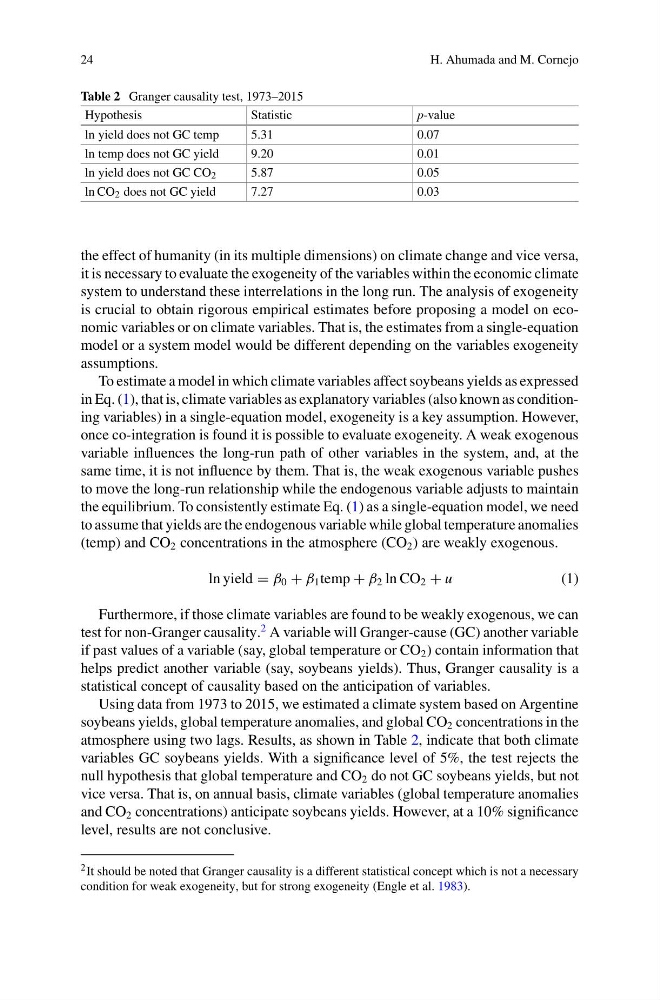
Table 2 Granger causality test, 1973–2015
Hypothesis
Statistic
p-value
ln yield does not GC temp
5.31
0.07
ln temp does not GC yield
9.20
0.01
ln yield does not GC CO 2
5.87
0.05
ln CO 2 does not GC yield
7.27
0.03
the effect of humanity (in its multiple dimensions) on climate change and vice versa,
it is necessary to evaluate the exogeneity of the variables within the economic climate
system to understand these interrelations in the long run. The analysis of exogeneity
is crucial to obtain rigorous empirical estimates before proposing a model on economic variables or on climate variables. That is, the estimates from a single-equation
model or a system model would be different depending on the variables exogeneity
assumptions.
To estimate a model in which climate variables affect soybeans yields as expressed
in Eq. (1), that is, climate variables as explanatory variables (also known as conditioning variables) in a single-equation model, exogeneity is a key assumption. However,
once co-integration is found it is possible to evaluate exogeneity. A weak exogenous
variable influences the long-run path of other variables in the system, and, at the
same time, it is not influence by them. That is, the weak exogenous variable pushes
to move the long-run relationship while the endogenous variable adjusts to maintain
the equilibrium. To consistently estimate Eq. (1) as a single-equation model, we need
to assume that yields are the endogenous variable while global temperature anomalies
(temp) and CO 2 concentrations in the atmosphere (CO 2 ) are weakly exogenous.
ln yield = β 0 + β 1 temp + β 2 ln CO 2 + u
(1)
Furthermore, if those climate variables are found to be weakly exogenous, we can
test for non-Granger causality.
2 A variable will Granger-cause (GC) another variable
if past values of a variable (say, global temperature or CO 2 ) contain information that
helps predict another variable (say, soybeans yields). Thus, Granger causality is a
statistical concept of causality based on the anticipation of variables.
Using data from 1973 to 2015, we estimated a climate system based on Argentine
soybeans yields, global temperature anomalies, and global CO 2 concentrations in the
atmosphere using two lags. Results, as shown in Table 2, indicate that both climate
variables GC soybeans yields. With a significance level of 5%, the test rejects the
null hypothesis that global temperature and CO 2 do not GC soybeans yields, but not
vice versa. That is, on annual basis, climate variables (global temperature anomalies
and CO 2 concentrations) anticipate soybeans yields. However, at a 10% significance
level, results are not conclusive.
2 It should be noted that Granger causality is a different statistical concept which is not a necessary
condition for weak exogeneity, but for strong exogeneity (Engle et al. 1983).
H. Ahumada and M. Cornejo
Table 2 Granger causality test, 1973–2015
Hypothesis
Statistic
p-value
ln yield does not GC temp
5.31
0.07
ln temp does not GC yield
9.20
0.01
ln yield does not GC CO 2
5.87
0.05
ln CO 2 does not GC yield
7.27
0.03
the effect of humanity (in its multiple dimensions) on climate change and vice versa,
it is necessary to evaluate the exogeneity of the variables within the economic climate
system to understand these interrelations in the long run. The analysis of exogeneity
is crucial to obtain rigorous empirical estimates before proposing a model on economic variables or on climate variables. That is, the estimates from a single-equation
model or a system model would be different depending on the variables exogeneity
assumptions.
To estimate a model in which climate variables affect soybeans yields as expressed
in Eq. (1), that is, climate variables as explanatory variables (also known as conditioning variables) in a single-equation model, exogeneity is a key assumption. However,
once co-integration is found it is possible to evaluate exogeneity. A weak exogenous
variable influences the long-run path of other variables in the system, and, at the
same time, it is not influence by them. That is, the weak exogenous variable pushes
to move the long-run relationship while the endogenous variable adjusts to maintain
the equilibrium. To consistently estimate Eq. (1) as a single-equation model, we need
to assume that yields are the endogenous variable while global temperature anomalies
(temp) and CO 2 concentrations in the atmosphere (CO 2 ) are weakly exogenous.
ln yield = β 0 + β 1 temp + β 2 ln CO 2 + u
(1)
Furthermore, if those climate variables are found to be weakly exogenous, we can
test for non-Granger causality.
2 A variable will Granger-cause (GC) another variable
if past values of a variable (say, global temperature or CO 2 ) contain information that
helps predict another variable (say, soybeans yields). Thus, Granger causality is a
statistical concept of causality based on the anticipation of variables.
Using data from 1973 to 2015, we estimated a climate system based on Argentine
soybeans yields, global temperature anomalies, and global CO 2 concentrations in the
atmosphere using two lags. Results, as shown in Table 2, indicate that both climate
variables GC soybeans yields. With a significance level of 5%, the test rejects the
null hypothesis that global temperature and CO 2 do not GC soybeans yields, but not
vice versa. That is, on annual basis, climate variables (global temperature anomalies
and CO 2 concentrations) anticipate soybeans yields. However, at a 10% significance
level, results are not conclusive.
2 It should be noted that Granger causality is a different statistical concept which is not a necessary
condition for weak exogeneity, but for strong exogeneity (Engle et al. 1983).