

How Econometrics Can Help Us Understand the Effects …
21
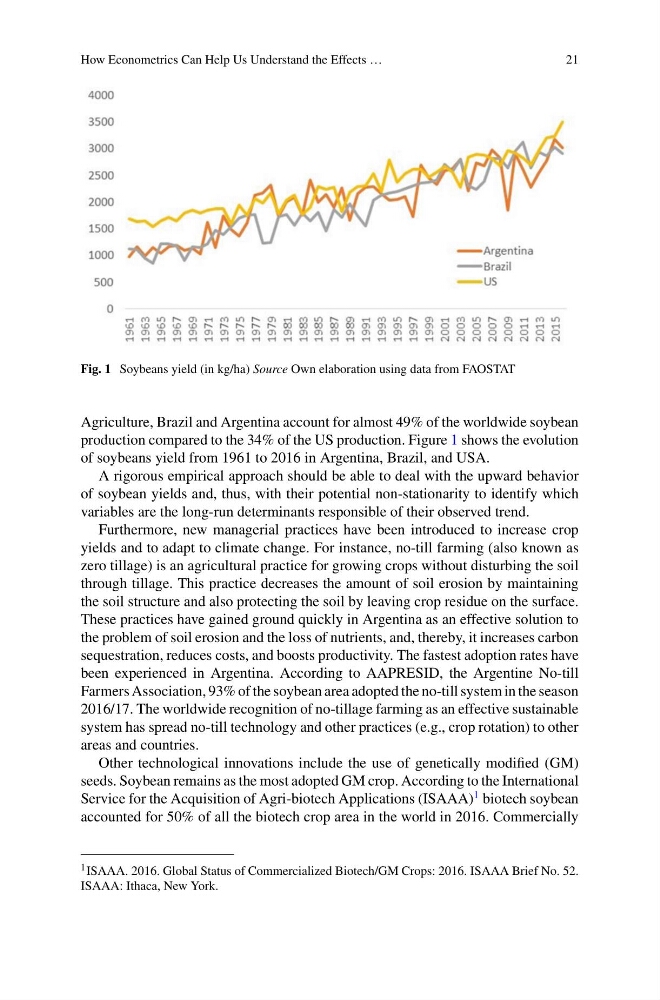
Fig. 1 Soybeans yield (in kg/ha) Source Own elaboration using data from FAOSTAT
Agriculture, Brazil and Argentina account for almost 49% of the worldwide soybean
production compared to the 34% of the US production. Figure 1 shows the evolution
of soybeans yield from 1961 to 2016 in Argentina, Brazil, and USA.
A rigorous empirical approach should be able to deal with the upward behavior
of soybean yields and, thus, with their potential non-stationarity to identify which
variables are the long-run determinants responsible of their observed trend.
Furthermore, new managerial practices have been introduced to increase crop
yields and to adapt to climate change. For instance, no-till farming (also known as
zero tillage) is an agricultural practice for growing crops without disturbing the soil
through tillage. This practice decreases the amount of soil erosion by maintaining
the soil structure and also protecting the soil by leaving crop residue on the surface.
These practices have gained ground quickly in Argentina as an effective solution to
the problem of soil erosion and the loss of nutrients, and, thereby, it increases carbon
sequestration, reduces costs, and boosts productivity. The fastest adoption rates have
been experienced in Argentina. According to AAPRESID, the Argentine No-till
Farmers Association, 93% of the soybean area adopted the no-till system in the season
2016/17. The worldwide recognition of no-tillage farming as an effective sustainable
system has spread no-till technology and other practices (e.g., crop rotation) to other
areas and countries.
Other technological innovations include the use of genetically modified (GM)
seeds. Soybean remains as the most adopted GM crop. According to the International
Service for the Acquisition of Agri-biotech Applications (ISAAA)
1 biotech soybean
accounted for 50% of all the biotech crop area in the world in 2016. Commercially
1 ISAAA. 2016. Global Status of Commercialized Biotech/GM Crops: 2016. ISAAA Brief No. 52.
ISAAA: Ithaca, New York.
21
Fig. 1 Soybeans yield (in kg/ha) Source Own elaboration using data from FAOSTAT
Agriculture, Brazil and Argentina account for almost 49% of the worldwide soybean
production compared to the 34% of the US production. Figure 1 shows the evolution
of soybeans yield from 1961 to 2016 in Argentina, Brazil, and USA.
A rigorous empirical approach should be able to deal with the upward behavior
of soybean yields and, thus, with their potential non-stationarity to identify which
variables are the long-run determinants responsible of their observed trend.
Furthermore, new managerial practices have been introduced to increase crop
yields and to adapt to climate change. For instance, no-till farming (also known as
zero tillage) is an agricultural practice for growing crops without disturbing the soil
through tillage. This practice decreases the amount of soil erosion by maintaining
the soil structure and also protecting the soil by leaving crop residue on the surface.
These practices have gained ground quickly in Argentina as an effective solution to
the problem of soil erosion and the loss of nutrients, and, thereby, it increases carbon
sequestration, reduces costs, and boosts productivity. The fastest adoption rates have
been experienced in Argentina. According to AAPRESID, the Argentine No-till
Farmers Association, 93% of the soybean area adopted the no-till system in the season
2016/17. The worldwide recognition of no-tillage farming as an effective sustainable
system has spread no-till technology and other practices (e.g., crop rotation) to other
areas and countries.
Other technological innovations include the use of genetically modified (GM)
seeds. Soybean remains as the most adopted GM crop. According to the International
Service for the Acquisition of Agri-biotech Applications (ISAAA)
1 biotech soybean
accounted for 50% of all the biotech crop area in the world in 2016. Commercially
1 ISAAA. 2016. Global Status of Commercialized Biotech/GM Crops: 2016. ISAAA Brief No. 52.
ISAAA: Ithaca, New York.