

Natural Resources, Climate Change and Governance
137
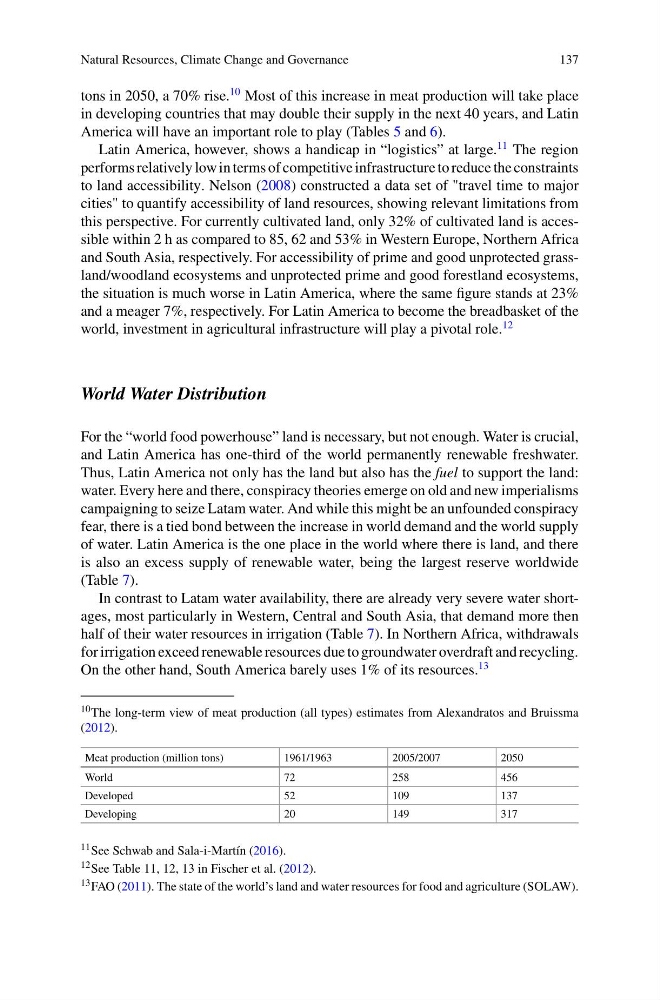
tons in 2050, a 70% rise.
10 Most of this increase in meat production will take place
in developing countries that may double their supply in the next 40 years, and Latin
America will have an important role to play (Tables 5 and 6).
Latin America, however, shows a handicap in “logistics” at large.
11 The region
performs relatively low in terms of competitive infrastructure to reduce the constraints
to land accessibility. Nelson (2008) constructed a data set of "travel time to major
cities" to quantify accessibility of land resources, showing relevant limitations from
this perspective. For currently cultivated land, only 32% of cultivated land is accessible within 2 h as compared to 85, 62 and 53% in Western Europe, Northern Africa
and South Asia, respectively. For accessibility of prime and good unprotected grassland/woodland ecosystems and unprotected prime and good forestland ecosystems,
the situation is much worse in Latin America, where the same figure stands at 23%
and a meager 7%, respectively. For Latin America to become the breadbasket of the
world, investment in agricultural infrastructure will play a pivotal role.
12
World Water Distribution
For the “world food powerhouse” land is necessary, but not enough. Water is crucial,
and Latin America has one-third of the world permanently renewable freshwater.
Thus, Latin America not only has the land but also has the fuel to support the land:
water. Every here and there, conspiracy theories emerge on old and new imperialisms
campaigning to seize Latam water. And while this might be an unfounded conspiracy
fear, there is a tied bond between the increase in world demand and the world supply
of water. Latin America is the one place in the world where there is land, and there
is also an excess supply of renewable water, being the largest reserve worldwide
(Table 7).
In contrast to Latam water availability, there are already very severe water shortages, most particularly in Western, Central and South Asia, that demand more then
half of their water resources in irrigation (Table 7). In Northern Africa, withdrawals
for irrigation exceed renewable resources due to groundwater overdraft and recycling.
On the other hand, South America barely uses 1% of its resources.
13
10 The long-term view of meat production (all types) estimates from Alexandratos and Bruissma
(2012).
Meat production (million tons)
1961/1963
2005/2007
2050
World
72
258
456
Developed
52
109
137
Developing
20
149
317
11 See Schwab and Sala-i-Martín (2016).
12 See Table 11, 12, 13 in Fischer et al. (2012).
13 FAO (2011). The state of the world’s land and water resources for food and agriculture (SOLAW).
137
tons in 2050, a 70% rise.
10 Most of this increase in meat production will take place
in developing countries that may double their supply in the next 40 years, and Latin
America will have an important role to play (Tables 5 and 6).
Latin America, however, shows a handicap in “logistics” at large.
11 The region
performs relatively low in terms of competitive infrastructure to reduce the constraints
to land accessibility. Nelson (2008) constructed a data set of "travel time to major
cities" to quantify accessibility of land resources, showing relevant limitations from
this perspective. For currently cultivated land, only 32% of cultivated land is accessible within 2 h as compared to 85, 62 and 53% in Western Europe, Northern Africa
and South Asia, respectively. For accessibility of prime and good unprotected grassland/woodland ecosystems and unprotected prime and good forestland ecosystems,
the situation is much worse in Latin America, where the same figure stands at 23%
and a meager 7%, respectively. For Latin America to become the breadbasket of the
world, investment in agricultural infrastructure will play a pivotal role.
12
World Water Distribution
For the “world food powerhouse” land is necessary, but not enough. Water is crucial,
and Latin America has one-third of the world permanently renewable freshwater.
Thus, Latin America not only has the land but also has the fuel to support the land:
water. Every here and there, conspiracy theories emerge on old and new imperialisms
campaigning to seize Latam water. And while this might be an unfounded conspiracy
fear, there is a tied bond between the increase in world demand and the world supply
of water. Latin America is the one place in the world where there is land, and there
is also an excess supply of renewable water, being the largest reserve worldwide
(Table 7).
In contrast to Latam water availability, there are already very severe water shortages, most particularly in Western, Central and South Asia, that demand more then
half of their water resources in irrigation (Table 7). In Northern Africa, withdrawals
for irrigation exceed renewable resources due to groundwater overdraft and recycling.
On the other hand, South America barely uses 1% of its resources.
13
10 The long-term view of meat production (all types) estimates from Alexandratos and Bruissma
(2012).
Meat production (million tons)
1961/1963
2005/2007
2050
World
72
258
456
Developed
52
109
137
Developing
20
149
317
11 See Schwab and Sala-i-Martín (2016).
12 See Table 11, 12, 13 in Fischer et al. (2012).
13 FAO (2011). The state of the world’s land and water resources for food and agriculture (SOLAW).